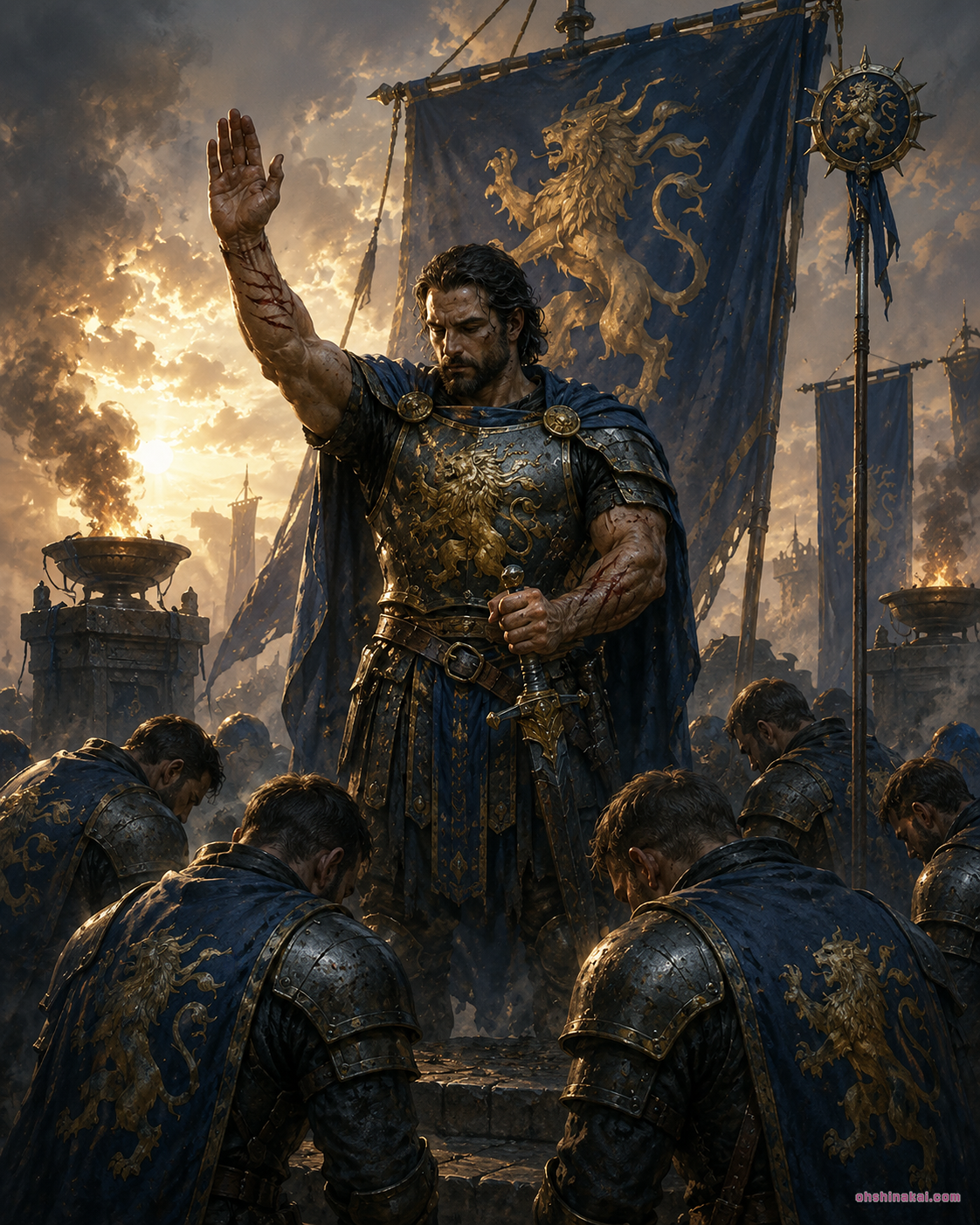
Lavinia: The Lionhearted Kingdom


"Pray if you wish. But victory is earned with iron, not incense."
— Warlord-Priest Garrik of Lavinia, before the Siege of Fernwall
The Kingdom That Never Stops Marching
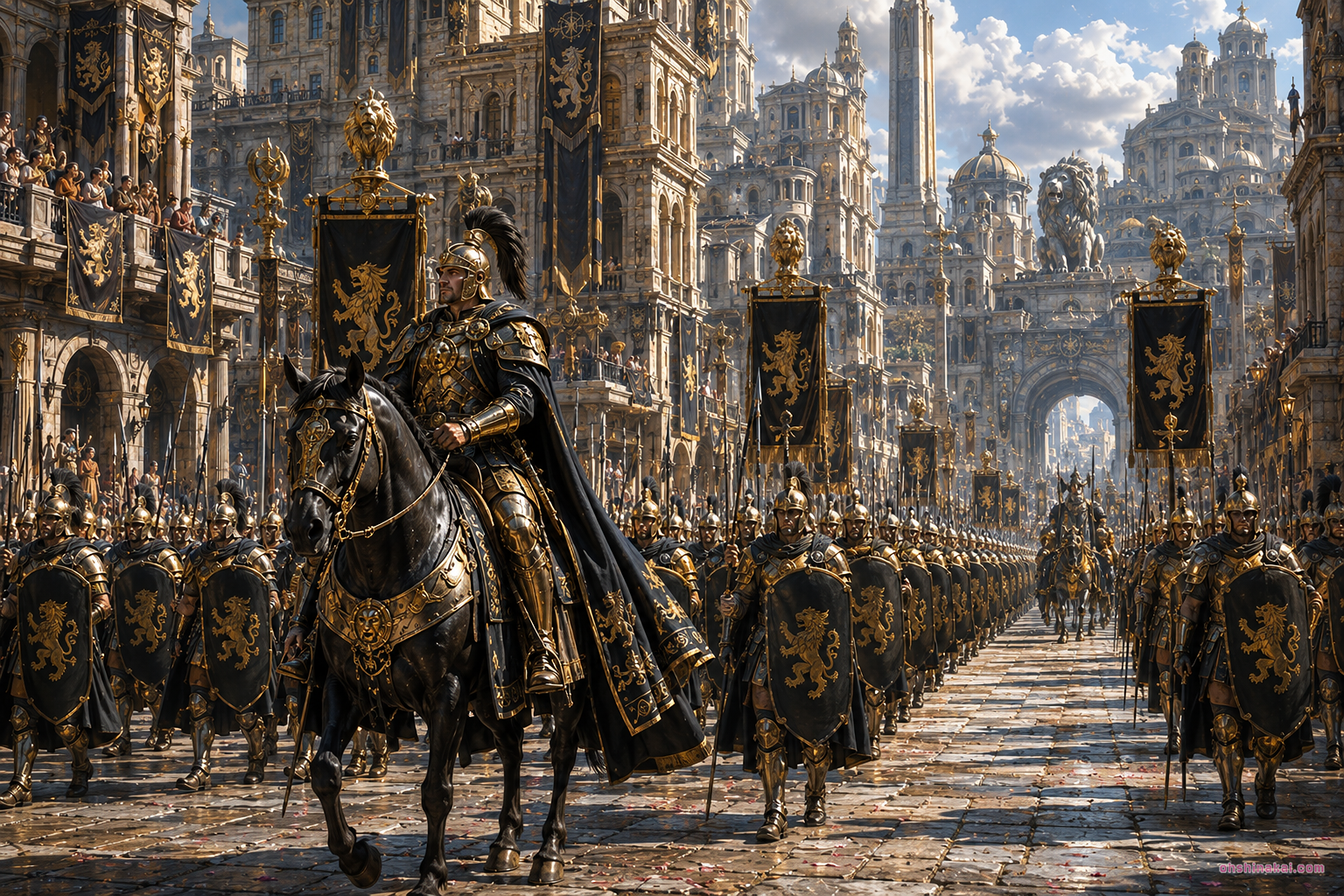
Lavinia does not apologize for what it is. On the rolling plains and thunderous borderlands of eastern Evernia, the Lionhearted Kingdom sprawls across conquered farmland, fortified estates, and strategic roads maintained with the kind of ruthless efficiency that makes neighboring n ations check their border garrisons twice a day. The landscape is marked by outposts, watchtowers, and vast aristocratic estates: many built on lands seized from conquered peoples or subjugated neighbors. War banners snap from every parapet. Military parades fill the capital's avenues on feast days. Children learn the rudiments of arms alongside their letters. And above it all, the rampant lion of Nellithi, crowned in gold, watches from every shield and standard.
Lavinia is an empire in all but name: a kingdom driven by martial ambition, strict hierarchy, and a state religion that sanctifies conquest as divine mandate. Its admirers call it a beacon of human achievement, discipline, and order. Its enemies, and they are many, call it a hunger that wears a crown.
The Lion Throne
Lavinia is an absolute monarchy. At the summit sits the Lion Throne, currently occupied by King Althor III, a ruler whose combination of tactical cunning and cold-blooded pragmatism has expanded Lavinian territory further than any king in three generations. His word is law. His decrees are enforced by inquisitors, magistrates, and battle-hardened knights. The court that surrounds him is a web of whispered threats, secret alliances, blackmailed officials, and hidden blade: a place where courtiers train in etiquette and coded language alongside horseback riding and archery.
Below the king, a council of dukes, generals, and the High Marshal of the Royal Legions governs the military and administrative apparatus. Nobility is hereditary, but knighthood and even lesser titles can be earned through glory on the battlefield. Military service is a sacred duty and the surest path to advancement. The nation's highest honors are reserved for those who expand Lavinia's reach in the name of the Lion Goddess.
Society is tightly stratified: an aristocratic warrior elite presides over farmers, laborers, and an ambitious tier of urban tradespeople. The cities are marvels of stone and iron, ringed with formidable walls and bustling with the organized energy of a state that runs on discipline. Arts, philosophy, and scholarship are respected but always pressed into service for the Crown. Dissent, subversion, or open reverence for nonhuman traditions meet with suspicion. The kingdom exalts human achievement and Law above the wild and the unknown, and it has the legions to enforce that preference.
The Pride of Nellithi
The state religion is the worship of Nellithi, The Lion Goddess, divine embodiment of glory, strength, and conquest. Her temples rise in every city and fortress, filled with the scent of incense and the clatter of weapons laid in offering at her altars. Her clergy, the Lion-Bearers (formally known as the Pride of Nellithi), are warrior-priests whose authority comes from demonstrated martial achievement rather than scholarship or spiritual contemplation. A Lion-Bearer who has never drawn blood in Nellithi's service is considered unfinished, a blade never tested.
The hierarchy is strict and earned through conquest: Cubs (unproven initiates) serve until blooded. Manes (the bulk of the priesthood) lead rites, train recruits, and bless troops before battle. Roars command temples and serve as chief war-priests to major armies. At the apex, a handful of Golden Fangs, living legends whose conquests have reshaped borders, answer to no temple and no temporal ruler. Their arrival on a battlefield can swing morale decisively.
Before every major campaign, commanders and soldiers are anointed with lion's oil and marked with sacred claw scars for luck. Nellithi's holy days are celebrated with games, martial displays, and public processions of "lion champions" chosen for feats of strength. The faith is strict and intolerant of rival cults: worship of woodland spirits, faerie deities, or foreign pantheons is suppressed. Magick is accepted only in controlled service to the Crown; unsanctioned sorcery is sedition.
The Wars That Define Lavinia
Lavinia's military is famously regimented and efficient: disciplined legions supported by cavalry, siege engines, and a cadre of battle-mages trained in both steel and sorcery. Strategic roads, maintained without fail, allow rapid troop deployment across the kingdom's vast frontiers. The military infrastructure is the finest in Evernia, and the kingdom's neighbors know it.
The woodland realm of Amaranthis is the focus of Lavinia's current ambitions. Proclaimed as "untamed and defiant land to be claimed for Nellithi's glory," Amaranthis has been the target of repeated campaigns that have produced some of the bitterest fighting in Evernian history. Lavinian armies lay siege to the groves; Amaranthis fights back with guerrilla tactics, illusions, and the forest itself: bogs that swallow cavalry, enchanted briars that entangle war machines, and whispers that drive soldiers to madness beneath moonless boughs. Diplomatic relations are nonexistent. Animosity runs centuries deep.
Falentia is a smaller but equally irritating neighbor. Lavinian generals view Falentia as an upstart that needs reminding of its place; Falentian engineers view Lavinia as a blunt instrument that keeps providing them reasons to invent sharper ones. The present era has seen escalating border skirmishes: Lavinian expansion met by Falentian airships and automated golems, a technological humiliation that Lavinian pride cannot easily absorb.
The kingdom's history is not all triumph. The Crisis of the First Century (~8–2 BFE) nearly destroyed Lavinia from within: migrations, plagues, peasant rebellions, and three rival claimants fighting for the throne in the border city of Novorande plunged the realm into continuous civil war. The treasury was depleted. Provinces declared independence. Refugees wandered the countryside. Only the rise of Althor, the last of the three claimants, who crushed his rivals and implemented sweeping reforms: strengthening the central monarchy, curbing mercenary power, enforcing loyalty oaths, pulled Lavinia back from collapse. The scars of the Crisis shape Lavinian politics to this day: the Crown's obsession with unity and control is not paranoia. It is memory.
Many whisper that the true ruler of Lavinia is not the king but the web of counselors and spymasters who control the flow of secrets. Noble feuds, vendetta assassinations, and the use of poison or sorcery as subtle weapons are a constant undercurrent in national politics. Outlaw bands like the Green Serpents and factions loyal to "lost lines" of succession remain wild cards, surfacing periodically to destabilize whatever stability the Crown has managed to build.