
The Refusing and the Bone Doctrine: What Became of the Lesser Dragons


"They were too proud to become the law, and too stubborn to simply die. So they became something worse: a living reminder that the old world is not finished with us."
– Attributed to an unnamed Kazirahan scholar, c. 400 BFE
[IN-WORLD LORE]
The Twilight of the Wyrms is one of the most documented events in Mystarian pre-history. Every child in Aridonia knows the tale: how Azkharael gathered the great wyrms and led them to merge with the world's foundations, becoming the sleeping, dreaming bedrock of reality itself. How Thurazakh became the granite heart of the highest mountain. How Valishaan burrowed into the earth and became the principle of growth.
What the popular telling leaves out, what the priests of Ghaidahah speak of only in low voices and what the Sisterhood of the Secret Flame has spent centuries cataloguing, is what happened to the rest.
Because not every dragon was a great wyrm, and not every dragon obeyed.
The Refusing
When Azkharael issued his final command from the peak of the world, his voice carried the weight of the Eternal Song itself. It was not a request. It was a law, spoken in Old Draconic, the language of absolute truth: dissolve, and preserve.
The great wyrms complied. They were old enough and powerful enough to understand what was being asked, and vast enough to accomplish it. Their bodies were already more law than flesh, more principle than bone.
But the lesser dragons, the younger wyrms, the regional guardians, the territorial beasts who commanded a single valley or a stretch of coastline, heard the same command and felt it differently. For them, dissolution was not a return to the cosmic order. It was annihilation.
These were not beings of pure principle. They had bodies that ached. They had territories they had fought for. They had memories of warmth and flight and the satisfaction of a kill. They were, in a way that the great wyrms had long ceased to be, alive in the mortal sense. Some tried to obey and failed. Their wills were too small to dissolve completely, and they became something else: half-merged anomalies trapped between flesh and geography. But others refused deliberately. They heard Azkharael's command, understood it, and chose defiance.
The Refusing, as they are known in the oldest Aridonian texts, were dragons who valued their individual existence over the preservation of the Eternal Song. In the framework of the Draconic Thread, which prizes law, order, and hierarchy above all things, this was the most profound act of disobedience imaginable. They broke the last law that the last lawmaker ever spoke.

What They Became
The Refusing survived, but survival cost them everything that had once made them magnificent. Without the Eternal Song to sustain them, without the great wyrms' harmonic structure holding reality in tune, the lesser dragons found their power eroding. The fae chaos that had overwhelmed the great wyrms ate at them too, just more slowly.
They adapted by shedding what they could not maintain. A dragon that had once commanded glaciers condensed its essence until it was a creature the size of a large horse, still radiating cold, still armored in pale blue scales, but unable to shape winter itself. A wyrm that had spoken thunderstorms into existence shrank to something that could barely crack lightning across a single ridge. They gave up their cosmic authority in exchange for the simple ability to keep breathing.
The process was not clean. The Refusing did not diminish gracefully. They compressed, shedding layers of elemental power like a snake shedding skin, each loss leaving them rawer, angrier, and more unstable. Their fires burned hotter but shorter. Their scales grew denser but covered less. Their minds, which had once contemplated the architecture of natural law, narrowed to the concerns of territory, hunger, and the grinding awareness of what they used to be.
Today, the Refusing that still survive (and there are more than most scholars admit) are scattered across the most remote and elementally charged corners of Mystaria. They den in volcanic vents, in the deepest ice caves of the Morgenai Peaks, in sea trenches where the pressure would crush any mortal vessel. They are drawn instinctively to places where the Draconic Thread runs strong: ley line junctions, ancient dragon lairs, and the sites where the great wyrms merged with the earth.
Wisdom left them centuries ago. So did anything resembling nobility. What remains has no interest in conversation.
What they are is dangerous, proud beyond all reason, and carrying a bitterness so old it has become indistinguishable from instinct. A Refusing does not attack out of hunger or malice alone. It attacks because every living thing it encounters is a reminder that the world moved on without it, and that the choice it made, to live, to refuse the law, bought it nothing but a slow diminishment that has lasted three thousand years.

Encountering the Refusing
Mortal encounters with the Refusing are rare, and those who survive them often struggle to communicate what they experienced. The creatures do not match any expectation. Forget the majestic, awe-inspiring beings of draconian temple murals. Forget the cunning, hoard-sitting wyrms of Bravonian sea shanties.
They are closer to wounded predators. Fast, vicious, territorially aggressive, and displaying an unnerving intelligence that stops just short of speech. Some scholars believe the Refusing have lost the capacity for Old Draconic entirely, their vocal apparatus too compressed and degraded to form the language of absolute command. Others, particularly the wandering dragon mystics of Tianlu, insist that the Refusing choose not to speak, because every word of Old Draconic they utter reminds them of the Song they abandoned.
There is no verified account of anyone successfully communicating with a Refusing. There are many verified accounts of people trying and dying.
The Bone Doctrine
Separate from the Refusing is the question of dragon remains. The few existing sources is clear: dragon bones are not fossils. They are crystallized fragments of a forgotten law of reality, and they pulse with immense, stable magic. A single dragon femur, properly excavated, contains more raw Draconic Thread energy than most mages will channel in a lifetime. Dragon scales, teeth, and shed horn fragments carry smaller but still significant charges. Even the soil around a dragon's resting place holds residual power for centuries.
This has never been in dispute. What has been in dispute, violently, theologically, and sometimes militarily, is what anyone is allowed to do with them.
The disagreements are old enough to have earned a name: the Bone Doctrine. Not a single doctrine, but a web of competing cultural, religious, and political positions on the status of dragon remains. It is one of the few issues in Mystaria where nations that agree on virtually nothing else can be counted on to argue with absolute conviction.
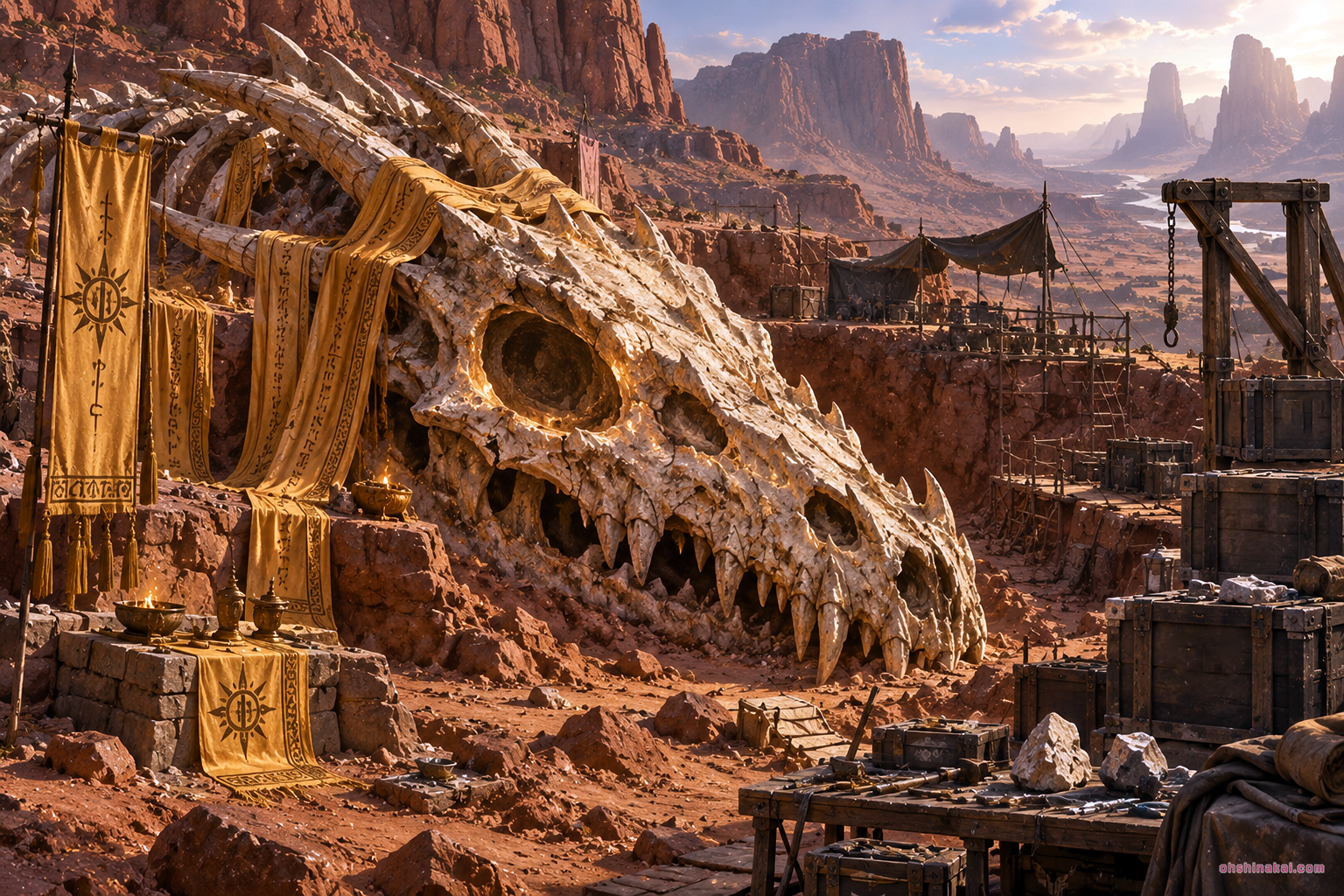
The Aridonian Position: Sacred Ancestors
For the Draconians of Aridonia, the question is not complicated, and the ferocity with which they defend their answer should tell outsiders everything they need to know: dragon remains are ancestors.
The Draconians trace their lineage to the dragons' last mortal interactions before the Twilight. They carry the echo of the Eternal Song in their blood. Their goddess, Ghaidahah, is the daughter of Rayya-Sahamarah and Lazak, born from the union of celestial and primal power that the dragons embodied. Every prayer they offer, every fire they light at dawn, every song in the Old Tongue connects them to the beings whose bones now lie scattered across the world.
To use a dragon bone as a magical component, whether grinding it into powder for a spell focus, setting it in a staff for amplification, or building it into a fortification for its warding properties, is, in draconian theology, an act equivalent to digging up your grandmother's body and using her femur as a tool. It is not merely disrespectful. It is a violation so fundamental that it severs the offender from the natural order that Ghaidahah upholds.
Aridonian law is explicit. Dragon remains found within their borders are to be interred with full funerary rites. The bones are cleaned, anointed with oils infused with desert herbs, wrapped in cloths bearing the prayers of the Dragon Goddess, and placed in the Vaults of Silence: deep underground chambers maintained by the priesthood, where the remains can rest undisturbed. The enhanced Draconians, those massive, heavily-scaled warriors who carry the most visible signs of their dragon ancestry, serve as hereditary guardians of these vaults. An attempt to breach one is treated as an act of war.

This position extends beyond their own borders. Draconian diplomats, traders, and mercenaries have been known to break contracts, abandon employers, and, in at least two documented cases, burn entire caravans to ash upon discovering that their employer was transporting dragon remains for commercial use. The phrase keth'zorah, roughly translated as "bone-shamer," is one of the most severe insults in the Aridonian lexicon, worse than coward, worse than oath-breaker.
The Phazani Position: Strategic Resource
The Phazani Kingdom's relationship with dragon remains is, like everything in the Iron Kingdoms, a matter of practical calculation.
Dragon bones are the single most potent natural amplifier of elemental magick known to exist. A war machine inscribed with a fragment of dragon scale can channel the Draconic Thread with a stability and force that no artificial focus can match. A foundry built over a deposit of dragon bone meal produces steel that holds enchantments three times longer than conventionally forged metal. The military and industrial applications are, from a Phazani perspective, too significant to leave buried in the ground because a foreign religion says so.
The Iron Kingdoms have never formally declared a position on the theological status of dragon remains. What they have done is fund quiet excavation operations in border regions, contested territories, and, most controversially, in areas where the Twilight of the Wyrms left traces that predate any modern nation's claim. Phazani agents, often operating through intermediaries in Zakaid or the Theodassan trade ports, have been acquiring dragon material for decades.
The practice is not spoken of openly. Phazani officialdom refers to it, when pressed, as "geological survey work" or "strategic mineral extraction." The Za̅hranite priesthood, whose dualistic theology frames the universe as a battle between light and darkness, does not officially endorse or condemn the use of dragon remains, a studied ambiguity that allows the state to operate without religious friction.
The Draconians know exactly what is happening. It is one of the deepest sources of tension between Aridonia and the Iron Kingdoms, and the fact that Draconian mercenaries still serve Phazani armies despite this knowledge speaks to the grim pragmatism of a warrior culture that needs coin but never forgets an insult.
The Sisterhood's Position: Dangerous Archive
The Sisterhood of the Secret Flame approaches the question from an entirely different direction. For the scholars and arcanists of the Witching Isles, dragon bones are neither ancestors nor resources. They are records.
A dragon bone is a crystallized fragment of the Eternal Song, a fossilized law of reality, frozen at the moment of the Twilight. To study one carefully, under controlled conditions, is to read a page from the rulebook that existed before the fae rewrote it. The Sisterhood's Dragon Archive, housed in a sealed wing of the Great Taroranga Library in Naiadis, contains the largest known collection of documented dragon remains in Mystaria, though the Sisterhood is careful to note that they possess records of the bones, not the bones themselves. (Whether this distinction is entirely honest is a matter the Sisterhood prefers not to discuss.)
Their position is that dragon remains should be studied but never exploited. The power within them is too fundamental, too close to the bedrock laws of reality, to be safely channeled by mortal hands. A mage who uses dragon bone as a spell focus is not simply amplifying their power. They are temporarily speaking with the authority of the Eternal Song itself, and the Resonance of that act, the way it reshapes the caster's soul toward absolute, unbending order, is severe and irreversible in ways that normal Draconic Thread use is not.
The Sisterhood has documented cases of mages who used dragon-bone foci for extended periods. The results are consistent and disturbing. Their personalities calcified. Their capacity for empathy, creativity, and flexible thinking eroded. In the worst cases, their skin took on a permanent metallic sheen, their eyes became fully reptilian, and they ceased to recognize the difference between a law of nature and a personal preference, treating every statement they made as an absolute command that reality should obey.
The Sisterhood's term for this condition is Petrifaction of the Will, and they consider it a fate worse than the Hollowing.
The Tianlunese Position: The Bones Are Listening
Tianlu's wandering dragon mystics hold a position that the other factions find somewhere between poetic and deeply unsettling.
They believe the bones are aware.
The awareness is nothing like a living creature's. The bones do not think, do not dream the way the merged great wyrms dream within the ley lines. What they do is closer to the way a law of physics "registers" being violated. The bones record what is done to them. And through the ley lines, which are, after all, the sleeping echoes of the Eternal Song, they transmit that record to the dreaming wyrms who became the world's foundations.
The implication is staggering and, to the dragon mystics, obvious: every act of desecration, every ground bone and every exploited scale, is being reported. The sleeping wyrms feel it. And each violation is a tiny weight on the wrong side of a cosmic scale. Push it far enough, disturb enough bones, channel enough stolen authority, and the sleepers may stir.
The wyrms would not stir to save the world. They would stir to correct it.
The dragon mystics do not frame this as prophecy or threat. They frame it as natural law. Hit a wasp nest enough times and the wasps come out. The question is not whether the wyrms will respond, but what form the response takes, and whether the "chaotic" races that now inhabit Mystaria will survive the correction.
This position has made Tianlu's dragon mystics deeply unwelcome in Phazani territory.
[BEHIND THE SCENES]