
Kazirah Mandate: The Oasis of Knowledge


"The gate opens at the moment prescribed. Not before. Not after. The sun does not negotiate."
– A Time-Keeper at the sacred opening of the Qasira city gates
[IN-WORLD LORE]
The Nation That Measures Everything
In Kazirah, the city gates do not open when the guards are ready. They open when the sun says they open, to the second, verified by a priest of the Mistress of Time who stands with a calibrated instrument and waits for the precise astronomical moment prescribed by centuries of calculation. The guards wait for the priest. The merchants wait for the guards. And the Time-Keeper waits for the universe, because Ayyda does not negotiate, and neither do the people who serve her.
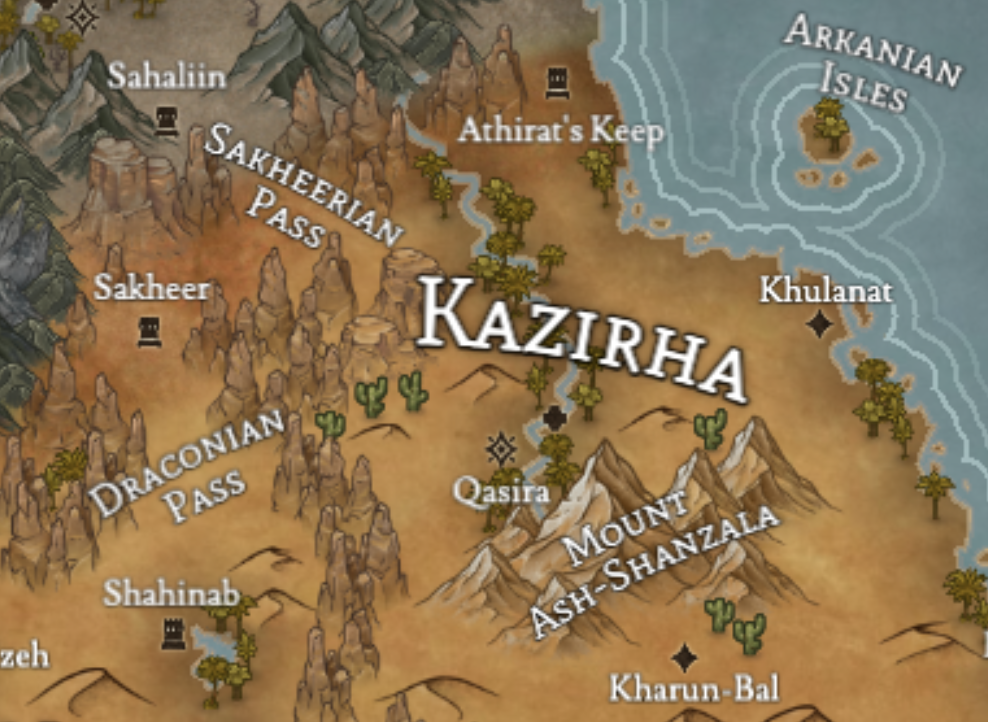
The Kazirah Mandate is a storied realm straddling the boundary between molten desert and rolling mineral-rich highlands. Defined by winding rivers, rocky mesas, fertile oases, and the cloud-haloed Jabal'alnor Peaks to the north, the Mandate is sustained by the Nahr'alshifa River, a lifeline that snakes from rain-fed highlands through vibrant towns and out across arid plains. The Kazirahans are known across Mystaria for three things: their scientific brilliance, their water-crafting sorcery, and their unbreakable alliance with the Draconians of Aridonia.
And beneath all of it, beneath the diplomacy, the engineering, the careful stewardship of every drop of water, runs a quiet, precise, faintly unsettling devotion to the measurement of time.
The Water Council and the Scholar-Kingdom
Kazirah is governed by the Water Council, a body of elders chosen for notable service, mastery of lore, or heroic deeds. Merit and communal harmony are valued above rank or wealth. The Kazirahan language and alphabet form the scholarly standard across southern Mystaria: codified around 400 BFE to facilitate water-rights agreements and scientific discoveries, then rapidly adopted across Khurayari, Nyambra, Bravonia, and beyond, eventually enabling the first postal systems and spreading institutional literacy northward.
Daily life is shaped by careful water stewardship, geometric architecture, and the rhythm of the Nahr'alshifa's annual floods. The boundaries between city and desert blur at the great seasonal bazaars, where Kazirahan dew-collectors bargain with Aridonian herders, mystics, and merchants from the Tribelands. The Draconian alliance is the Mandate's most important diplomatic relationship: old pacts of mutual defense, water-sharing, and cultural exchange bind the two peoples, and Draconian smiths and mercenaries are a common sight in Kazirahan cities, just as Kazirahan engineers and priests are welcomed at Aridonian courts.
Ayyda, the Mistress of Time
Most nations worship gods of power, love, or war. Kazirah worships Ayyda, the Mistress of Time, a lesser deity in the Nine Fortunes cosmology whose following is small by design, because to draw too much attention to time is to invite awareness of its passage, and awareness of passage invites the desire to stop it, which Ayyda considers the most dangerous impulse in existence.
Ayyda is depicted as a serene woman with an hourglass in one hand and a lattice of stars in the other, her face sometimes veiled, sometimes ageless, her footsteps always marking the steady progress of the sun, the river, and the seasons. Her temples, marked by sundials, water clocks, and astronomical murals, are found in every major settlement. The faithful gather not only for worship but to set their clocks, launch irrigation schedules, and begin official ceremonies at the exact moments prescribed by the priesthood.
Her clergy, the Time-Keepers (also called Zenith Wardens), are woven into civic life so thoroughly that the distinction between priesthood and bureaucracy has dissolved. They govern calendars, certify contracts, oversee the sacred opening of city gates, set irrigation schedules, and time every official ceremony to astrological precision. A contract signed without a Time-Keeper's temporal seal can be challenged on grounds of timing alone. A ritual performed at the wrong moment is considered not merely ineffective but dangerous.
The most feared function of the Time-Keepers is the declaration of endings. When a Time-Keeper declares something over: a truce, a contract, a reign, a life, it is over. Their declaration is institutional finality. They do not comfort. They do not negotiate. They measure, and they announce, and whatever follows is the world adjusting to a fact that was already true.
The Cities of Precision
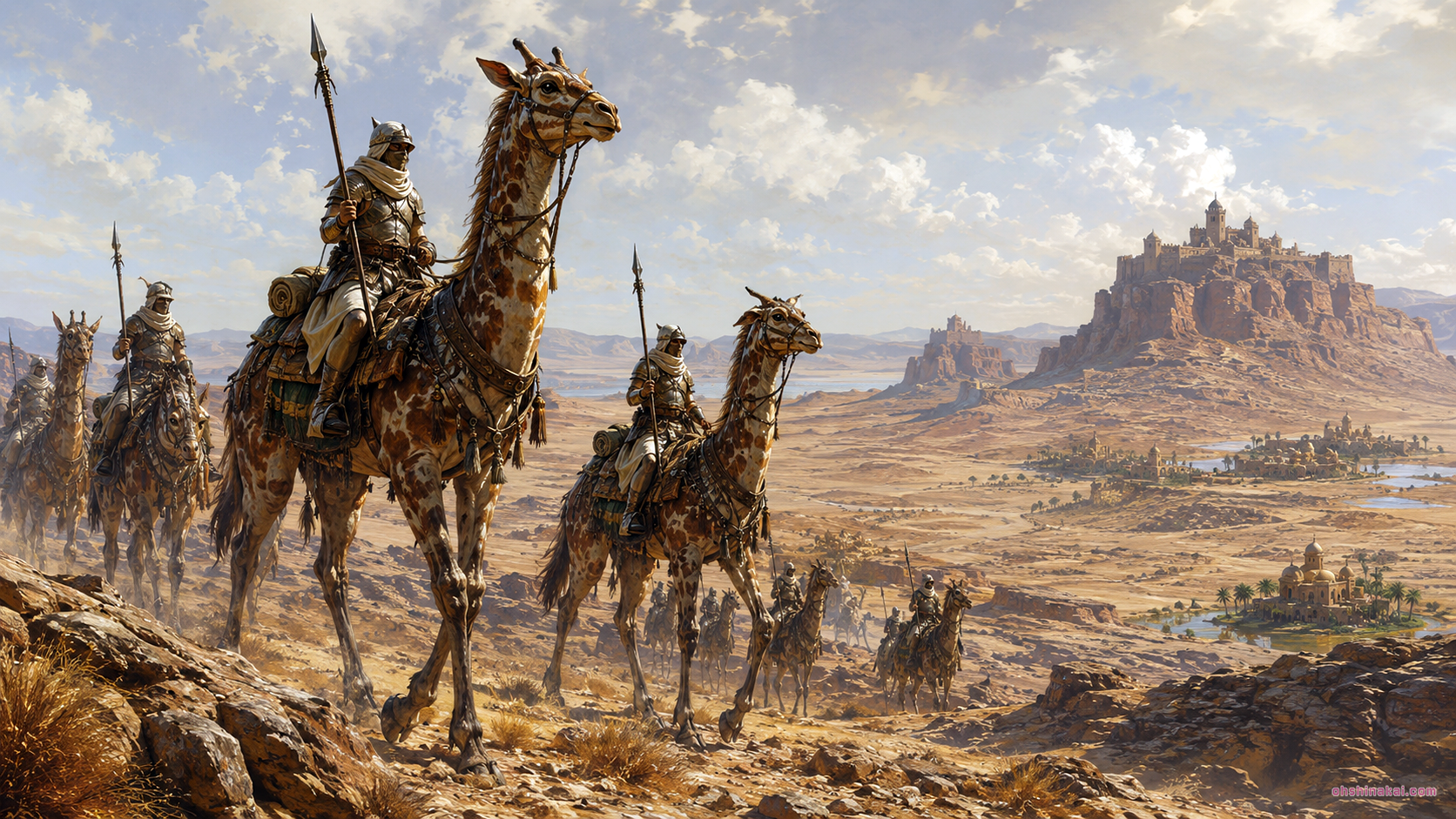
Qasira, the jewel-bright capital, stretches along both banks of the Nahr'alshifa, domes and minarets reflected in canal water, white-walled villas shaded by date palms, and grand observatories where the Kazirahan calendar (the most accurate in Mystaria) is maintained. Khulanat, in the northeast, is a fortified temple-city of ziggurats and cliff-carved shrines, now housing priest-scholars who preserve millennia of spell-lore and ceremonial rites. Athirat's Keep watches over the perilous passes of the Jabal'alnor Peaks, home to legendary guardians and the elite Dewrider cavalry mounted on sahaldi, giant, drought-resistant giraffe-beasts unique to Kazirah. And Sakheer, at the highland crossroads, is the melting pot where caravans from every direction converge.
[BEHOND THE SCENES]