
Jalimariya: The Kingdom of the Sunlit Plains


"In Khurayari, you can buy anything. Saffron from Bravonia, ivory from Nyambra, a knife from Zakaid, and a secret from anyone. The only thing you can't buy is a quiet evening. The city doesn't believe in them."
– Sadoran merchant, writing to his business partner
[IN-WORLD LORE]
The Kingdom Where Everything Meets
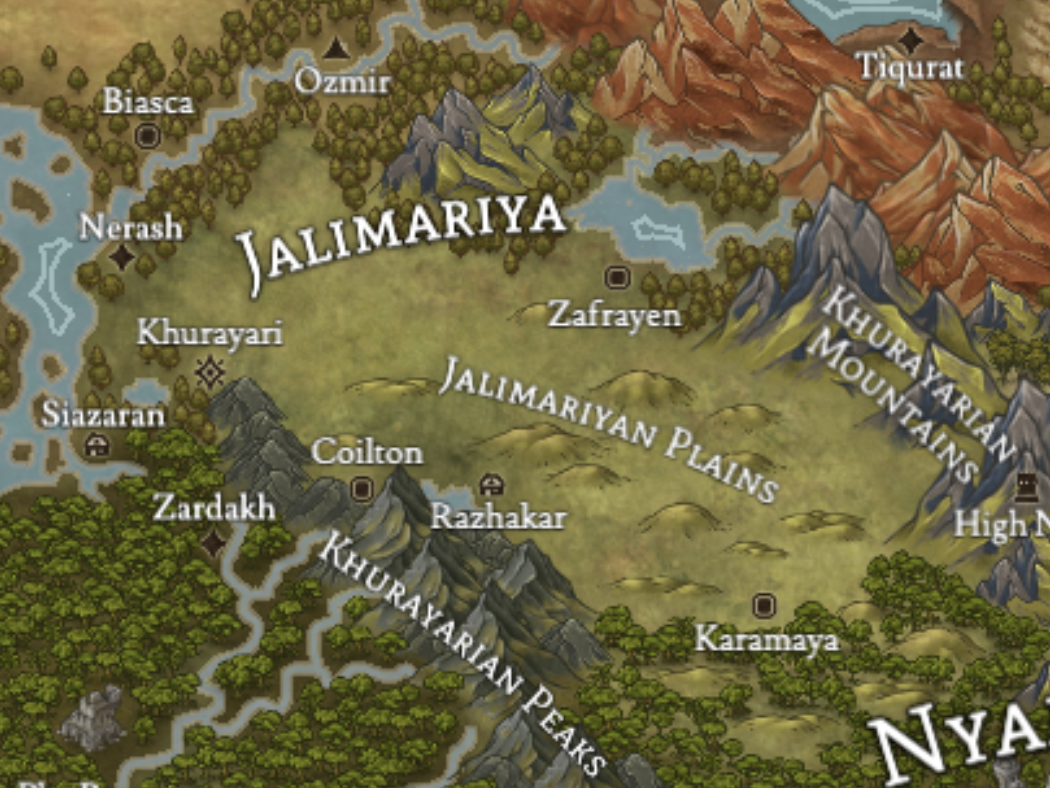
Jalimariya is what happens when you put fertile land at the exact point where every trade route in Argania crosses. The golden plains roll south from Sadoros in waves of dry grass and red dust, broken by the jagged western wall of the Khurayarian Mountains and the thick green edge of the Caldorian rainforest to the south and east. It is hot, humid, and perpetually busy. Monsoon rains green the grasslands each year; dust-laden winds sweep down from the mountains; and thick, fragrant mists rise at dawn from the jungle margins. Between the savanna, the peaks, and the forest, Jalimariya has assembled a kingdom out of geography, ambition, and the iron practicality of people who learned centuries ago that standing at a crossroads means you can charge tolls in every direction.
Bordered by Sadoros to the north, Nyambra across river and savanna to the southeast, and the boundless wilds of Caldoria to the west, Jalimariya is both crossroads and barrier, its lands claimed by cattle lords, border-wardens, and traders of every persuasion and ancestry.
Khurayari, the Capital of the Sun
Khurayari is Jalimariya's beating heart, a city that once served as a provincial seat of the Theodassan Empire and now retains a cosmopolitan grandeur that owes as much to the fifty nations that trade through its gates as to the empire that built them. Broad avenues lined with ancient columns lead to vibrant markets buzzing under shaded arcades. The skyline is punctuated by soaring spirals, copper-domed temples, and the busy quays where barges unload saffron, ivory, and dyed cloth bound for Nyambra, Sadoros, or Bravonia.
Khurayari is famous for its annual Sun Markets, sprawling trade fairs that draw merchants and celebrants from across three continents. The city is a melting pot of languages, beliefs, and cuisines: Bravonian merchants argue prices alongside Sadoran administrators, Nyambran storytellers hold crowds on the dockside plazas, and Draconian veterans drink alongside Zakaidian mercenaries in taverns that enforce precisely one rule: pay your tab. The Great Archive, a warren of shadowed halls and scroll-laden libraries, is jealously guarded by the city's scholarly caste and considered one of the most comprehensive collections of trade law, imperial history, and cartographic records in Argania.
Coilton and the Goblin Syndicate
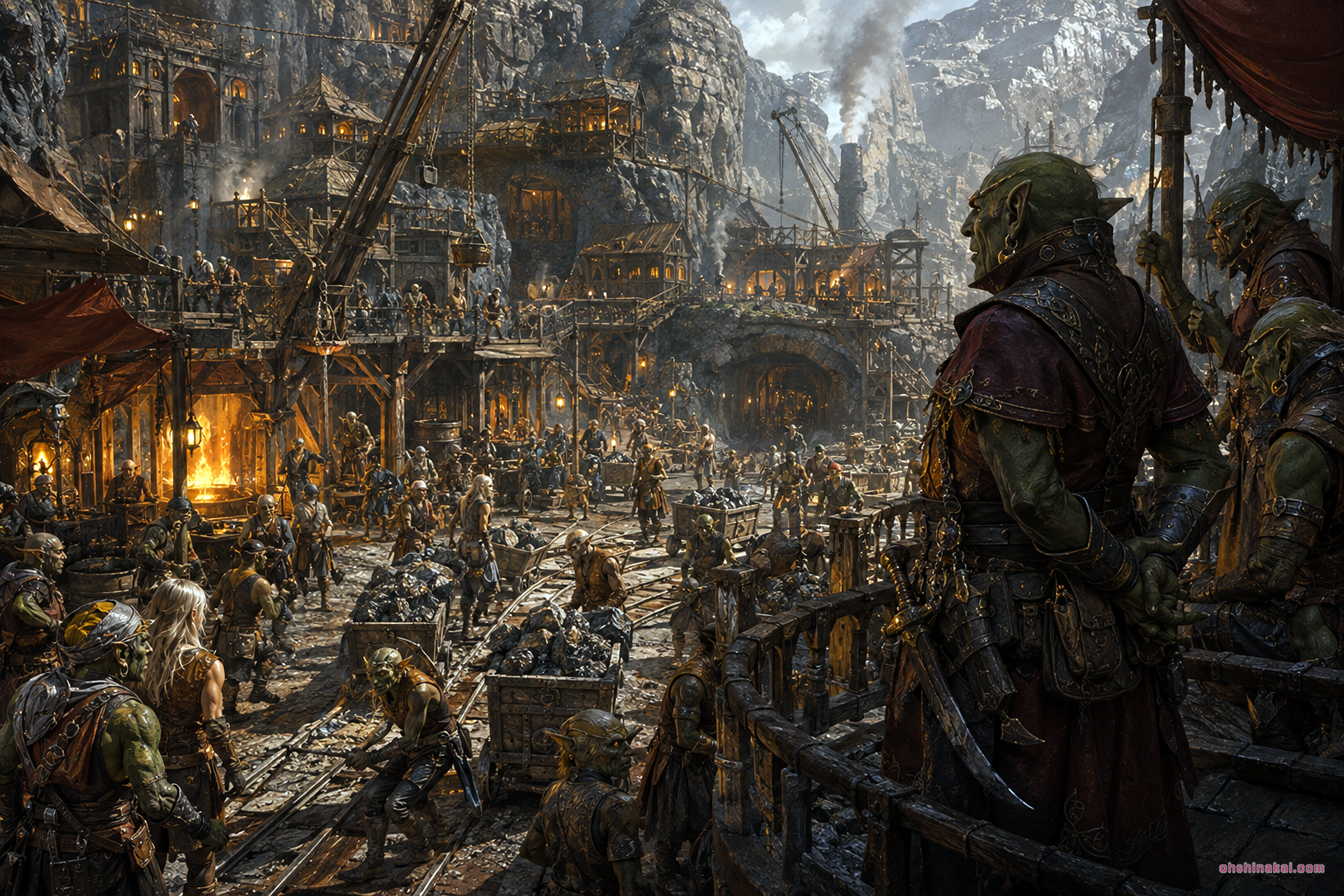
South and west of Khurayari, tucked in the shadow of the Khurayarian Mountains, Coilton is a different kind of power entirely. On paper, Coilton is Jalimariya's mining capital, a labyrinth of smoke-belching forges, rowdy boarding houses, and bustling mineral markets. In practice, Coilton is a goblin state-within-a-state. The Coilton Syndicate, a shrewd and tightly-knit goblin cartel, controls every shaft, pit, and gemstone that leaves the mountain. The syndicate governs the town's daily affairs with pragmatic efficiency: enforcing work quotas, dispensing justice (harsh, fast, and rarely appealed), and brokering ore and gem deals with traders from across Mystaria.
The arrangement with the Jalimariyan crown is pure pragmatism. The kingdom provides military protection (from bandits, wild trolls, and agents of the meddling Order of the Chalice) and the syndicate surrenders a generous portion of profits to the royal treasury. The annual Grudge Reconciliation Banquet brings syndicate bosses and Jalimariyan magistrates together for uneasy festivities and whispered negotiations, a ritual as much about power as profit. The miners are mostly goblins and elves, with a working population of humans and gnomes, and the social dynamics underground are their own world entirely, ruled by the syndicate's enforcers, lit by phosphorescent fungus and goblin-made lamps, and governed by customs that the Khurayarian courts wisely decline to examine too closely.
The Settlements
Nerash, on the western coast where the River Ophis empties into the Sea of Orsino, is Jalimariya's gateway to the ocean. A bustling port city of salt-crusted docks and weathered stone warehouses, Nerash handles the kingdom's seaborne trade: saffron, gems from Coilton, and jungle goods bound for Bravonia, Branitzoba, and Sadoros. Its harbor-masters are legendary negotiators, and its dockside taverns are where Jalimariyan pragmatism meets maritime ambition. Sailors from a dozen nations crowd the wharves, and the smell of spiced fish and tar hangs over everything.
Zafrayen, a lakeside town in the central lowlands east of Khurayari, sits where the Jalimariyan Plains meet the foothills. Its shallow lake provides irrigation for surrounding farms and serves as a seasonal gathering point for herders driving cattle between the plains and the mountain pastures. Zafrayen is quieter than the capital, known for its pottery workshops, its lake-fish stews, and the old Theodassan bridge (now mostly decorative) that spans the lake's narrowest point.
Razhakar, a small mountain town on the lower slopes of the Khurayarian Mountains south of the Jalimariyan Plains, clings to a series of terraced ledges above a deep river gorge. Its people are goat-herders, woodcutters, and the occasional prospector hoping to find what Coilton's syndicate missed. Razhakar's elevation makes it cooler than the sweltering plains below, and wealthy Khurayarians have been known to retreat here during the worst of the monsoon heat.
Siazaran, near the capital, is perched on a series of bluffs overlooking the Caldorian rainforest. It serves as both outpost and guardian: its daring scouts and rangers patrol the jungle edge, trading in exotic hardwood, resins, and medicinal herbs while keeping watch for whatever the forest decides to send out next.
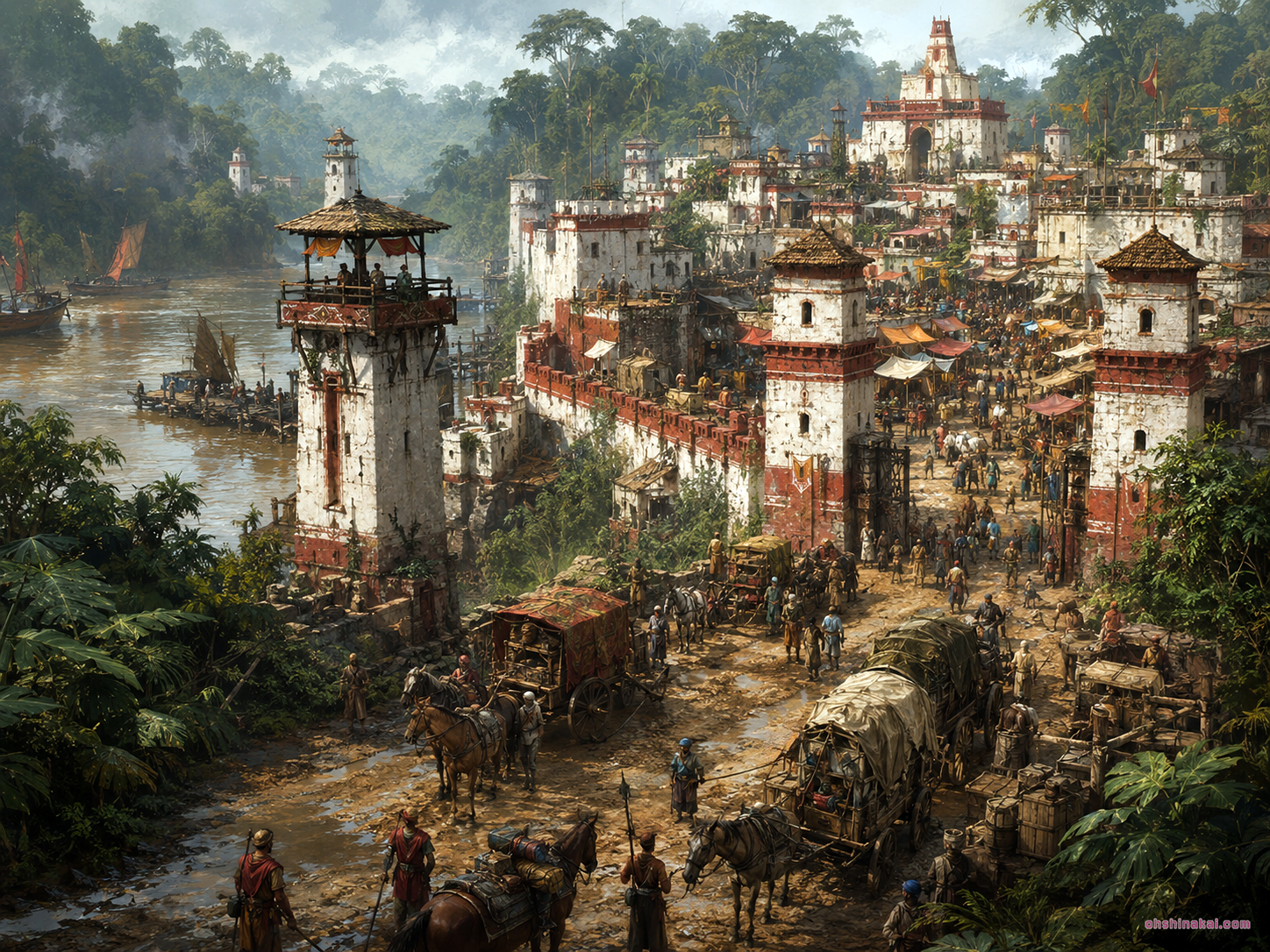
Zardakh, in the far southwest near the Caldorian border, is a walled city of white stone and red clay pressed between river and jungle. Originally a fortified outpost during the last days of the Theodassan Empire, it has grown into a vital bastion on the southern frontier. Zardakh's watchtowers command views of the muddy river and the perilous rainforest beyond, while its bazaars overflow with bushmeat, silks, jungle fruit, and the tales of travelers bound for Nyambra or Caldoria. The city's fencing schools and martial dance academies draw students from Khurayari and beyond, and its guards are famed throughout the kingdom for their discipline.
Culture and the Crossroads
The people of Jalimariya are proud, striving, and deeply pragmatic. Their ancestry is mixed (descendants of imperial colonists, indigenous steppefolk, woodland tribes, and traders from distant nations) and Jalimariyan culture reflects that diversity. Hospitality is sacrosanct. Storytelling is an art form. Horsemanship is the measure of a person. And religion is as varied as the land itself: sun-worship, ancestor veneration, river cults, thunder gods, and the lingering memory of Theodassan rites coexist with foreign faiths and mystery cults brought by trade and migration. Nobody in Khurayari asks which god you pray to. They ask whether you can pay.
[BEHIND THE SCENES]