
Yakhuli: Realm of the Wanderweavers


"A true Wanderweaver can repair a broken heart with a tapestry, or twist the world's fate with a single golden thread. Whether they actually do either is between them and the River Wives."
– Overheard in Shaalinar, origin uncertain
[IN-WORLD LORE]
The Nation That Refuses to Stand Still
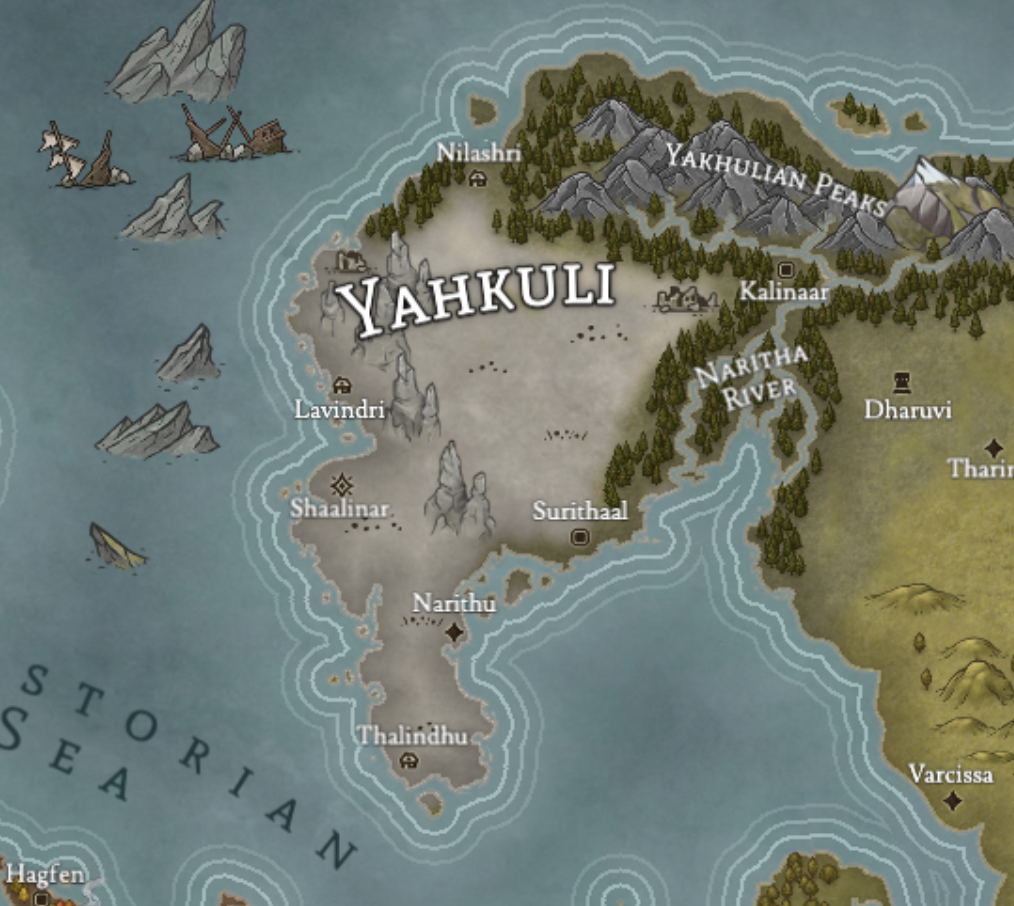
Yakhuli doesn't have borders. It has coastlines, mountain ridges, and a population that considers the concept of fixed territory to be, at best, a polite suggestion.
The western coast is tidal lowland: rolling salt flats that shimmer like hammered silver, mist-shrouded deltas, and barrier islands that appear and vanish with the moon's pull. The air there is heavy with insects and laughter and the distant hum of looms. But travel northeast and the land changes. The Yakhulian Peaks rise in a forested wall, their slopes thick with pine that runs in an unbroken corridor along the Naritha River from the mountain headwaters all the way down to the coast. The pine forests are a different Yakhuli entirely: cool, resinous, quiet, the trees so dense in places that the river below is heard long before it's seen.
Between these two landscapes, the Yakhuli have built a civilization that rests lightly on both. The cities (Shaalinar, Narithu, Nilashri, Kalinaar) are built with airy woodwork and rope bridges, designed to sway rather than resist, to give rather than hold. And through all of it, moving in vividly decorated caravans adorned with windchimes, colored ribbons, and painted sigils, the Wanderweavers travel. They have been traveling since before the cities existed. They intend to keep traveling long after the cities are gone.
The Wanderweavers
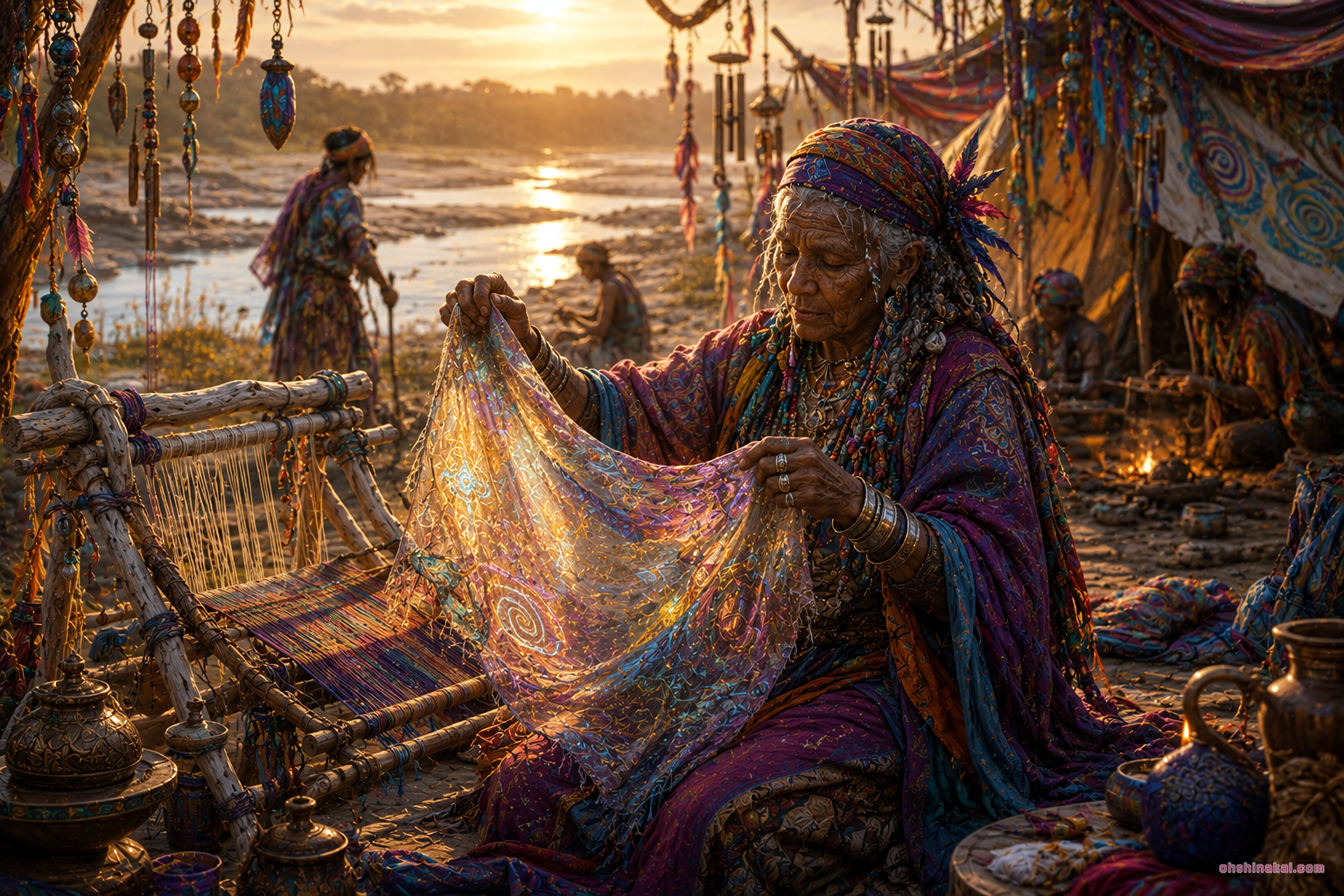
The Wanderweavers are an ancient mystical tradition and nomadic culture of traveling magicians, dancers, storytellers, and artisans. Descendants of the original Yakhuli clans and gifted with a touch of otherworldly magic, they travel in small family bands or loose leagues, never calling any place home for too long. They move on foot, aboard riverboats, or on the backs of horned sand-striders, riding beasts adapted to the salt flats and tidal terrain.
Their magic revolves around weaving, both literal and metaphysical. They spin intricate carpets, shimmering sashes, nets of glass beads, and also tales, spells, and blessings. Their most famous creation is dreamcloth: enchanted fabric that records memories, visions, and prophecies in its patterns. A piece of dreamcloth can hold a dying grandmother's life story, a vision of a future war, or the exact route to a hidden harbor. Reading dreamcloth is a skill that takes decades to master and cannot be faked.
The senior Wanderweavers (Thread Witches and Waycallers) lead ceremonies, teach the arts, and read the past and future in the warp and woof of the world itself. Their most celebrated leaders, the Pathmothers and Windspinners, are sought by kings and outcasts alike for counsel and feats of navigation that border on the miraculous. They can conceal a caravan from sight, bless a ship to find favorable winds, or untangle a curse like pulling a knot from a tapestry.
Many Yakhuli eventually settle in towns or become sailors, but a deep-seated pull called the Longing String draws many back to the road. The phrase captures something the Yakhuli consider fundamental: the world is not meant to be observed from a fixed point. It is meant to be walked through, woven into, and carried with you.
The River Wives
Yakhuli faith centers on the River Wives, ancient, mysterious, and sometimes mercurial spirits believed to dwell in the great rivers, tidal inlets, and marshes that thread through the homeland. Each river, stream, or brackish lagoon has its own Wife or her daughters: spirits who can grant safe passage or swift ruin depending on their mood and the quality of the offering.
Yakhuli festivals are processions to the water's edge, where offerings of song, silver, woven garlands, and colored ribbons are cast into the currents. River stones wrapped in dreamcloth are left by children as tokens for protection. Wise elders make libations and whispered prayers before crossing any body of water or launching a boat. Tales abound of artists, wanderers, or lovers who vanished beneath the surface, some favored by the Wives, others forever lost.
The Wanderweavers' founding myth holds that Lhiraya the Lost, the first of their kind, wove a tapestry so beautiful that the River Wives themselves emerged from the water to watch. They gifted her a loom of driftwood and starlight and taught her the secrets of the threads: how to weave not just cloth, but stories, blessings, and the very fate of her people. Every Wanderweaver carries a small portable loom. Every caravan is a living chronicle. And every thread connects back to Lhiraya's original gift.
Hospitality is sacred in Yakhuli, to refuse shelter or a story is to offend not only mortal kin but the River Wives themselves, who may wander disguised among mortals. Welcoming a stranger is welcoming the possibility that the next guest is a goddess testing your generosity.
Relations and Reputation
Yakhuli's openness has won it both friends and suspicious neighbors. Merchants from Kazirah and the Witching Isles prize their navigation spells and tapestry lore. In Verdania, Wanderweavers are celebrated, sometimes holding positions within the nobility and royal courts. Rulers from Lavinia or Falentia approach them with mixtures of awe, suspicion, and hope. Meanwhile, the Tribelanders of the nearby plains regard the Wanderweavers' strange magic with wariness: the fortress of Dharuvi, on the eastern bank of the Naritha near the Tribelands border, holds the crossings tightly, and the walled town of Tharinal further south exacts tolls from travelers whose motives the Tribelanders don't entirely trust.
Attempts to impose borders or taxes on the Yakhuli usually fail. The land shifts. The tides rearrange the roads. And the Wanderweavers are gone like footprints in the surf.
The Settlements
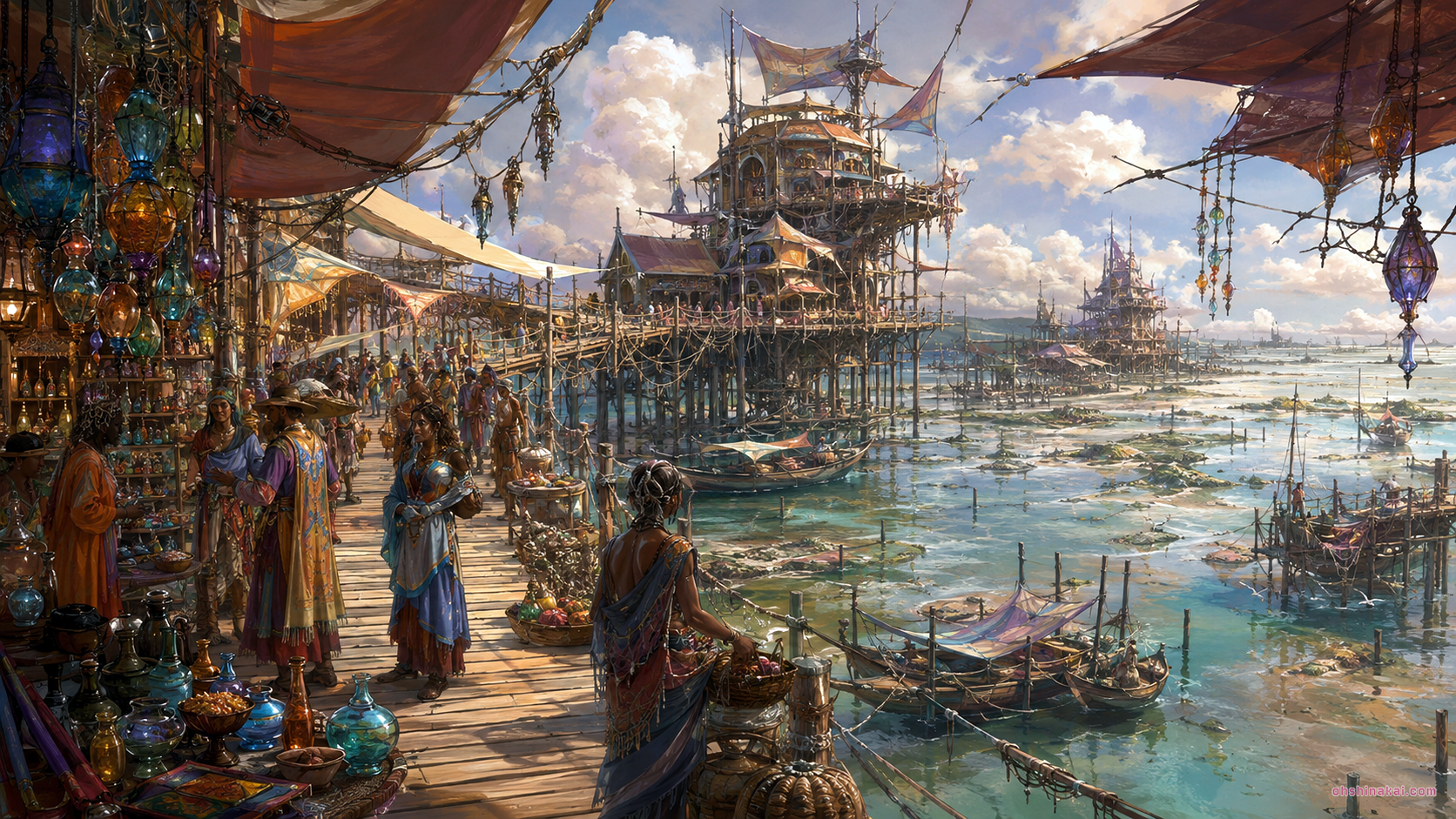
Shaalinar is Yakhuli's capital and largest city, perched on the western coast where the tidal flats meet the sea. Its raised boardwalks, airy market halls, and rope-bridge streets are built to flex with the tides rather than fight them. Merchants from across Mystaria trade here for dreamcloth, colored glass, woven textiles, and the navigation blessings that Wanderweaver Pathmothers sell to captains willing to pay.
Narithu, on the southern coast where the Naritha River reaches the sea, is a river-port town whose economy straddles salt-flat trade and river commerce. Fishing boats and Wanderweaver rivercraft share the harbor, and the town's dye-works produce the vivid pigments that color Yakhuli textiles and caravan decorations.
Nilashri, on the northern coast, is a quieter settlement known for its dreamcloth weavers. The finest apprentice Thread Witches train here, working in studios built along the sea-cliff edge where the light is best for reading the subtle color-shifts in enchanted fabric. Nilashri's weavers produce the most sought-after dreamcloth in Yakhuli, and commissions from foreign courts can take years to complete.
Kalinaar is nestled in the foothills of the Yakhulian Peaks, surrounded by the pine forests that line the upper Naritha. The settlement has a different character from the coastal towns: cooler, quieter, scented with resin rather than salt. Kalinaar serves as a retreat for senior Wanderweavers, a trading post for highland goods (pine timber, mountain herbs, resinous incense), and the traditional starting point for the river journey down the Naritha to Narithu. The pine forests around Kalinaar are considered sacred to certain River Wives whose domain is freshwater rather than tidal, and Wanderweaver caravans passing through leave offerings of ribbon and thread tied to the lower branches.
Further south, the small port of Varcissa faces the open sea at the southeastern tip of Yakhuli, trading with coastal vessels from the Tribelands and points east.
Lavindri, on the western salt flats north of Shaalinar, is a working village built on the edge of the vast evaporation pans that produce Yakhuli's finest sea salt. The glare off the drying flats is blinding at midday, and Lavindri's harvesters work the early morning and late evening, raking crystallized salt into baskets and loading it onto carts bound for Shaalinar's markets. The village is small but essential: Yakhuli salt, prized for its purity and faint mineral sweetness, is one of the nation's steadiest exports, traded as far as Nordvindia and Lhakira.
Thalindhu, on the southwestern peninsula where the coast curves south, is a fishing village of stilted houses and shell-strewn beaches. Its people work the rocky shallows for oysters, crabs, and the iridescent abalone shells that Wanderweaver artisans use in decorative inlay. Thalindhu's pearl divers are among the best in Yakhuli, free-diving to depths that make visiting sailors nervous, and the village's annual pearl auction draws buyers from Shaalinar and occasionally from as far as Branitzoba.
Surithaal, on the southern coast east of Narithu, is the most outward-facing of Yakhuli's coastal towns. Its modest harbor handles whatever maritime trade the Wanderweavers permit with the wider Kallistorian Sea: salted fish, dreamcloth, dye pigments heading out; iron tools, foreign textiles, and Sadoran wine coming in. Surithaal's harbor-masters are Wanderweaver-trained and apply the same pragmatic flexibility to trade policy that the caravans apply to everything else: welcoming to honest merchants, impenetrable to those whose intentions feel wrong, and impossible to argue with about the difference.
[BEHIND THE SCENES]