
Palangi Sari: The Land of the Rainbows


"Love offered across great differences is more luminous than love offered between those who are already alike, because it requires more of the soul to sustain it."
– Bidadari teaching, recorded in the Bayangan Council archives
[IN-WORLD LORE]
The Archipelago Where the Divine Still Walks
The rainbows never stop. That is the first thing every traveler reports, and the last thing they believe until they see it for themselves.
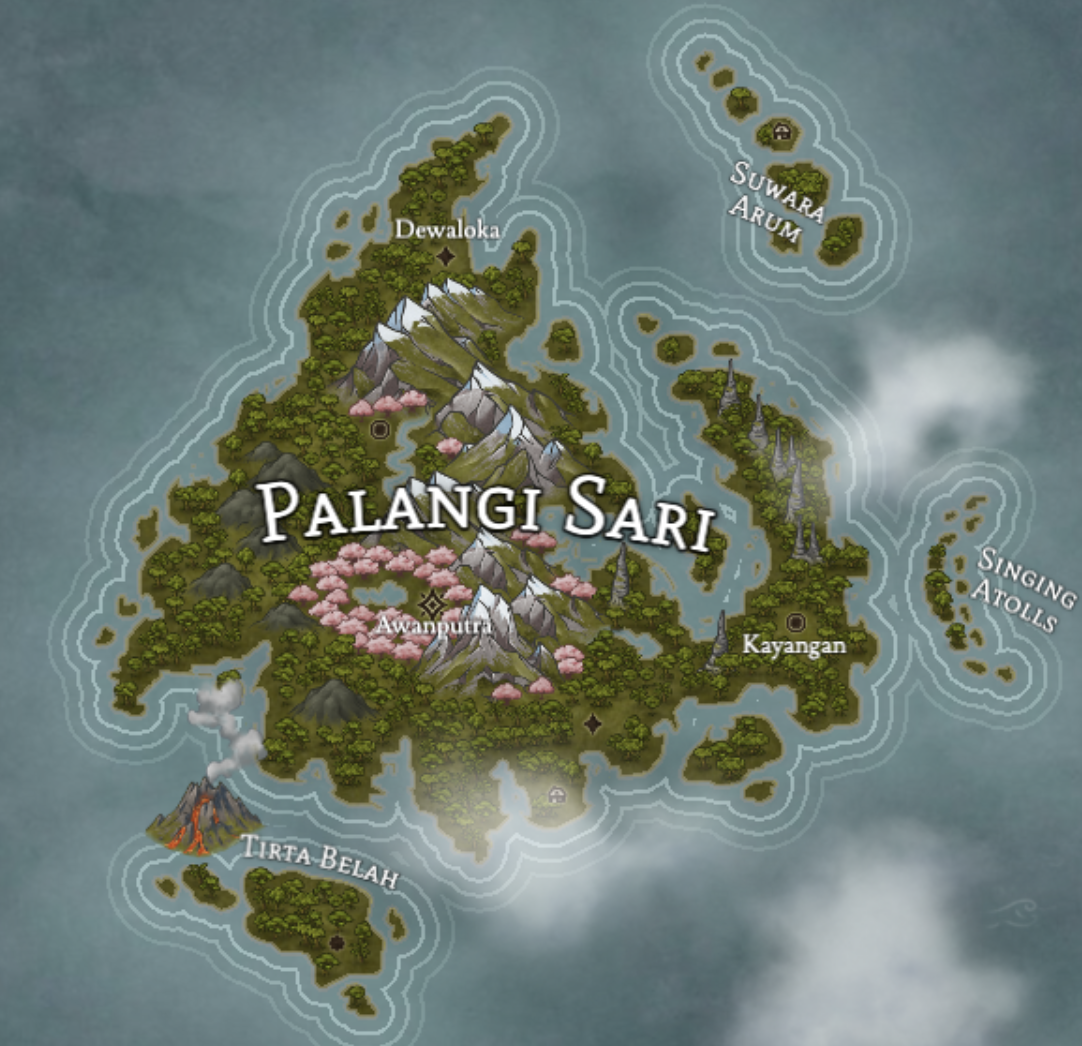
Palangi Sari rises from the sea in a chain of mountainous islands wreathed in enchanted mist, their slopes cascading with waterfalls, their skies permanently ribboned with color. The brilliance is said to be a manifestation of the Bidadari's divine essence rippling through the atmosphere: a reminder that the beings who live here are not mortal in the way that other peoples are mortal, and that the land they inhabit exists at the boundary between the physical and the sacred.
The Bidadari are celestial daughters of the divine, woven from the tears of the celestial planes and shaped by the compassion that built Palangi Sari itself. They are magnificent, long-lived to the point of functional immortality, and dedicated to upholding compassion and cosmic order. Their culture is one of refined grace and fierce duty: art, music, and dance are sacred acts through which they channel their divine essence, and every melody they create is an echo of the heavens' harmony.
Mortals rarely tread here. The archipelago is hidden behind ancient wards and enchanted mists, and entry is granted only to those invited by the Sky Princess or deemed pure of intent. For those fortunate enough to reach its shores, Palangi Sari offers transformation: divine inspiration, spiritual trials, or the quiet, overwhelming experience of standing in a place where the sacred is not believed in but simply present.

The Bayangan Council and the Sky Princess
Palangi Sari is governed by the Bayangan, a council of the eldest and wisest Bidadari. Each member represents an aspect of divine law: Mercy, Judgment, Wisdom, Creation. The Bayangan guide their society with patience and measured deliberation, ensuring each Bidadari fulfills their unique celestial decree.
Above the Council stands the Sky Princess, Palangi Sari's revered ruler, whose spiritual and political authority ties the archipelago together. She is both a mystical and real figure, said to be a chosen representative of Ma̅rziah, the Merciful Goddess, and a direct descendant of the first Bidadari who descended from the celestial planes. Her presence is marked by radiant calm and profound wisdom. An enigma even to her closest advisors, the Sky Princess is believed to be immortal, her essence renewed every few centuries by divine will.
In legend, the Sky Princess is married to the Cloud King, a mythical fomorian giant who slumbers beneath the Bulanara Mountains' northern peaks, his colossal form shaping the jagged ridges themselves. He governs the skies while he dreams, weaving storms and rainbows. During thunderstorms, the Sky Princess is said to commune with his spirit, channeling his power to maintain the balance between the heavens and the land.
The Rasi: How the Bidadari Love
Bidadari organize themselves into larger nuclear families. Their foundational structure is the Rasi, a term that translates most closely as "constellation," though the Bidadari point out that a constellation is fixed while a Rasi moves.
A Rasi is a group of between two and twelve individuals (in some cases, increasingly including members of other races, like cambions, fox spirits, huldras or humans) who share a deep sense of purpose, virtue, and care. Formation is not a ceremony so much as an acknowledgment of something already happening: a gradual deepening of connection, confirmed when all members feel what the Bidadari describe as "the settling," a sense of inner stillness that comes when one has found where they belong. Within a Rasi, relationships are neither hierarchical nor exclusive. Love is understood as radiant: it does not divide when shared, it compounds. A Bidadari who loves three members of her Rasi is understood to have a larger heart, and this is admired.
The Bayangan Council regulates Rasi bonds by one principle only: no bond may be used to diminish or possess another member. The Bidadari carry a deep aversion to owning another soul. Love, in their theology, is the recognition of a soul's divine light, and one does not own light.

The Islands
Saryadewa, the largest and most central island, is the political and spiritual heart of the archipelago. The Celestial Spire, a towering monument of radiant white stone veined with gold, serves as the seat of governance. Holy rivers run through the island, forming reflective pools said to show hidden truths of the soul.
Awanputra, the City of the Sky Princess, sits in a lush valley surrounded on three sides by the Bulanara Mountains ("Glowing Moon Mountains"), whose peaks catch moonlight and glow faintly silver at night. The Sky Palace crowns the city's heart, its silver-and-crystal spires casting prisms of dancing light over gardens that bloom year-round.
Kayangan ("Moonlit Realm") nestles at the base of the Bulanara's southeast slopes, a smaller walled town serving as the gateway to the sacred mountain peaks. Its cobblestoned streets are lined with hostels, tea houses, and incense-wreathed pavilions. The Moonlit Bazaar near its southern gates sells divine trinkets, enchanted silks, and rare herbs from the Abadi Grove.
Dewataloka ("Abode of the Gods") rises on Palangi Sari's northern peak, a walled temple city considered the most sacred site in the archipelago. Towering temples to all Nine Fortunes fill its streets, though the Temple of Enduring Grace, dedicated to Ma̅rziah, dominates the center: a colossal silver statue of the Merciful Goddess kneeling with open arms, palms glowing with eternal golden light.
The Singing Atolls, east of Saryadewa, are a crescent of tiny islands where every wave, breeze, and rustling frond contributes to a symphony of natural harmony. The Purnama Choir performs soul-stirring songs here believed to heal mortals and immortals alike, their melodies creating invisible waves of peace that sailors describe as a haunting calm.
Suwara Arum ("Isle of Fragrant Voices") acts as the gateway to the archipelago, where celestial travelers and trusted mortals are welcomed at marble harbors glowing in the moonlight. The Abadi Grove, westernmost of the sanctuaries, is an enchanting forest of towering bioluminescent trees where Bidadari seek solitude and communion with nature spirits.
And deep to the southwest, the Tirta Belah remains the oldest and most perilous site: a jagged, raised island surrounded by boiling waters, believed to be a fragment of an ancient celestial realm split during a cosmic war. Its time-warping energies and unstable magic make it dangerous even for the Bidadari, and only the eldest dare venture into its depths.
The Setengah Cahaya: Children of the Half-Light
When a Bidadari loves a mortal and that union produces a child, what results is a Setengah Cahaya, a half-light. These individuals inherit two natures in unequal measure. They age, but slowly. They recover from illness with unusual speed. Many carry vestigial signs of celestial heritage: faint luminescence to the skin, hair that catches color like a prism, or eyes that shift hue with strong emotion.
What they reliably inherit is a heightened sensitivity to the spiritual state of those around them, feeling the attunement of Rasi bonds as something almost audible, a harmonic in the air. They tend toward roles that use this sensitivity: healers, mediators, artists, diplomats, spiritual advisors. The Bayangan Council maintains a dedicated seat for a Setengah Cahaya representative, recognizing that these individuals understand both worlds in ways that full Bidadari do not.

[BEHIND THE SCENES]