
Joram: The Jade Marches


"Lhakira meditates. The Tribelands raid. We stand between them and do neither. We hold the gates, we grow the grain, and we wait for the day one side or the other decides we've outlived our usefulness."
– Marshal Daegon Joravaar, addressing the Jade Council after a Tribelander incursion
[IN-WORLD LORE]
The Shield That Became a Nation
South of Lhakira's floating citadels and enchanted groves, between the mountain wall that separates the eastern coast from the Tribelands and the ocean that faces Arashima, lies a territory that was never meant to be a country.
Joram began as a Lhakiran military protectorate, established centuries ago when the Council of Magi decided that the Hermit Kingdom's southern frontier needed a buffer: something to absorb Tribelander raids, patrol the mountain passes, and grow the grain that Lhakira's scholarly cities consumed but disdained to produce. Lhakiran mage-lords appointed garrison commanders, built fortifications along the western passes, and recruited settlers from Lhakira's lower castes, from Tribelander clans willing to trade raiding for farmland, and from Yangdonese families seeking opportunity beyond the monsoon belt.
That was three hundred years ago. The garrison commanders became hereditary marshals. The settlers became Jorami. The protectorate became a nation, in practice if not in Lhakiran law.
Today, Joram is a semi-autonomous march state of approximately two hundred thousand people, governed by the Jade Council (a body of hereditary marshals, military commanders, and grain-lords), nominally subject to Lhakira's Council of Magi, and increasingly unwilling to pretend that "nominally" means anything. The Jorami pay tribute in grain and military service. Lhakira provides magical support, trade access, and the legal fiction that Joram is still a protectorate rather than an independent kingdom. Both sides know the arrangement is fraying. Neither side wants to be the one to say so.
The Land
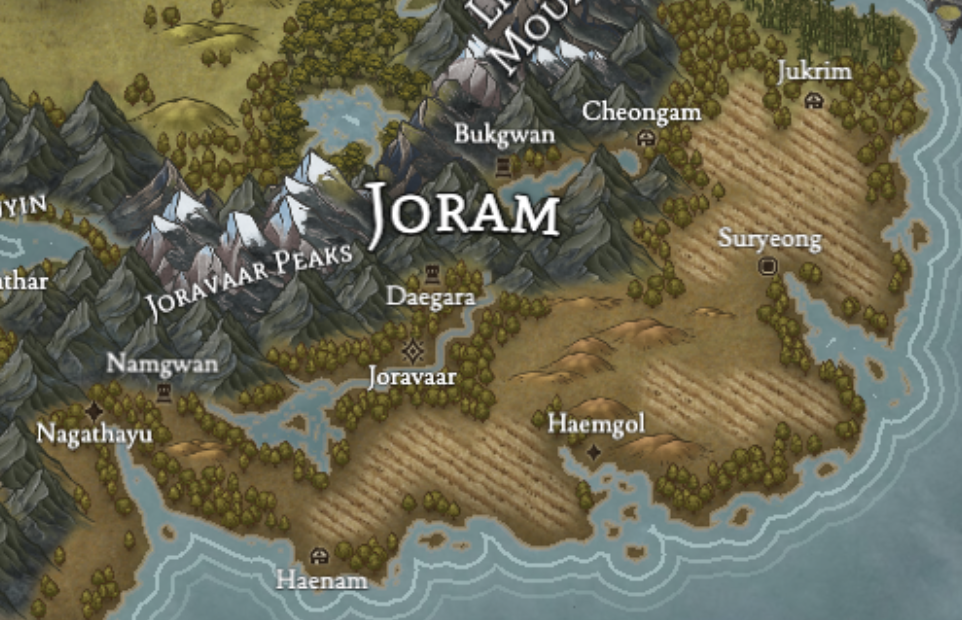
Joram's geography is defined by the contrast between its western and eastern halves. The Joravaar Mountains (named for the first marshal-governor) form the western border: a jagged, heavily fortified range whose passes are the only land route between the Tribelands and the eastern coast. These passes, collectively called the Jade Gates, are the reason Joram exists. Whoever holds them controls movement between the nomadic interior and the settled seaboard. There are three: the main gate at Daegara in the center, Bukgwan (the northern gate) near Cheongam on the Lhakiran border, and Namgwan (the southern gate) where the mountains meet Yangdonese territory near Nagathayu. Together the three gates form a defensive line that no Tribelander warband has breached in living memory.
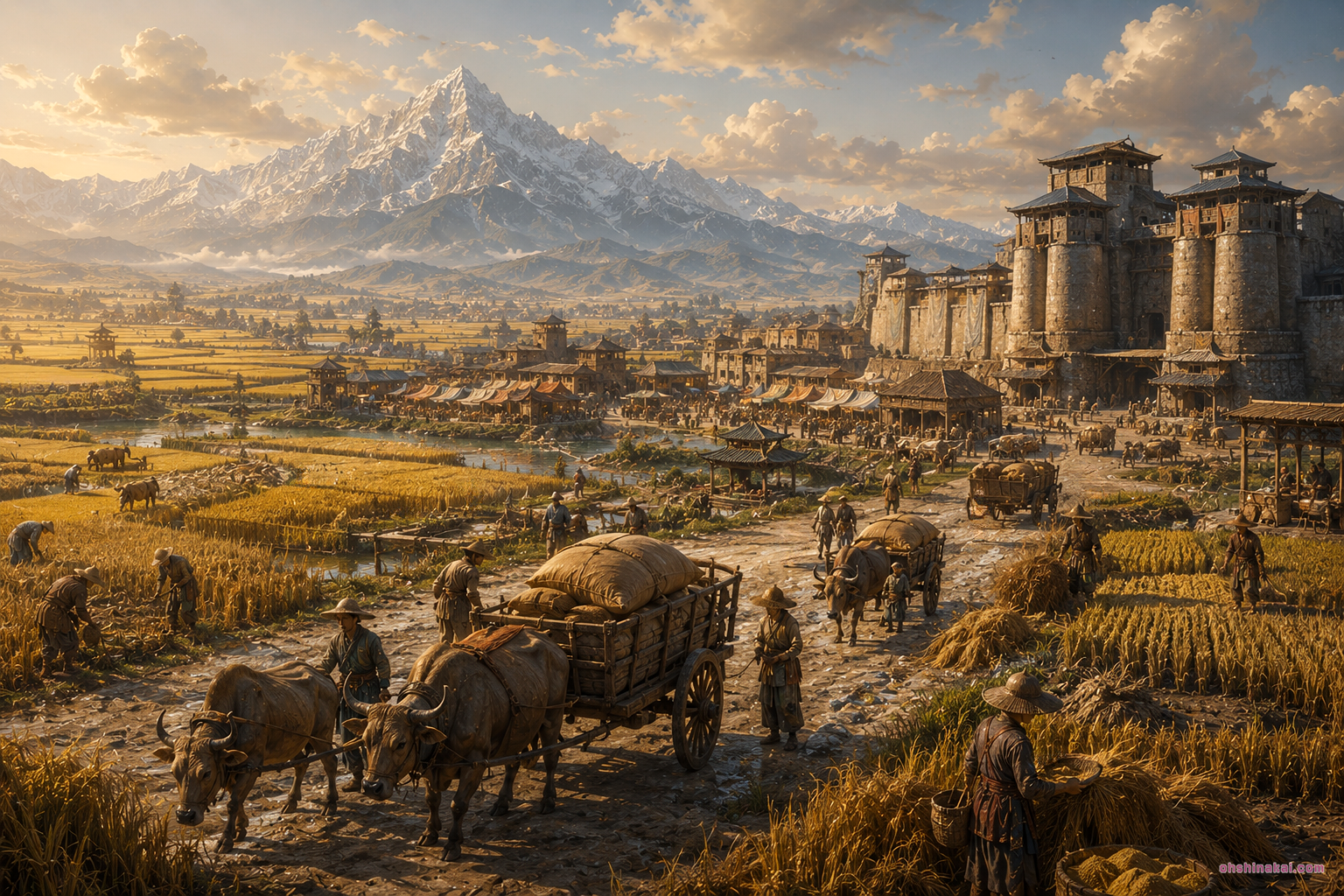
East of the mountains, the land descends through forested foothills into wide, fertile plains that stretch to the coast. The soil is rich, fed by snowmelt from the peaks and by seasonal rains carried inland from the Arashiman Ocean. Rice paddies, millet fields, and vegetable gardens cover the lowlands, producing surpluses that feed not only Joram's own population but a significant portion of Lhakira's cities. The eastern coast is mild and humid, dotted with fishing villages and small trading ports that maintain cautious commerce with Arashiman merchants.
The climate transitions from cold and alpine in the western mountains to warm and semi-tropical on the eastern coast. Monsoon rains sweep in from the ocean during summer, turning the plains lush and the rivers fast.
The Settlements
Joravaar, the capital, sits at the foot of the western mountains where the main pass road descends into the plains. It is a fortress-city that has grown beyond its walls: the original Lhakiran garrison citadel (still called the Old March, its jade-green stone unmistakable) is now surrounded by a sprawling town of timber-framed market halls, granaries, smithies, and the residences of the Jade Council. Joravaar is practical rather than beautiful, a city designed for defense and administration whose only luxury is the view: the mountains behind, the plains ahead, and on clear days, a faint shimmer on the eastern horizon that might be the sea.
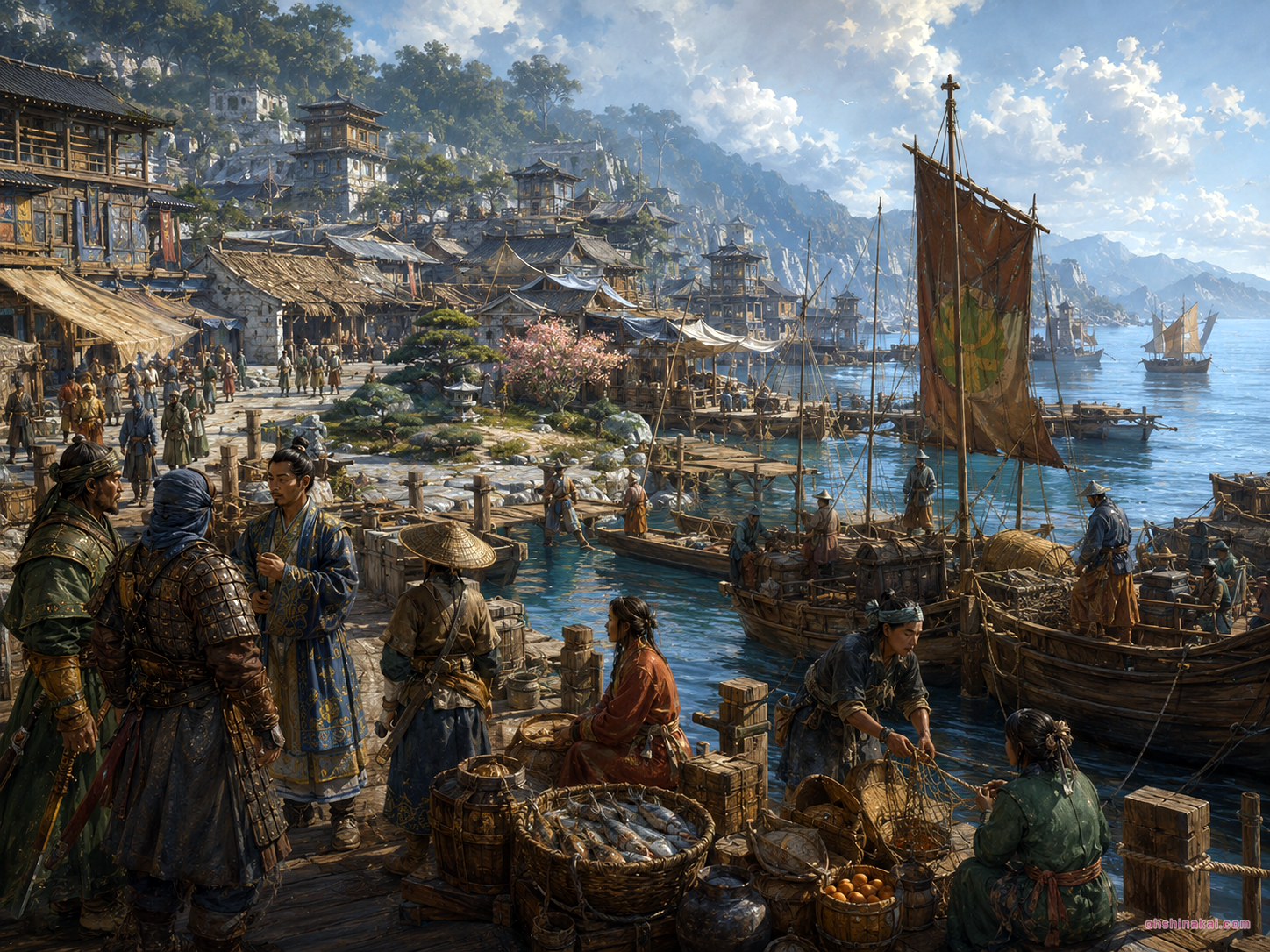
Haemgol, the largest settlement on the eastern coast, is Joram's port and its window to the wider world. Arashiman traders, Lhakiran magical envoys, and Yangdonese merchants converge here, trading rice, iron, lacquerware, and the mountain herbs that Jorami foragers harvest from the high passes. Haemgol is the most cosmopolitan place in Joram, and the only settlement where Lhakiran influence is visible in the architecture: a handful of enchanted lanterns along the harbor promenade, a small Harmonist meditation garden maintained by Lhakiran monks, and a trade office staffed by a junior mage-attaché whose primary job is reminding the Jorami that Lhakira still technically owns the place.
Daegara, high in the Joravaar Mountains at the main Jade Gate, is a garrison town of stone barracks, signal towers, and wind-blasted training grounds. Every Jorami soldier serves a rotation at Daegara, and the posting is both a point of pride and a test of endurance. The wind never stops. The cold is relentless. The Tribelander scouts on the other side of the pass are always watching. Daegara's commander holds the honorary title of Warden of the Jade Gate, and the position carries more practical authority than most seats on the Jade Council.
Suryeong, in the central plains, is Joram's agricultural heart: a market town surrounded by the kingdom's most productive rice paddies and millet fields. The granaries of Suryeong are Joram's strategic reserve, and their contents are a matter of state security. A bad harvest in Suryeong means Lhakira goes hungry, and a hungry Lhakira is a Lhakira that remembers it owns its protectorate.
Cheongam, a small mountain village in the northwest where the Joravaar range meets the Lhakiran Mountains, is the oldest settlement in Joram, predating the Lhakiran protectorate by centuries. Its people are descendants of the original highland inhabitants, and they maintain traditions (ancestor shrines, stone-cairn burials, a distinctive dialect) that predate Lhakiran influence. Cheongam's elders are consulted on matters of customary law and mountain lore, and their knowledge of the high passes is unmatched. The nearby Bukgwan (northern gate) is the least trafficked of the three Jade Gates, used primarily by Lhakiran envoys and the occasional Tribelander trade party permitted passage under escort. The village's name means "blue rock" in the old highland tongue, referring to the distinctive blue-grey stone of the surrounding peaks.
Haenam, on the southern coast where Joram's farmland gives way to mangrove and rocky shore, is a fishing village that has grown slowly into a small port. Its boats supply fresh catch to Joravaar and Suryeong, and its salted fish travels as far as Lhakira. Haenam's position near the Namgwan (southern gate) also makes it a resupply point for the garrison there, and its fisherfolk double as coastal scouts, watching the southern waters for Arashiman vessels, Yangdonese traders, and the occasional pirate from the Arkanian Isles.
Jukrim, in the northeast near the Lhakiran border, sits at the edge of the bamboo forests that mark the transition between Jorami farmland and Lhakiran territory. The village is small, quiet, and the most Lhakira-influenced settlement in Joram: its people tend bamboo groves that supply raw material for construction, paper, and the flexible practice spears used in Jorami military training. A Lhakiran customs post just north of the village processes trade and tribute caravans moving between the two nations, and Jukrim's tea-houses are the unofficial venue where Jorami grain-lords and Lhakiran procurement officials negotiate the annual tribute quota before it reaches the Jade Council for formal ratification.
Culture: Two Roots, One Trunk
Jorami culture is a blend that neither parent would fully claim. Lhakiran influence is visible in the administrative structure (the Jade Council mirrors the Council of Magi in miniature), in the literacy rate (higher than any neighboring nation except Lhakira itself), and in the philosophical language: Jorami officers quote Harmonist proverbs while drilling their soldiers, though whether they believe them or simply find them useful is a question that Lhakiran visitors learn not to ask.
Tribelander influence runs deeper than the Jorami usually admit. The martial culture (every adult trains with spear, bow, and horse), the preference for council-based governance over autocracy, the seasonal festivals that echo the Tribelander moots, and the stubborn, bone-deep conviction that freedom is more important than comfort all trace back to the Tribelander clans who settled the marches alongside Lhakiran colonists three centuries ago. Jorami cavalry, while not as fearsome as the sabretooth-riders of the open steppe, is the best-trained mounted force in the eastern region, and the horse is a far more potent cultural symbol than the jade the nation is named for.
Yangdonese influence is subtler but present: the cuisine (rice-based, heavily spiced, with a preference for fermented fish sauces), the agricultural techniques (terraced paddies adapted from Yangdonese models), and a strand of folk religion that honors local land-spirits alongside the more formal Harmonist philosophy imported from Lhakira.
The result is a people who are tougher than Lhakirans, more disciplined than Tribelanders, and more practical than either. Jorami humor is dry, their hospitality is generous but blunt, and their patience with Lhakiran condescension is wearing thin.
The Independence Question
Joram's defining political tension is the gap between what it is and what Lhakira says it is. Lhakiran law still classifies Joram as a protectorate: a military frontier administered on behalf of the Council of Magi, whose marshal-governors serve at the pleasure of the Archmage. Jorami reality is a self-governing nation with its own council, its own military, its own economy, and three centuries of accumulated identity that no legal fiction can erase.
The Jade Council is divided. The Marchists (the majority faction) want formal independence: recognition as a sovereign nation, an end to grain tribute, and the right to conduct their own foreign policy. The Loyalists (a smaller but influential group, particularly among the eastern trading families) argue that Lhakira's magical support and trade access are too valuable to risk, and that independence would leave Joram exposed to Tribelander aggression without the Hermit Kingdom's arcane backing. A third faction, the Reformists, want neither full independence nor continued subjection but a renegotiated compact: equal partnership rather than protectorate status, with Joram providing grain and military service in exchange for genuine representation on Lhakira's Council of Magi.
Lhakira, for its part, has shown no inclination to grant any of these requests. The Council of Magi views Joram as it always has: a useful buffer, a reliable granary, and a problem that can be deferred indefinitely. Whether that assessment is still accurate is a question the magi prefer not to examine.
[BEHIND THE SCENES]