
Dálvi: The Land of Mammoths and Forgotten Stone


"The humans ride mammoths because they are too small to walk through the drifts. The trolls walk because they are too proud to ride. The fomorians walk because the mammoths are too small to carry them. We all arrive at the same place. That is Dálvi."
– A troll Elder Matriarch, explaining the social order to a bewildered Vándrgarðr trader
[IN-WORLD LORE]
The Place Where Giants Outnumber Men
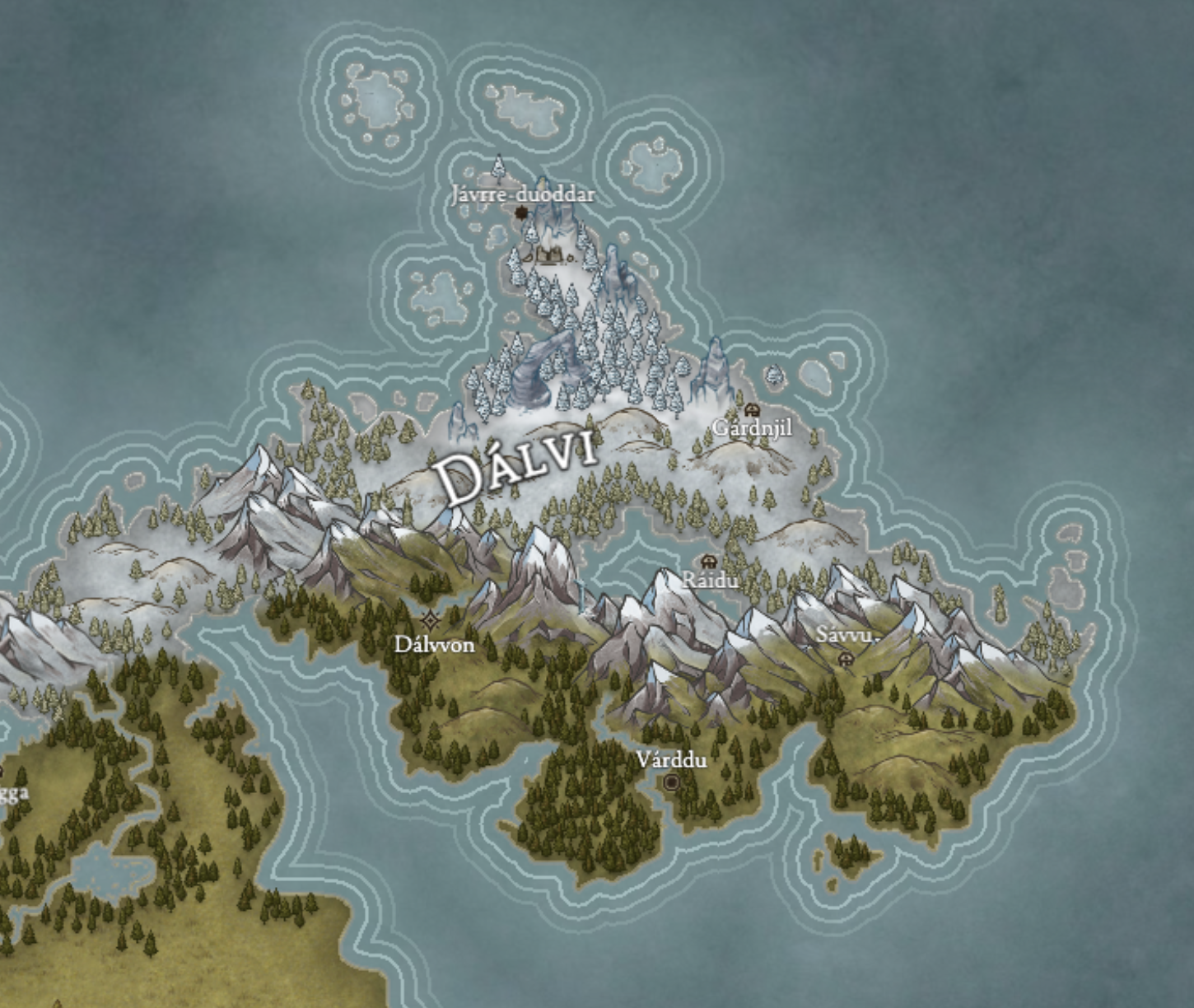
East of Vándrgarðr's frozen fjords, beyond a wall of snow-capped mountains that even the hardiest Nordvindian would think twice about crossing, lies a land that does not belong to humans. Humans live here. They have settlements, herds, and chieftains. They ride the great woolly mammoths across the tundra and hunt caribou in the boreal forests. But they do not rule Dálvi. Nobody rules Dálvi. What exists instead is something rarer and stranger: a territory where humans, trolls, and fomorians coexist in roughly equal standing, each people occupying their own niche in a landscape so vast and so harsh that there is room for everyone and competition benefits no one.
Dálvi is the largest concentration of trolls and fomorians anywhere in Mystaria, exceeding both the Ridgelands and Tartaros in sheer numbers. Where the Ridgelands' giant population is scattered across remote caves and glacial halls, and Tartaros's fomorians are organized into warlike clans under a Winter King, Dálvi's giants are woven into the fabric of daily life. Troll clans hold the mountain passes and the deep forests. Fomorian families occupy the high plateaus and the glacial coast. Human settlements sit in the sheltered valleys between, connected by mammoth-caravan routes and by the understanding that survival in Dálvi is a shared project or it is nothing at all.
And in the far north, past the last treeline, past the last troll cairn, past the point where even the fomorians grow quiet and careful, the ice hides something older than all of them.
The Three Peoples
The Humans of Dálvi are mammoth-herders, hunters, and traders who have adapted to the frozen landscape through a partnership with the great woolly mammoths that roam the tundra. The mammoths provide everything: transport across the vast snowfields (a human on foot would take weeks to cover distances a mammoth caravan crosses in days), wool for clothing and insulation, bone and ivory for tools and trade goods, and the sheer physical presence that makes a human settlement visible and defensible in a landscape that would otherwise swallow it. Mammoth calves are raised alongside human children, and a herder's bond with their lead mammoth is lifelong. The Dálvi do not ride horses. Horses would die here. Mammoths do not.
Human society is organized into extended family groups led by chieftains who earn their position through demonstrated skill in herding, hunting, and the diplomacy required to maintain relations with the troll clans and fomorian families who share the land. The chieftains convene at seasonal gatherings called drum-moots (named for the large hide drums that signal the gathering across the tundra), where disputes are settled, marriages arranged, trade conducted, and the mammoth herds assessed.
The Trolls of Dálvi are the most numerous people in the region, outnumbering both humans and fomorians. They live in clan-based communities throughout the mountains and boreal forests, occupying cave systems, forge-caverns, and deep forest lairs. Dálvi's trolls are culturally distinct from their Ridgeland cousins: where the Ridgeland trolls are isolationist and defensive, the Dálvi trolls have spent centuries living alongside humans and have developed a pragmatic tolerance that stops well short of warmth but functions perfectly well as a basis for coexistence.
Troll clans control the mountain passes, the deep-forest hunting grounds, and the alpine herb-gathering territories. They trade forge-work (iron tools, carved bone, runic weapons) and herbal preparations with the human settlements in exchange for mammoth ivory, dried meat, and the news from the outside world that the trolls pretend not to care about but always listen to carefully. Troll Elder Matriarchs sit alongside human chieftains at the drum-moots, and while the two peoples do not intermarry or share dwellings, they share the land with the matter-of-fact practicality of neighbors who have been neighbors long enough to stop being surprised by each other.
The Fomorians of Dálvi are fewer in number but impossible to overlook. Standing nearly five times the height of a human, pale-skinned and frost-horned, the Dálvi fomorians occupy the high plateaus, the glacial coastline, and the frozen northern reaches. They are less warlike than their Tartarosi cousins and less reclusive than the Ridgeland fomorians, though they share both groups' deep conviction that they are the inheritors of the titan legacy.
Dálvi's fomorians live in small family groups rather than the hierarchical clans of Tartaros. They are herders (of a sort: they tend the wild caribou herds that migrate across the northern tundra, culling and protecting them with a custodial patience that humans find unnerving), fishers who wade into the frozen sea to haul up catches that would fill a human boat, and guardians of the titan ruins in the far north. Their relationship with the human and troll populations is cordial but distant: a fomorian might walk through a human settlement without stopping, acknowledge the chieftain with a nod that shakes snow from the rooftops, and continue north without explanation. The humans have learned not to ask where the fomorians are going. The fomorians have learned not to step on the mammoths.
The Settlements
Dálvvon, in the central lowlands where the boreal forest opens into wide tundra, is the largest human settlement in Dálvi and the closest thing the region has to a capital. Its longhouses are built from massive pine logs, insulated with mammoth wool and banked with earth. The Great Drum Hall at Dálvvon's center is where the seasonal drum-moots convene, and the enormous hide drum that gives the hall its name can be heard across the tundra for miles. Dálvvon's mammoth corrals are the largest in Dálvi, and the settlement's ivory-carvers produce trade goods that reach as far as Vándrgarðr and Nordvindia.
Sávvu, on the eastern coast, is Dálvi's primary fishing settlement and its window to the sea. The harbor is crude by mainland standards (wooden jetties, hide-covered boat shelters, and smoking racks that line the shore for hundreds of meters), but the catches are enormous. Sávvu's fishers work the cold northern waters in heavy clinker-built boats, and the settlement is the most likely place for outsiders to make contact with Dálvi: Vándrgarðr traders from Sólheimar occasionally round the coast to trade iron tools for Dálvi's smoked fish and mammoth ivory.
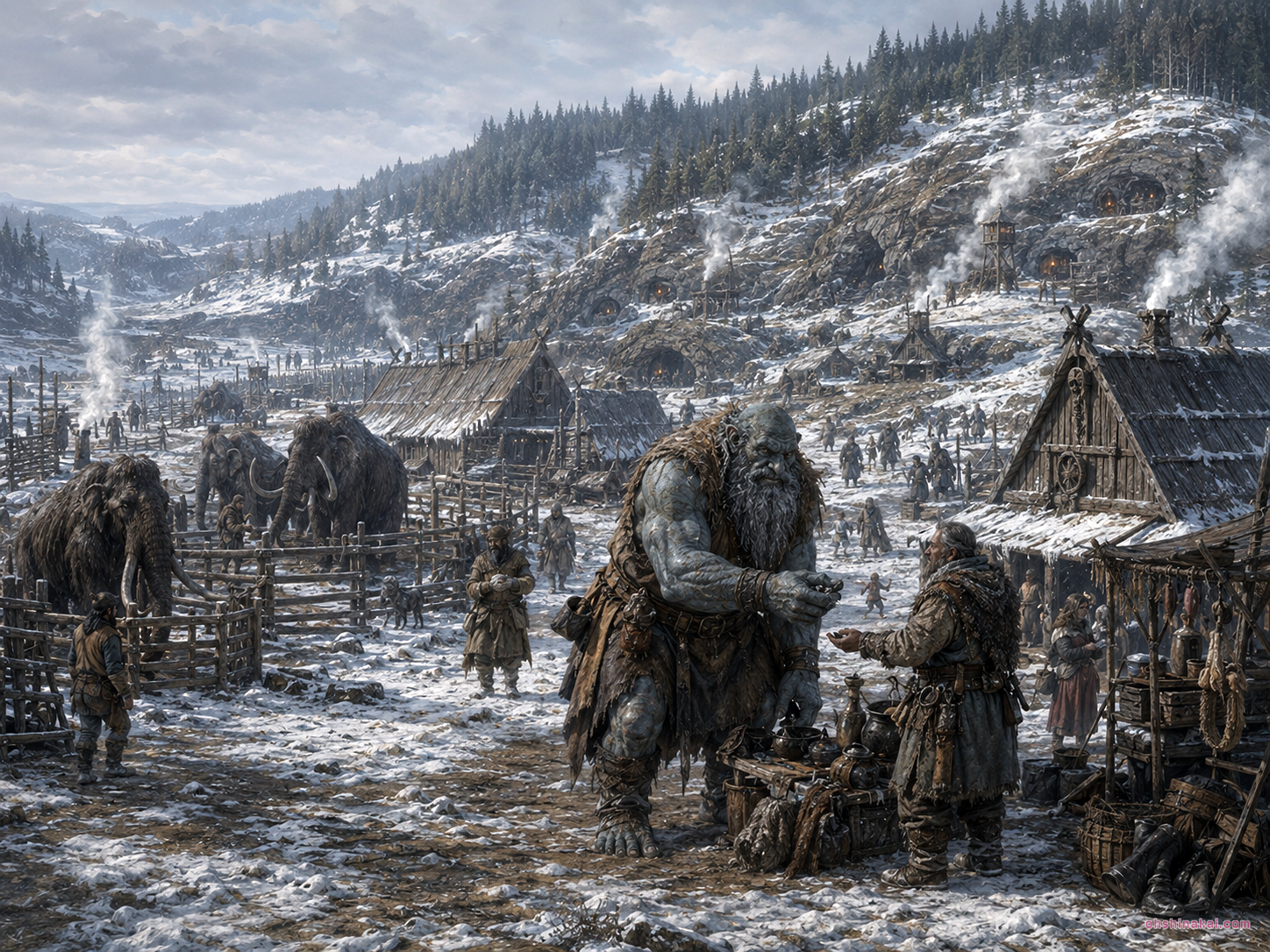
Várddu, in the southern forests, is a troll-majority settlement: one of the few places in Mystaria where trolls and humans live in the same community. The troll clans occupy the cave systems in the surrounding hills, while human families farm the narrow valley floor and tend small mammoth herds. Várddu's forge-caverns produce some of the finest ironwork in the region, and the settlement's mixed population gives it a unique character: human children grow up hearing troll sagas, and troll apprentices learn human trade-craft, and both peoples pretend this is completely normal.
Ráidu, in the forested highlands north of Dálvvon, is a seasonal trade camp where troll forge-goods from the mountain caverns are exchanged for mammoth ivory and dried fish from the lowlands. A small troll clan occupies the site year-round, maintaining the forge-caverns and the surrounding trails, but the camp swells to several hundred during the autumn trade gathering, when troll craftsmen, human herders, and the occasional fomorian arrive to barter, feast, and settle debts. Ráidu is where the troll and human economies physically intersect, and the autumn gathering is considered the most important commercial event in Dálvi after the drum-moots themselves.
Gárdnjil, on the northeastern glacial coast, is the closest inhabited point to Jávrre-duoddar. Three fomorian families maintain a permanent vigil here, tending signal fires and observing the titan ice from a cluster of stone shelters built into the coastal rock. A small contingent of human volunteers rotates through on seasonal shifts, maintaining the Drum of Warning: the great signal drum that would alert the southern settlements if anything in the far north changed. Gárdnjil's fomorian wardens occasionally report hearing deep vibrations from beneath the ice that no instrument can detect. The human watchkeepers write these reports down carefully, file them in Dálvvon, and try not to think about them too much.
The Far North: The Titan Ice
Beyond the last settlements, beyond the treeline, beyond the point where even the tundra gives way to bare ice and glacial formations, the far north of Dálvi holds the region's deepest secret.
The ice formations visible from the coast are not natural. They are titan ruins: the remnants of structures so old and so large that they make fomorian architecture look like children's toys. Spires of translucent ice-stone rise from the frozen sea, carved with glyphs that no living creature can read. Walls of fused crystal and rock extend beneath the surface, their depths unmapped and unmappable. The ruins are cold in a way that goes beyond temperature: a cold that presses against the mind, that makes thoughts slow and heavy, that whispers in frequencies that only fomorians can hear.
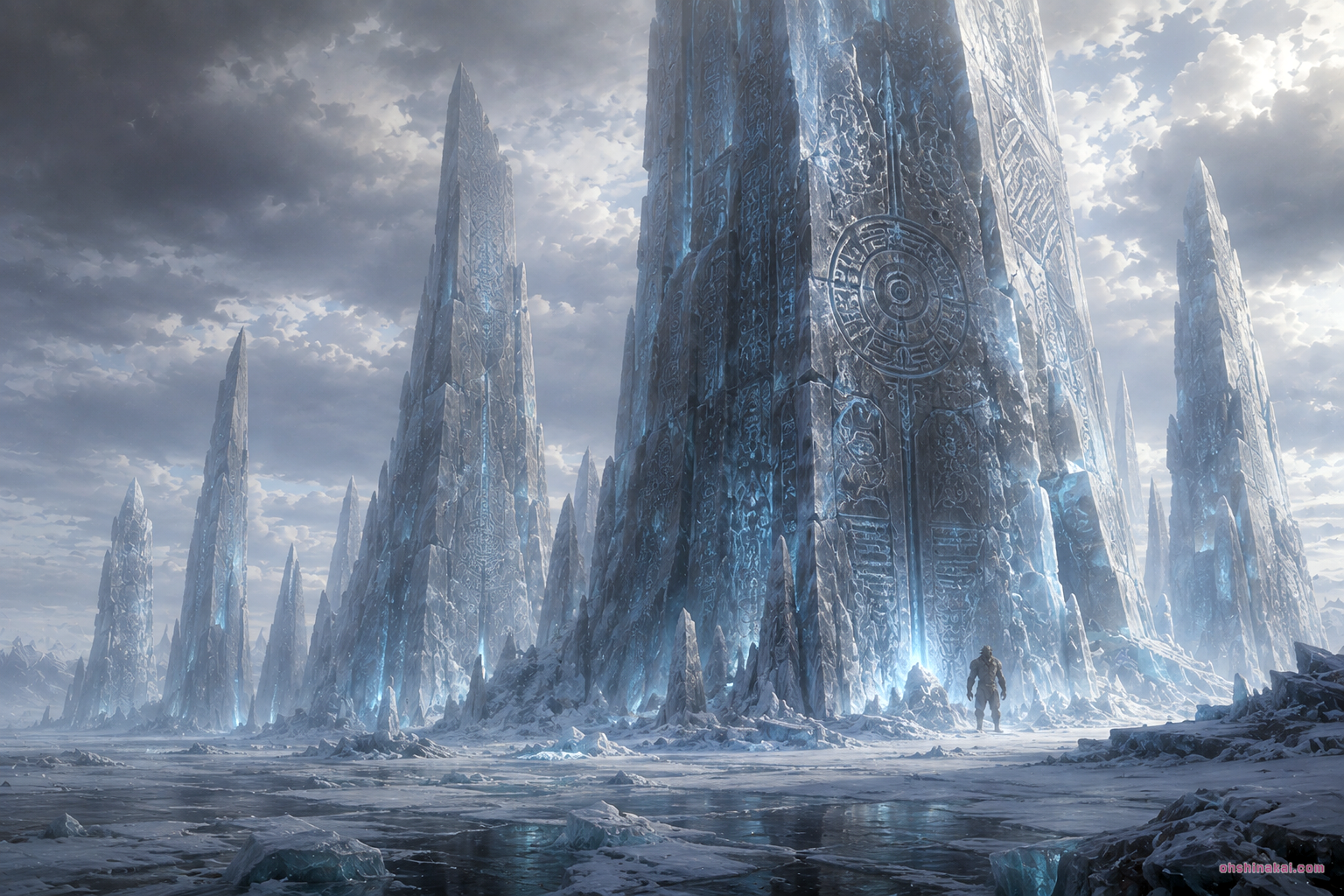
The Dálvi call this place Jávrre-duoddar (the Lake Above the Sky), and their oldest songs describe what sleeps beneath it. The songs are not specific. They do not need to be. Whatever the titans left in the ice is old enough that the fomorians (who remember the titans as gods) approach the ruins with reverence and terror in equal measure. The troll Elder Matriarchs forbid their clans from venturing past the last cairn-markers. And at Gárdnjil, the fomorian wardens and their human counterparts watch the northern horizon and keep the Drum of Warning ready.
Nothing has changed in living memory. The Dálvi watch anyway. The songs say that one day something will, and the songs have never been wrong about anything else.
[BEHIND THE SCENES]