
Tandarak: The Highland of Cast Bones


"Azaniya's shamans ask the dead what they feel. We ask the dead where they land. Their method requires trust. Ours requires counting."
– Castkeeper Tigaru of Dabrak, in conversation with an Imaian herbalist
[IN-WORLD LORE]
The Oracle That Doesn't Listen
East of Sadoros and north of Jalimriya's golden plains, the Tandari highlands rise in a wall of rugged peaks and wind-scoured mesa tops. West of Azaniya's misty forests, the mountains give way to deep gorges and stone so old it has forgotten the rains that shaped it. The soil is thin. The trees are sparse. The cattle are hardy and the people hardier. And on the exposed plateau tops, where wind strips the rock bare and bleaches bone to white powder under an enormous sky, the Castkeepers of Tandarak throw their ancestors' knucklebones across the stone and read the future in the pattern of their fall.
Tandarak practices osteomancy (divination by cast bones) but to call it fortune-telling would be to misunderstand the entire culture. The bone-readings that govern Tandari life are not mystical visions or spiritual communion. They are procedural, repeatable, and quasi-legalistic: closer to a court ruling backed by centuries of established precedent than to a shaman's trance. Two Castkeepers casting the same bones for the same question should arrive at the same reading, because the system is interpretive, not revelatory.
Every significant decision in Tandarak passes through a bone-cast. Criminal trials. Medical diagnoses. Planting seasons. Marriage contracts. Declarations of war. The bones are the operating system, and the Castkeepers are the only ones who know how to read the output.
Castkeepers and Their Bones

A Castkeeper's authority comes not from personal charisma or spiritual gift but from the bones themselves. Every Castkeeper inherits or earns a unique collection of ancestral remains (knucklebones, vertebrae, carved fragments of larger bones) passed down through specific lineages. Each bone in a set carries the accumulated memory of every casting it has participated in, and the vocabulary of a reading depends entirely on whose bones are present. A set containing the knucklebones of a celebrated warrior will read differently on questions of conflict than a set built from the remains of healers and farmers. The bones bring their history to the cast.
This is the critical distinction from Azaniya's spirit-binding. Across the border, Azaniyan shamans open themselves to the ancestors at Murkshore Lake and receive visions, prophecies, emotional guidance. The experience is mystical, subjective, personal. In Tandarak, the Castkeeper performs a physical procedure. The bones fall. The pattern is read against centuries of established interpretation. Another Castkeeper, casting the same bones, should see the same answer. Where Azaniya reaches down into watery depth to commune with spirits, Tandarak casts outward across exposed stone and reads what physics and ancestral residue produce together.
The two nations share a border and a deep, grudging mutual respect. Azaniyans consider Tandari bone-reading spiritually shallow: it treats the ancestors as passive objects rather than active presences. Tandari consider Azaniyan spirit-binding dangerously subjective: you can verify a cast, but you cannot verify a vision. Despite this philosophical rivalry, the nations rarely fight, and each quietly consults the other when their own methods produce ambiguous results. An Azaniyan shaman rattled by a troubling vision may send a discreet message to a Tandari colleague for a second opinion. A Castkeeper faced with an unreadable pattern may reluctantly seek an Azaniyan spirit-binder's insight. Neither side admits this happens often.
Takhari and the Circle of Marrow
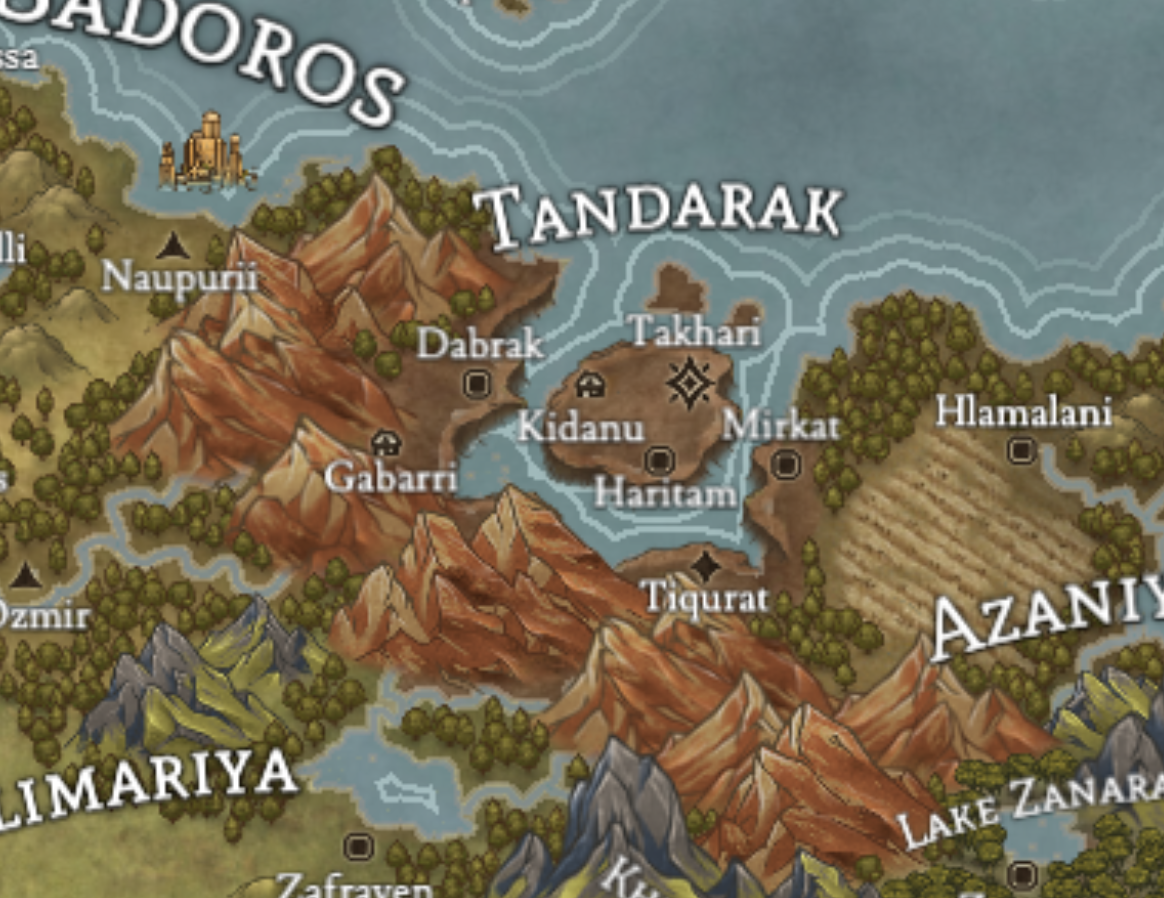
The capital is a flat-topped mesa called Takhari, its stone surface worn smooth by centuries of castings. Faint grooves and impact marks from countless thrown bones create a palimpsest of decisions layered over generations, a physical record of governance written in dents and scratches on the rock. The settlement itself clusters around the mesa's rim, terraced stone buildings stepping down the cliffside with views across the gorge country toward Azaniya's forests to the east and Sadoros's coastal hills to the northwest.
Tandarak is governed by the Circle of Marrow, a council of seven senior Castkeepers, each representing a major clan. The head of state, the Spine, is chosen through an elaborate multi-day casting ceremony where candidates present their bone-sets and perform diagnostic casts before the assembled nation. The Spine serves until death or until the Circle unanimously determines that their judgment has become unreliable, a process called "the Cracking," named for the way a failing Spine's authority is said to fracture like old bone under stress.
Clan identity revolves around bone lineages. When a respected elder dies, the clan's Castkeeper extracts specific bones through careful funerary process, cleans and cures them, and adds them to the clan's casting set. A clan's bone-set is its most precious possession, older and larger sets carry more authority because they contain more "voices." Losing a bone-set to theft or war is equivalent to losing your legal archives, your ancestral identity, and your political legitimacy in a single catastrophe. The sacred ossuary-settlement of Tiqurat, built into a cliff face, stores the oldest and most revered sets in honeycombed stone chambers, each bone cataloged by lineage and era.
Beyond the capital and its sacred sites, the Tandari highlands support a scattering of smaller settlements. Kidanu, a highland waystation on the main trail between Takhari and Dabrak, hosts a small seasonal court where traveling Castkeepers hear minor disputes from herders and traders passing through. On the western slopes facing Sadoros, the herding village of Gabarri is known for its long-horned cattle and the annual bone-market where clans trade minor casting bones. Mirkat, a lookout garrison on the eastern ridge overlooking Azaniya's forests, is where military-specialist Castkeepers monitor the border and practice the martial applications of bone-reading that have kept Tandarak's eastern frontier secure for centuries. And south of Takhari, the sacred plateau of Haritam is where coming-of-age hunts take place and young Tandari carve their first casting bone from an animal they've taken themselves.
The Tiganu, a long wind-scoured spine of exposed rock running east-west across the central highlands, serves as both natural road and territorial marker between the northern and southern clans. At its western foot, the Biraku provide the primary water source for Dabrak and the gorge-country settlements.

The First Cast and the Nine Fortunes Problem
Tandari creation lore holds that the world itself was formed when a primordial being (sometimes called Takhari, "The One Who Threw") cast a handful of bones across the void. Where each bone landed, something came into existence: a mountain, a river, a species, a season. The world is therefore a single enormous bone-reading that nobody has finished interpreting. Every Castkeeper who practices their art is, in a small way, continuing the work of reading the original cast.
This cosmology positions Tandarak uncomfortably relative to the Nine Fortunes faith. The Tandari don't deny the existence of the Nine. They simply consider them prominent "bones" in the original cast: powerful patterns rather than conscious beings worthy of worship. Most Sa̅hamarahist theologians and the cambion communities who steward the faith consider this interpretation deeply heretical. The tension never quite erupts into open conflict, partly because Tandarak's highland terrain is murderously difficult to invade and partly because nobody, not even zealous clergy, wants to antagonize the people who can diagnose your illness, settle your lawsuit, and predict your harvest with a handful of knucklebones.
The market town of Dabrak, in the gorge country where the Tandari highlands descend toward the Jalimriyan plains, is where Tandari expertise meets the outside world. Dabrak sits at a crossroads: Sadoran merchants arrive from the northwest, Jalimriyan traders climb from the south, and Azaniyan spirit-binders cross from the eastern forests. Castkeepers and Imaian herbalists maintain a longstanding complementary relationship here: the Castkeeper diagnoses through bone-reading, the herbalist prepares the remedy. The Imaia-Tandarak medical corridor, running south through the Khurayarian Mountains, is one of the most important trade routes in Mystaria, a partnership built on two traditions that don't fully understand each other's methods but trust each other's results.
[BEHIND THE SCENES]