
Elarindor: The Kingdom That Was


"You can still hear her singing on nights when the fog comes in off the coast. The queen who ruined us. She weeps upon a throne that isn't there anymore, in a palace that belongs to the Phazani now. And the roses in the garden still grow wrong."
– An Elarindoran exile, drinking in a Hallgildan tavern
[IN-WORLD LORE]
The Ghost That Was a Kingdom
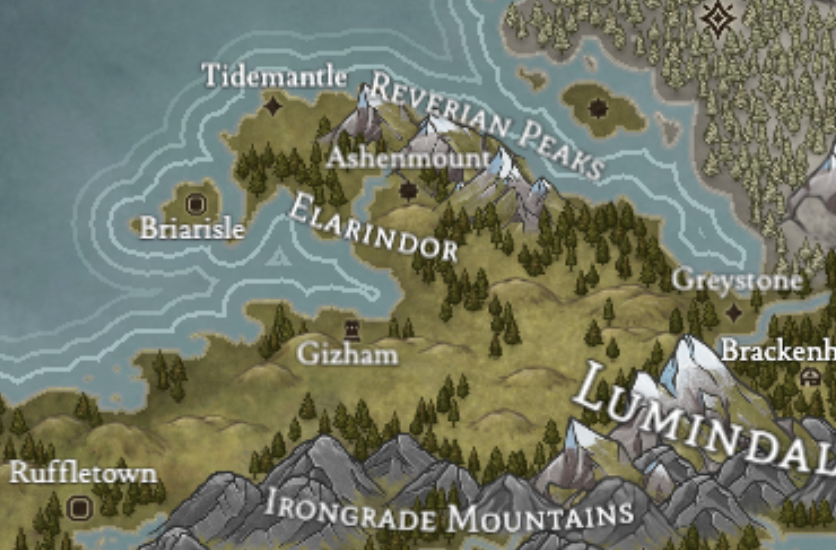
Northwest of Lumindale's quiet moors and southwest of Hallgilda's mountain passes and deep forests, there is a stretch of forested coastline, green islands, and rolling countryside that looks, from a distance, like it should be one of the most pleasant places in Evernia. The trees are tall. The harbors are sheltered. The soil is good. And something is deeply, permanently wrong.
Elarindor was once a prosperous kingdom of magic, art, and trade. Its relations with Verdania were harmonious. Its mines in the Reverian Peaks produced iron that fed forges across the continent. Its royal house, the Reverias, presided over a court that was the envy of its neighbors. Travelers spoke of Elarindor as a place where joy and prosperity seemed woven into the land itself.
Then Queen Isolde made her faerie bargain, and the curse ate the royal house from within. The Forge Wars stripped the kingdom of its mines, its unity, and its will to resist. And when the Phazani Blackguards besieged the capital for nineteen months, broke through after a betrayal within the court, and marched the surviving aristocracy into exile on the road that history remembers as the March of Ashes, there was nothing left to save.
Today, Elarindor is a Phazani-occupied territory. Its name survives on old maps and in the memories of exiles scattered across Hallgilda, Lumindale, and Verdania. The land itself endures, haunted by the echoes of what it used to be and by the faerie curse that started its decline. Phazani governors administer the territory from the old capital. Phazani Blackguards patrol the roads. Phazani miners work the remaining Reverian outposts. And in the ruined palace gardens, the roses still grow wrong: twisted, thorned, and blossoming in colors that no gardener planted.
The Rise and the Curse
In its prime, Elarindor was a mid-sized Evernian kingdom whose wealth flowed from the Reverian Peaks (iron-rich mountains on its southern border with Phazani), from maritime trade along its western coast, and from the fertile countryside that fed a comfortable, cultured population. King Thorendil Reveria presided over a court where magic and art flourished, and relations with neighboring Verdania (whose ruling Evercrest family shared distant kinship with the Reverias) were warm.
The rot began with Queen Isolde, the last of the Reveria line. Obsessed with immortality and terrified that her legacy would die with her, Isolde turned to forbidden sources: an ancient book, a pact with spirits above and below. What she received was a faerie's bargain. The crown would be made new, never to fade. The realm would be bound to her name forever: but not in the way she anticipated.
The Curse of House Reveria unraveled the royal family across generations. Daughters risked endless enchanted sleep. Sons could not lie without flowers withering around them. The palace gardens and halls became haunted: ghostly echoes, restless spirits, roses that grew in impossible colors. The curse weakened the monarchy, fractured the court, and left Elarindor vulnerable at the worst possible moment.
The Forge Wars
The Reverian Peaks, iron-rich and strategically vital, became the fault line along which Elarindor broke apart.
The First Forge Wars (170-150 BFE)
Elarindor's miners, dissatisfied with the neglect and corruption of the nobility, revolted. Phazani warlords sent clandestine support and arms to the rebels. Skirmishes spiraled into mountain-wide conflict, with hill tribes and trolls raiding supply lines. Phazani forces entered under the banner of "restoring order" and seized control of the lower slopes and mining towns. Elarindor lost key territories and never recovered its political unity.
The Second Forge Wars (114-101 BFE)
Faerie courts, taking advantage of the chaos, infiltrated the weakened kingdom. Ancient noble lines vanished: some murdered, others simply disappearing amid rumors of enchantment and supernatural misfortune. Faerie agents systematically dismantled local resistance, and most of the former Elarindor territory fell under the sway of faerie lords. Phazani patrols encountered uncanny magic and vanishing soldiers. The mines became dark legend.
The Fall (70-66 BFE)
The Phazani invaded what remained. The Blackguards besieged Ashenmount for nineteen months. After an alleged betrayal within the Elarindor court, the city fell. Survivors who did not submit were forced onto the March of Ashes: a brutal forced exodus in which the conquered aristocracy was executed, married into Phazani houses, or sent to labor camps in the west. Elarindor ceased to exist as a sovereign nation.
The Territory Today
Modern Elarindor is administered as a Phazani frontier province. Governors appointed by the Ironclad Dynasty oversee the territory from Ashenmount, collecting taxes, managing timber exports, and maintaining the road network that connects the Phazani heartland to the northern coast. Blackguard patrols keep order, though "order" in Elarindor is a relative term: the forests are deep, the population is resentful, and the faerie curse has never been lifted.
The Phazani have rebuilt what serves their purposes and abandoned what does not. The harbor towns are functional. The timber mills are productive. The Reverian mining outposts on the southern border operate under heavy guard. But the old palace remains a ruin (the Phazani governor conducts business from a repurposed guild hall rather than occupy a building where the walls weep and the roses grow teeth), and the interior forests are avoided after dark.
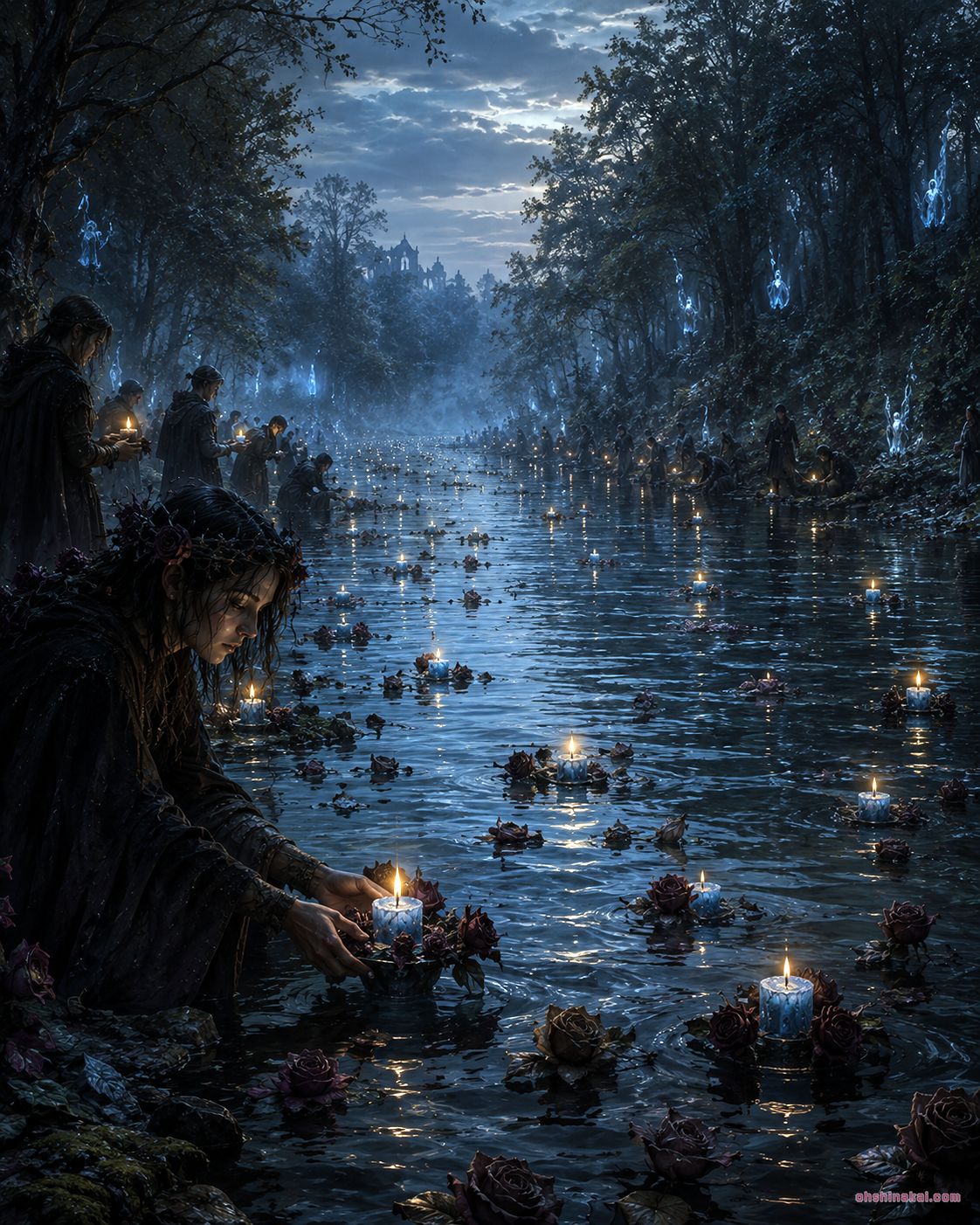
The Elarindoran population has not been replaced. The same families who lived here before the conquest still farm the valleys, fish the coast, and cut timber in the forests. They pay Phazani taxes, obey Phazani laws, and speak Phazani in public. In private, they tell the old stories, light blue candles on Faerie Remembrance Eve, and float withered roses on the rivers to honor the cursed heirs and plead for mercy from the faerie court.
The Settlements
Ashenmount, the old capital, sits in the interior hills where the main road from Phazani crosses into the Elarindoran heartland. The city earned its current name after the March of Ashes; whatever it was called before, the exiles remember and the Phazani do not care. Ashenmount is a city of two layers: the Phazani administrative quarter (rebuilt guild halls, a Blackguard garrison, the governor's residence) sits alongside the older Elarindoran city (crumbling colonnades, vine-choked plazas, and the ruined royal palace that no one will occupy). The governor conducts business from a repurposed merchant hall rather than set foot in the palace, where the walls still weep with runic condensation each spring and the garden roses bloom in colors that make visiting botanists uneasy. The population is mixed: Phazani officials and soldiers in the upper town, Elarindoran families in the lower quarters, and a tension between them that never quite boils over because both sides need the other more than they want to admit.
Tidemantle, on the western coast, is Elarindor's surviving port: a harbor town of salt-crusted stone quays and weathered boat sheds that handles timber exports, coastal trade, and the fishing that feeds the territory. Tidemantle is the least haunted place in Elarindor. The locals claim the sea wind keeps the forest spirits at bay, and whether or not that is true, the town has a practicality that the interior lacks. Old Elarindoran maritime traditions survive here most visibly: fishing families, boat-builders, and salt-traders whose customs predate the Phazani occupation and will almost certainly outlast it. The Phazani care about Tidemantle's harbor. Everything else, they leave alone.
Briarisle, on the largest of the offshore islands, is the closest thing Elarindor has to a free settlement. During the March of Ashes, some Elarindorans fled to the islands, and the Phazani never bothered to garrison them. Briarisle is a quiet fishing community of a few hundred people who maintain the highest concentration of old Elarindoran customs anywhere in the territory: the festivals, the songs, the recipes, the stories. It has an unspoken reputation as a place where exiles return, where the Knights of the Damned resupply without being reported, and where blue candles burn on Faerie Remembrance Eve without anyone looking over their shoulder. The Phazani know about Briarisle. They consider it too small and too poor to bother with. The Elarindorans consider that assessment their greatest protection.
The Haunting
Elarindor's faerie curse did not end with the conquest. If anything, the Phazani occupation has deepened the land's strangeness. The Weeping Hall Phenomenon (runic condensation that appears inside the ruined palace each spring, forming patterns that exiles and wise-folk attempt to read as portents) continues unabated. The Midsummer Blight (crops failing in bad years unless rituals appeasing the forest spirits are performed) still strikes the interior, and the festivals that accompany it (foraging, costumed children, a quest for a "good" rose in the haunted gardens) have survived despite Phazani disapproval.
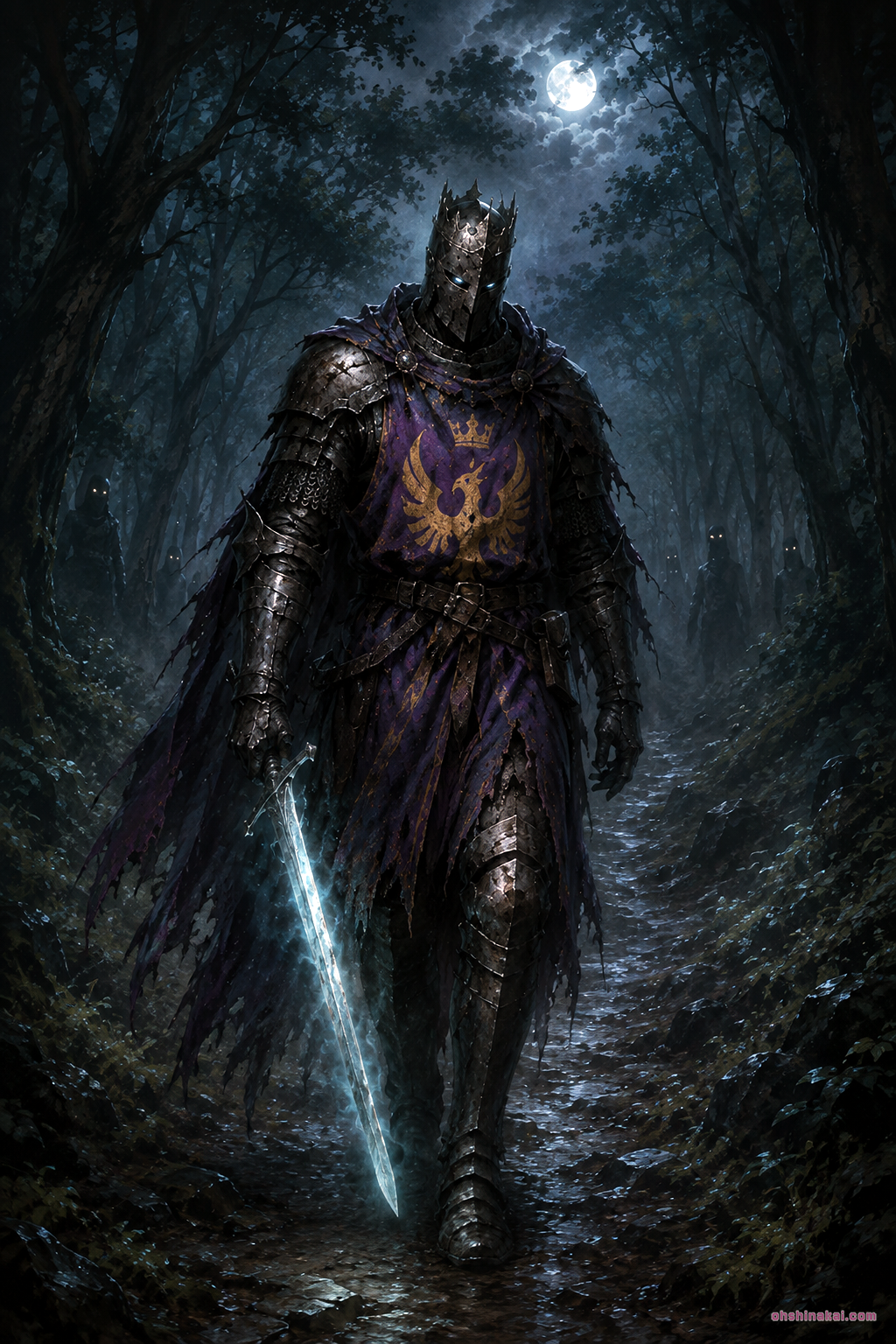
The Knights of the Damned, perhaps Elarindor's strangest legacy, emerged from the final days of the kingdom. Noble knights, some already stricken with vampirism or specter-taint from the curse, swore a crimson oath on the shattered crown to protect the common people, cursed or not. Their first act was rescuing a plague village beset by both Phazani occupiers and true undead. Today, the Knights of the Damned are outcasts and legends: half-cursed champions fighting for the weak on the edge of darkness, tolerated by no authority and needed by everyone.
[BEHIND THE SCENES]