
The Long Fall: How an Empire Dies


Aldermark is called The Last Elven Empire for a reason. It ends. This post is about how a civilization that ruled Central Europe for five centuries came apart, slowly, then all at once, and why I chose to build a world that was already over before the story begun.
The Decision: Start at the End
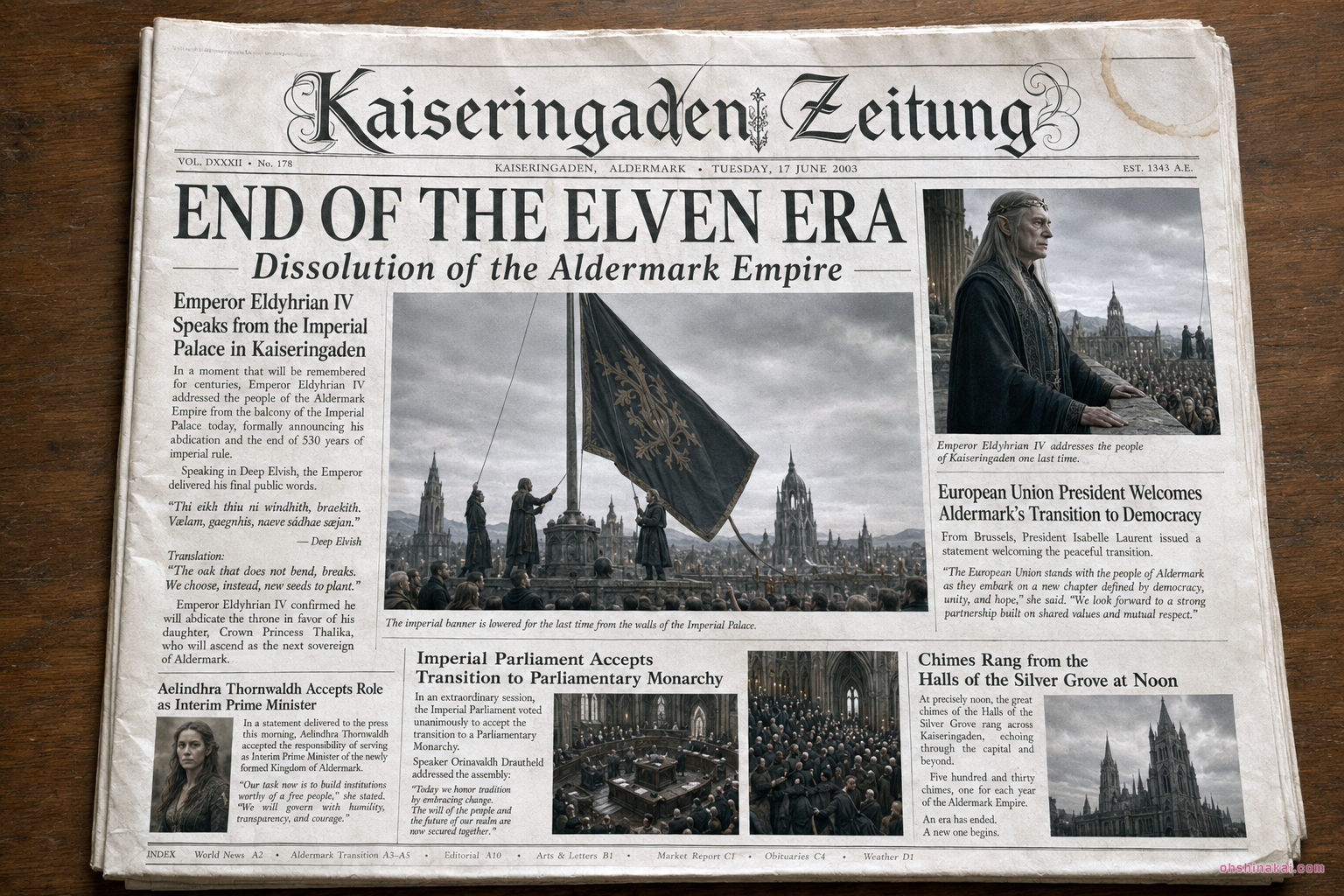
Most fantasy empires are at their height when you meet them, or rising. I made the opposite choice. By the time anyone steps into Aldermark, the empire is already dissolved, formally ended in 2003, and its immortal citizens are living in the wreckage of the only world they ever knew.
That choice does a lot of work. It means every elven character carries genuine, lived grief: they didn't read about the empire's fall in a history book, they watched it, over their own enormous lifespans. It means the present-day setting is post-imperial: elves scattered into a human-dominated world, navigating diaspora, prejudice, and obsolescence. And it gives the whole project a tone I love: not triumph, but aftermath. The wistful dignity of a people who were once the most advanced civilization on Earth and now run gyms in Leeds and wait tables in München.
So the fall isn't backstory. It's the emotional weather of the entire setting.
A Slow Erosion, Not a Single Blow
The most important decision: Aldermark does not fall to a dark lord or a single catastrophic battle. It falls the way real empires fall, through centuries of accumulating disadvantage that nobody could fix because fixing it meant abandoning the very things that made them them.
The erosion runs in three long waves.
Wave One: The Industrial Revolution (18th–19th c.)
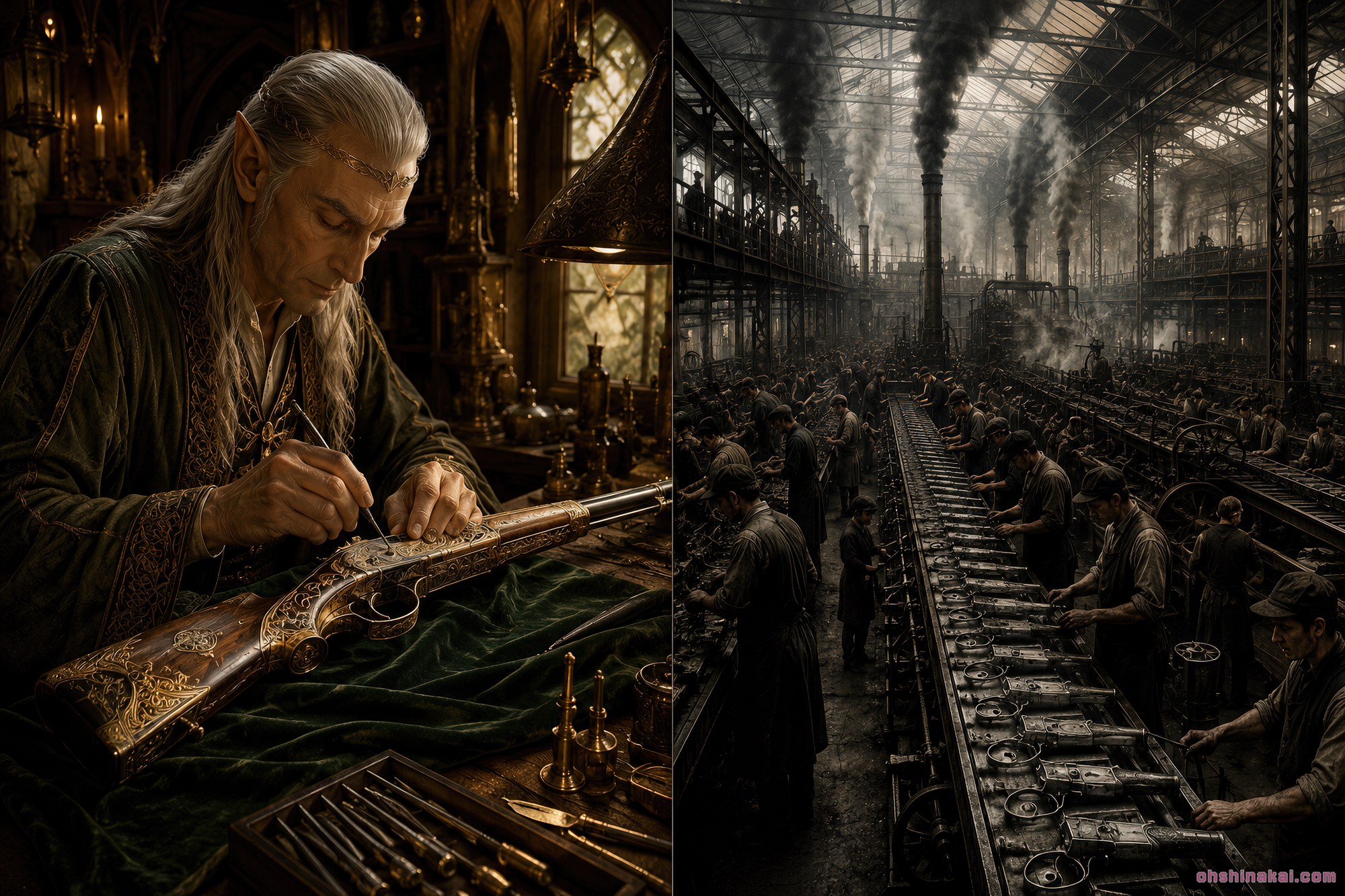
For most of its history Aldermark held an insurmountable technological lead. The Industrial Revolution erased it. Human nations learned to mass-produce: firearms, steel, railways, and the elvish cultural commitment to quality over quantity became a liability. The elves made the finest rifle in the world; the humans made a hundred thousand adequate ones. As I put it in the core history, the elves were "reluctant to embrace the rapid change brought about by industrial systems that favored quantity over quality." Their greatest virtue became the thing that buried them.
Wave Two: Human Nationalism and the Great Wars (20th c.)
Centuries of Alberich's patient absorption of human populations meant Aldermark's territories were full of humans, in southern Germany, Austria, Bohemia, parts of Poland, who had spent generations as competent, capable subjects of an elvish aristocracy that still reserved the innermost circles of power for elves. The rise of modern nationalism and democracy gave them both the language and the opportunity to demand self-rule. The elvish meritocracy, which had once looked enlightened, now looked antique: an aristocracy in a century that had decided aristocracy was obsolete.
The First World War was the hammer blow. Though officially neutral, Aldermark sat in the worst possible place, squarely between the German and Austro-Hungarian campaigns. Human nationalists inside imperial territory seized the chaos: rebels in Prague and Bavaria declared independence mid-war. And the elvish military doctrine, precision, strategy, the elegant decisive stroke, was simply not built for the mechanized mass slaughter of total war. An army optimized for surgical brilliance broke against tanks, aerial bombers, and the sheer industrial volume of human killing.
Wave Three: Irrelevance (late 20th c. - 2003)
After the wars, the empire limped on as a prestige fossil. Human cities, London, Paris, Berlin, had become the real centers of population, science, and economy. Human universities out-published elvish ones. The empire that had once led the world in astronomy, medicine, and engineering was now diplomatically aloof, economically stagnant, and quietly working its way toward a dignified exit. In 2003, it took it.
The Last Words
I gave the empire's ending to its final emperor, Elydhrian IV of the Kheladhris line, and I wrote his farewell in Deep Elvish because the language carries weight English can't. His final public words were not a lament and not a curse. They were simply acceptance:
"Thi eikh thiu ni windhith, braekith. Vælam, gaegnhis, naeve sádhae sæjan."
The oak that does not bend, breaks. / We choose, instead, new seeds to plant.
There's a deliberate grammatical detail buried in that line. The final verb, sæjan, "to sow", is indicative, not volitional. In Thungalëthaur the volitional mood marks an act of will, a binding intention. Elydhrian doesn't use it. He's not declaring a new beginning into being; he's simply describing what will happen now, the way you'd describe the weather. The empire is already over. There's nothing left to will. (More on why that grammatical choice is important in the upcoming Building Thungalëthaur - Inside Deep Elvish post)
Why a Fall Makes a Better World
If you only take one lesson from this post, take this one: an empire that has already fallen is far more interesting to write inside of than one at its peak.
A peak empire generates one kind of story: defense, conquest, the view from the top. A fallen one generates dozens. What do near-immortals do when the institution that gave their lives meaning is gone? How do you carry a culture forward with no state behind it? What's it like to be the most sophisticated person in any room and also a refugee, a curiosity, a relic? Every character in this setting is answering some version of that question, whether they're a resistance veteran running a gym, a media mogul who outlived the censors who once oppressed her, or a waitress facing east toward a homeland she can't go back to.
Aldermark is a world built in the past tense on purpose. The empire is gone. The elves remain. That's the story.
Previous ← King Alberich & the Realm of Merit · Next → Building Thungalëthaur - Inside Deep Elvish