
The Arsenal of the Solar System: How Mars Weaponized an Economy


There is a saying on Ganymede, popular among dockworkers who have dealt with Martian trade delegations: "When Mars sells you a handshake, check for a loading mechanism." It is meant as a joke, but the Martians find it accurate.
Mars exports three things in significant volume: cybernetics, weapons systems, and the unyielding conviction that the galaxy is a dangerous place and only the armed will survive it. The first two are products. The third is marketing. Together, they have made the red planet the most formidable military-industrial economy in the solar system, and every Martian you meet will tell you, with a pride that borders on liturgical, that this is exactly as it should be.
The Logic of the Machine
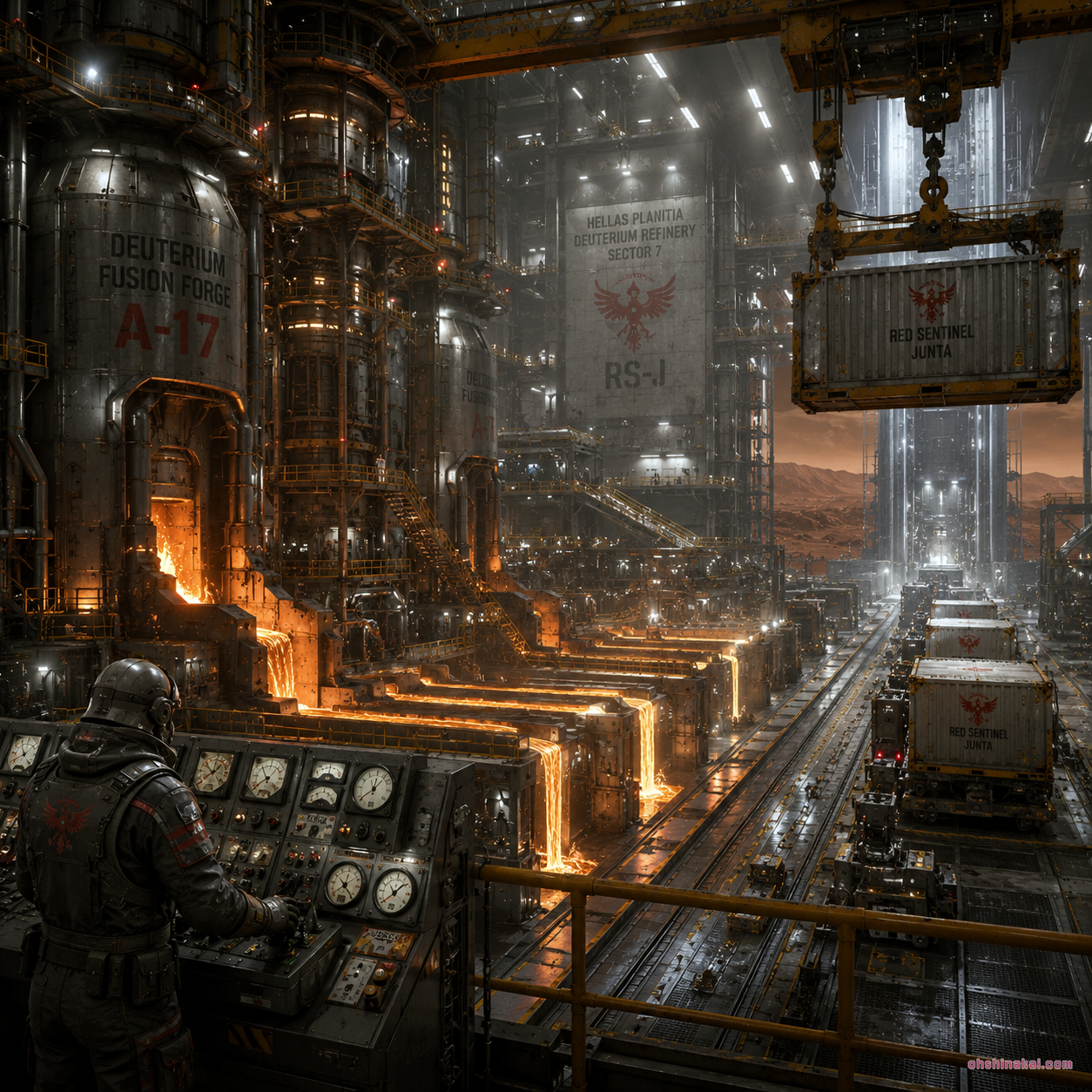
The Martian economy is not a free market in any conventional sense. It is a directed system, organized around a single strategic principle: self-sufficiency guarantees sovereignty. Every economic decision, from deuterium extraction quotas to university research funding, is filtered through this lens. Can it reduce Mars's dependence on external supply chains? Fund it. Can it be exported to increase Mars's leverage over potential adversaries? Manufacture it. Does it serve neither purpose? Table it.
The result is an economy that looks, from the outside, like a war footing maintained in peacetime. The Hellas Planitia Industrial Zone, the vast impact crater repurposed as the planet's primary production floor, runs three shifts around the clock. Iron, nickel, and titanium are extracted, refined, and shaped into everything from starship hull plating to cybernetic joint assemblies. Deuterium from the basin's fusion plants powers reactors across the system and generates revenue that flows back into defense spending with the predictability of an assembly line.
The Cyber Forge Foundries, buried in a fortified section of Hellas Planitia, are where the Junta's technological edge is literally built. Biomechanics R&D labs develop the next generation of neural interfaces and combat augmentations. Sleeve manufacturing plants produce synthetic bodies and replacement limbs at industrial scale: for soldiers injured in the field, for veterans electing deeper integration, for civilians who see enhancement as aspiration. Harmonia-Class assembly bays produce fully-automated combat drones for the planetary defense grid. Every stage is supervised by human and cyborg technicians, because Mars learned during the Hostile AI Crisis that unsupervised automation is a vulnerability, not an asset.