Shikarapura, the Nation the Dark Elves Built
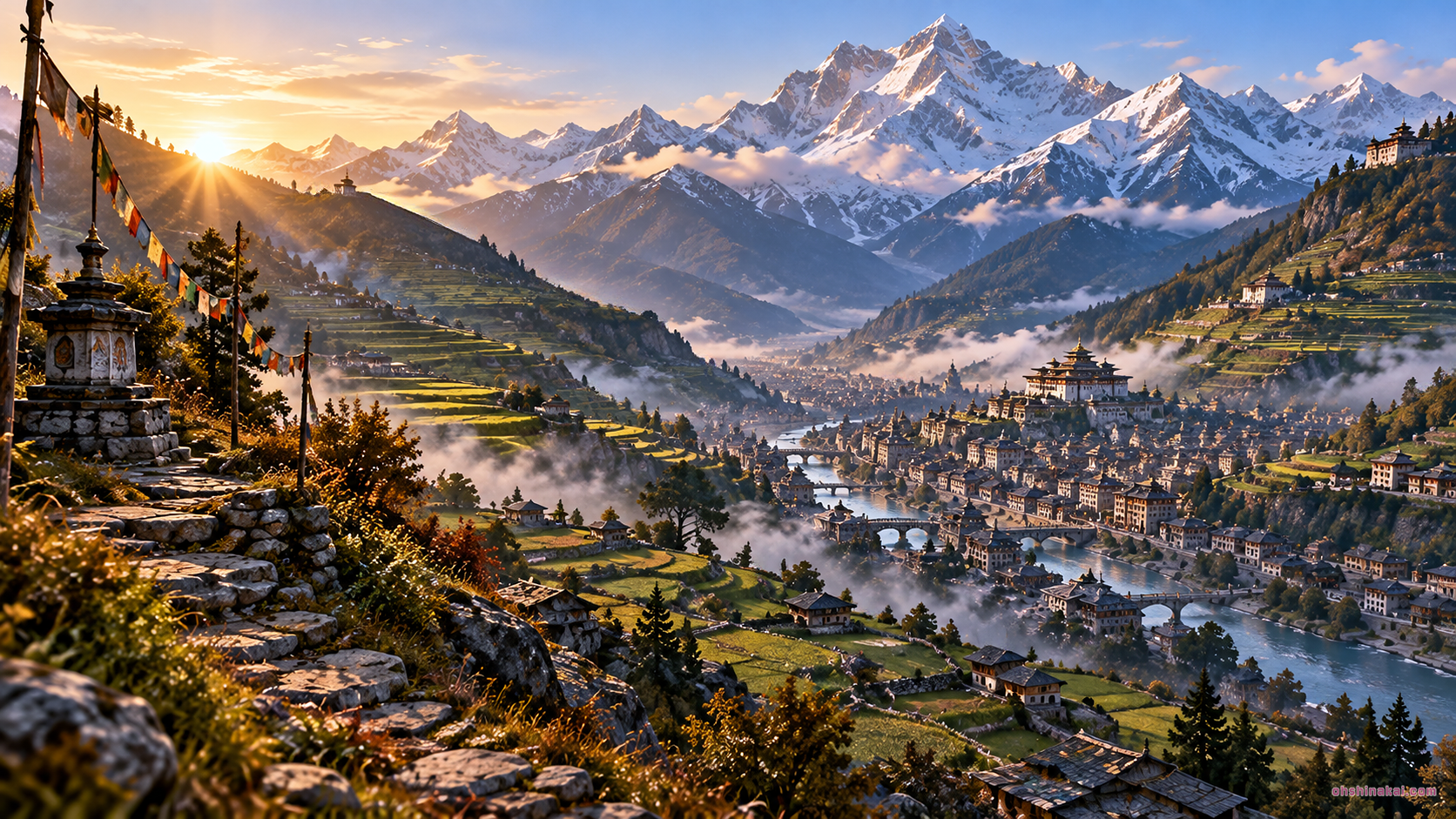
In 1392 the elves of Europe voted on their future, and the side that lost walked away. Three centuries later, in a valley between Nepal and Bhutan, the descendants of the losing side built a country. Shikarapura has no airport, almost no roads and no army that carries weapons, and it admits about ten thousand tourists a year. It is also the most complete answer anyone has given to the question the elves argued over at the Convocation: what happens to a people that refuses to become what its neighbours want it to be?

The Vote
The story starts in a forest in what is now Aldermark. In 1389 the Elvish Convocation met at Elkhwaldh Grove to decide whether the elves would integrate with the human civilisations growing around them or withdraw to keep their old ways. The debate lasted three years. In 1392 the Convocation voted 89 to 55 for integration.
The winners became the city elves, and eighty years later they founded the Aldermark Empire. The losers began to leave. Their leader, the prophet Dravithon, gave a warning before he went that dark elves still quote: They will not hate us forever. What comes after hate is worse. They will want to become us, and in the becoming, they will unmake us.
The dark elves did not go anywhere in particular at first. For three centuries they moved east in small bands through Central and South Asia, looking for a homeland that met a demanding list: high enough to discourage casual human contact, fertile enough to farm, isolated enough to protect their culture without sealing it off, and sacred enough in its shape to feel like home. They found it in the eastern Himalaya.
Building for the Children of Children
In 1720, the Aldermark emperor Kheladhris IV formally recognised the dark elves’ right to govern themselves and granted their leader, Sharava, authority over a settlement in the region. It was a remarkable act from a city-elf empire toward the people who had rejected it, and it opened the way for everything that followed.
Sharava chose the valley now called the Aravatithal for its fertility, its defensibility and its orientation toward the great peak of Khuvanyen. In 1730 he founded what became Shikarapura City. His construction order, spoken in Deep Elvish and kept in the national archives, is still the national motto: Vár pharanaeru hér. Ni für uns, für thiu kundhi thiró kundhi. We build here, not for us but for the children of our children. The Elvish word at its centre, pharani, building meant to outlast the builder, describes the country’s whole approach to time.
By 1734 the scattered dark elvish groups of the region had united into a single nation. The Kharnatakáthémplh, the Sun Temple at the eastern edge of the capital, was finished in 1757, its spire aligned to catch the first light of each solstice.
Meeting Europe Again
Isolation didn’t last. Portuguese traders pushing into the Himalaya reached the western passes in the 1760s, and in 1764 they built a stone fortress, now Fortkharvanbhorg, to control the trade routes toward Nepal and Tibet. For a people who had crossed a continent to get away from European power, a European fort on their border was a serious test.
They answered it the way they answer most things: slowly, and without violence. Trade, cultural exchange and patient negotiation led to the Portuguese India–Shikarapura Treaty of 1797, which recognised Shikarapuran sovereignty in return for Portuguese trading rights through the western pass. Over the following decades Shikarapura took the fortress back by negotiation. It is a museum today, and the annual Karvan Festival re-enacts the colonial era inside its walls as a celebration of a sovereignty won without war.
A Republic of Consensus
Shikarapura wrote its constitution in 1825 and became a federal presidential republic in 1829. Its founding principles were the ones the dark elves had been living by for centuries: decisions by consensus, the authority of elder councils, representation for every community (dark elvish, Nepali, Bhutanese and Indian) and pacifism as a governing philosophy rather than a policy.
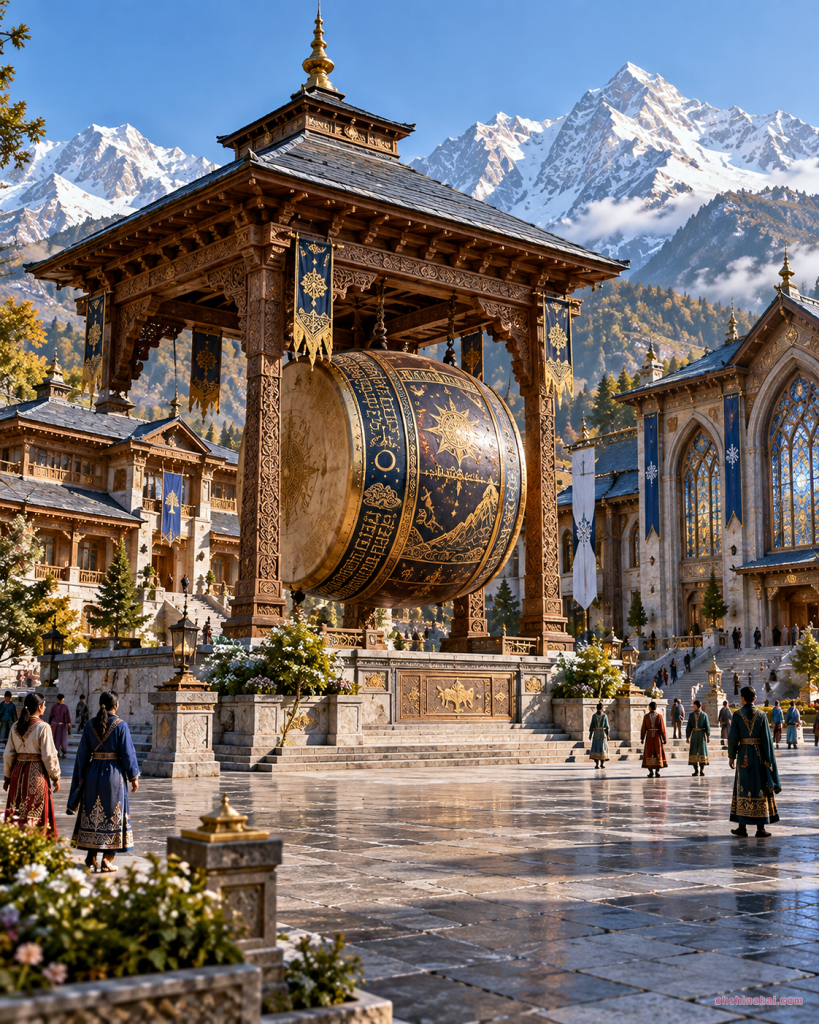
The republic is non-partisan. Its parliament, the Shikarapura National Congress, has a Senate and a Chamber of the People and meets in the Congress Hall on Shikarathingphlatz, the capital’s central square. Across the square stands the Presidential Palace, which visitors tend to find surprisingly plain. That is deliberate. In dark elvish thinking, power should not announce itself.
In the middle of the square hangs the Eternity Drum, a great lacquered bamboo drum in a carved pavilion, struck at harvests, treaties and inaugurations. For three centuries it has been the sound of the nation agreeing with itself.
Who Lives There
Shikarapura has about 4.8 million people, nearly 1.3 million of them in the capital. Two-thirds are Shikarapuran, meaning elvish. That includes the Dhaarikhahthu, the aboriginal dark elves of the eastern highlands, who keep the oldest continuous tradition in the elvish world. About a quarter of the population is Nepali, with smaller Bhutanese and Indian communities.
Four languages are official. Deep Elvish is used for ceremony and formal occasions, Shikarapuran is the everyday common language, and Nepali and Dzongkha are spoken by their own communities. Around eight in ten Shikarapurans speak more than one.
The country’s mix is most visible in Lumaranghdhael, the subtropical farmland of the south. Its market sells elvish berry preserves beside Nepali momos and Indian sweets. Its festival calendar includes elvish harvest rites, Dashain, Tihar and Diwali, and the dark elves join in the Tihar festivities by helping make flower mandalas. Nobody stages these for tourists. They are how three communities have learned to live in one valley.
Three Faiths Under One Roof
Shikarapura’s religious life is its most unusual feature.
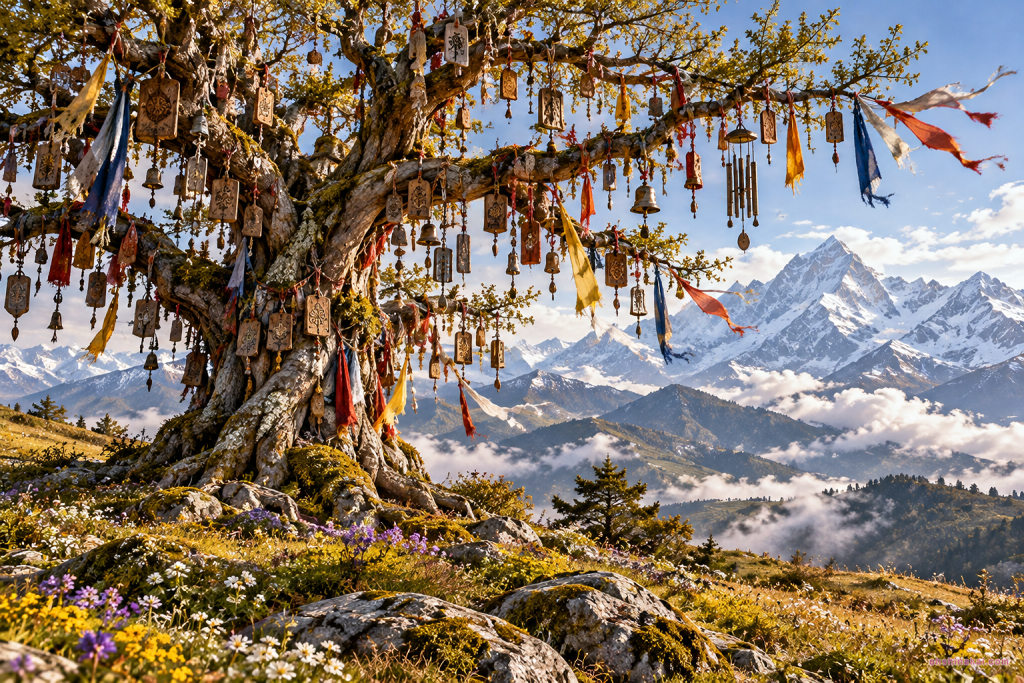
The largest tradition, followed by about 42 percent of the population, is the ancestral faith of the Dhaarikhahthu. It is animist: every river, mountain, tree, stone and animal carries a spirit, an asurya or “watcher.” It has no scripture and no clergy in the usual sense. Its shamans, the yatumat, read nature’s will to decide when to plant and when to move the herds. Its shrines are natural ones: the Skyboughs, living trees hung with talismans and wind chimes, and the Dhaivatashila, a crag that the Dhaarikhahthu believe opens onto the world of the ancestors.
Buddhism, about 29 percent, arrived over the passes from Tibet and Bhutan and settled alongside animism without displacing it. Freyjaism, about 16 percent, came east with the dark elves who left Europe after the Convocation, and grew after 1893, when Shikarapura became a founding member of the OEA and the two branches of the elvish family were formally reconnected for the first time since the Convocation. Shikarapuran Freyjaism has adapted to its new home: its Völva priestesses use Himalayan herbs and follow the monsoon calendar instead of the European one.
The three traditions don’t merge. They share space. At the Bherghvaelëmonstri, the Mountain Veil Monastery, the animist Spirit Prayer Pavilion opens directly into the Buddhist Hall of a Hundred Lanterns. At the winter Solstice of Radiance in the Sun Temple, animist chants, Buddhist mantras and Freyjaist hymns are performed one after another. Shikarapuran theology has a calm answer to the question of which faith is right: the animists call the underlying reality the asuryas, the Buddhists call it dharma and the Freyjaists call it seidr, and all three are describing something real.
Pacifism as a Way of Life
The dark elves reject violence entirely, including in self-defence. In daily life that shows up in small things. Doors aren’t locked. Elders mediate disputes. Violent crime is almost unknown.
It also shows up in the country’s history. During the world wars Shikarapura stayed strictly neutral, and it quietly sheltered Jewish refugees who crossed the Himalayan passes to reach it. They were given ghaest-rikht, the ancient elvish law of guest-right, and protected until the war ended. A small memorial garden near the Mountain Veil Monastery marks it.
Shikarapura still contributes a brigade, SHIRESP, to the OEA’s Elvish Response Force, but on its own terms. SHIRESP carries no weapons. It brings field medicine, mountain rescue, engineering and, above all, mediators, and relies on the armed brigades for its protection. Every few years someone in the National Congress asks whether a pacifist nation should be part of a military alliance at all. The answer has always been the same: staying away would leave others to decide what peace looks like.
The Land as Law
Shikarapura’s environmental policies are among the strictest in the world, though Shikarapurans would say they aren’t really policies. About sixty percent of the country is forest, and that figure has held steady for the whole of its recorded history. Snow leopards, red pandas and an endemic clouded leopard survive here because the people who share their habitat regard killing them as a spiritual offence. The Deep Elvish word for ecological balance, aerdvaedhri, translates as “the earth’s breathing.”
The same attitude shapes the infrastructure. There is no airport and almost no road network; people travel on foot, by yak and mule, or on the capital’s small geothermal trams. Small hydroelectric generators on the Nyalon Creek power the capital, supplemented by solar, and fossil fuels are close to absent. Visitors often comment that the loudest things in the city are birdsong, water and, on the right days, the Eternity Drum.
Then there is Khuvanyen, at 7,230 metres the country’s highest peak and the home of the ancestral spirits. It has never been climbed, and it never will be. To the Dhaarikhahthu, standing on its summit would be like walking on a grave.
Opening the Door, a Little
For most of its history Shikarapura kept the world at a distance by choice. That began to change with its admission to the United Nations on 21 November 1988, after a fierce debate in the National Congress. Traditionalists warned that engagement would erode what isolation had protected. Reformists argued that a nation of millions couldn’t stay invisible in a world of billions. The reformists won by a narrow margin, and the argument between openness and preservation has shaped Shikarapuran politics ever since.
The next step was the Tourism Accord of 2001. It was a compromise reached after years of national discussion, in which the Dhaarikhahthu in particular feared for their land and way of life. Its rules are strict: about ten thousand tourist visas a year, a compulsory cultural orientation for every visitor, a ban on mass tourism and luxury resorts, and a Sustainable Development Fee paid directly into conservation and local communities. Entry to the Dhaarikhahthu homeland of Dhaarikhavanheimr needs the elders’ consent, and they can withdraw it at any time.
The Experiment
Dravithon predicted in 1392 that the city elves would be undone by the humans they chose to live among. The Aldermark posts on this blog have spent several weeks tracing how much of that prophecy came true: the Morality Police, the assimilation, the crown, the long negotiation over what being elvish means inside a human Europe.
Shikarapura is the other side of the bet. Its people chose a narrow and steep path on the assumption that a people who decided for themselves how to live would endure. Three centuries in, the result is a small, slow, multilingual, multi-faith republic that refuses to grow in the way the rest of the world measures growth, and that keeps its doors unlocked.
Shikarapurans have a line they offer departing guests, and it serves as the country’s farewell: Thi aerdh haldhith thinaz namn. The earth holds your name.
Glossary of Thungalëthaur Terms
- Pharani A building meant to outlast its builders (Shikarapuran)
- Asurya A watcher-spirit; the sacred spirit in every natural thing (Shikarapuran animism)
- Ghaest-rikht Guest-right; the ancient elvish law of hospitality
- Aerdvaedhri Ecological balance; “the earth’s breathing”
- Kharnatakáthémplh The Karnathaka Sun Temple, Shikarapura City
- Bherghvaelëmonstri The Mountain Veil Monastery
- Shikarathingphlatz Shikara Square, the capital’s ceremonial centre
- Dhaarikhavanheimr Daarikavan; the homeland of the Dhaarikhahthu dark elves
- Fortkharvanbhorg Fort Karvan, the former Portuguese fortress town
- Lumaranghdhael Lumarang, the subtropical farmlands of the south
Join the conversation