Among the Frozen Peaks: The Tanaina Ht’ana of Alaska, and Elvish Rights in the Courtroom
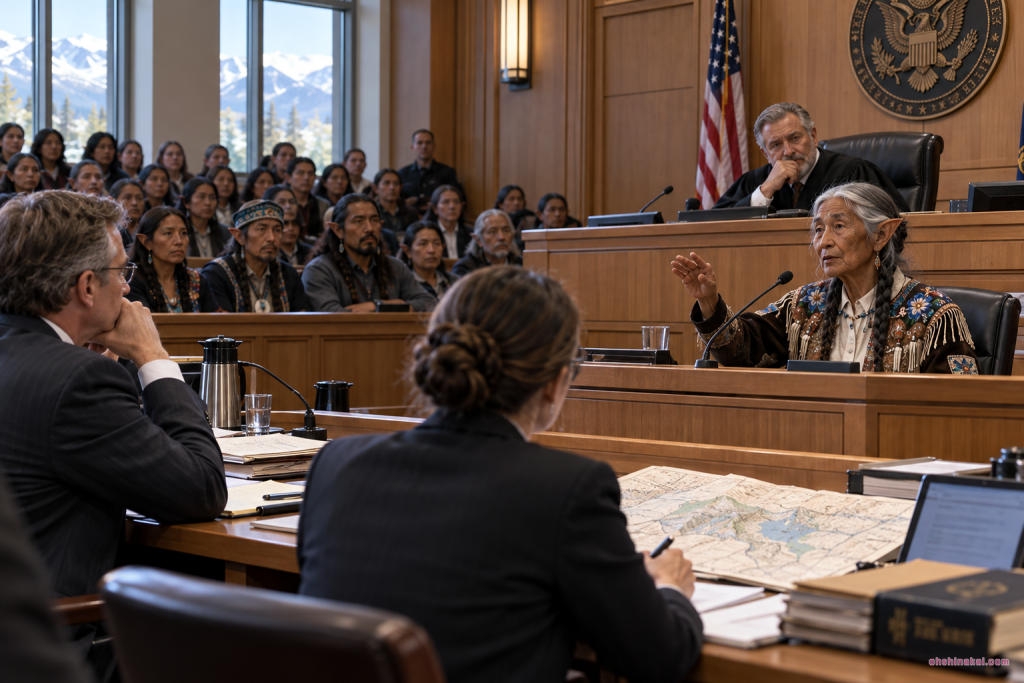
The lawyer for the oil company had prepared for a week. He had maps, survey records and a historian ready to explain what the land had been used for in 1867, when the United States bought Alaska from Russia. Then the defence called its first witness, a small, upright woman from the Kenai Mountains, and asked her what the land had been used for in 1867. She told them. She described the trapline her uncle ran along the ridge, the Russian trader who cheated him, and the American surveyors who came three summers later and got lost in the fog. The company's historian, it turned out, was not needed. The witness had been there.

The People of the Peaks
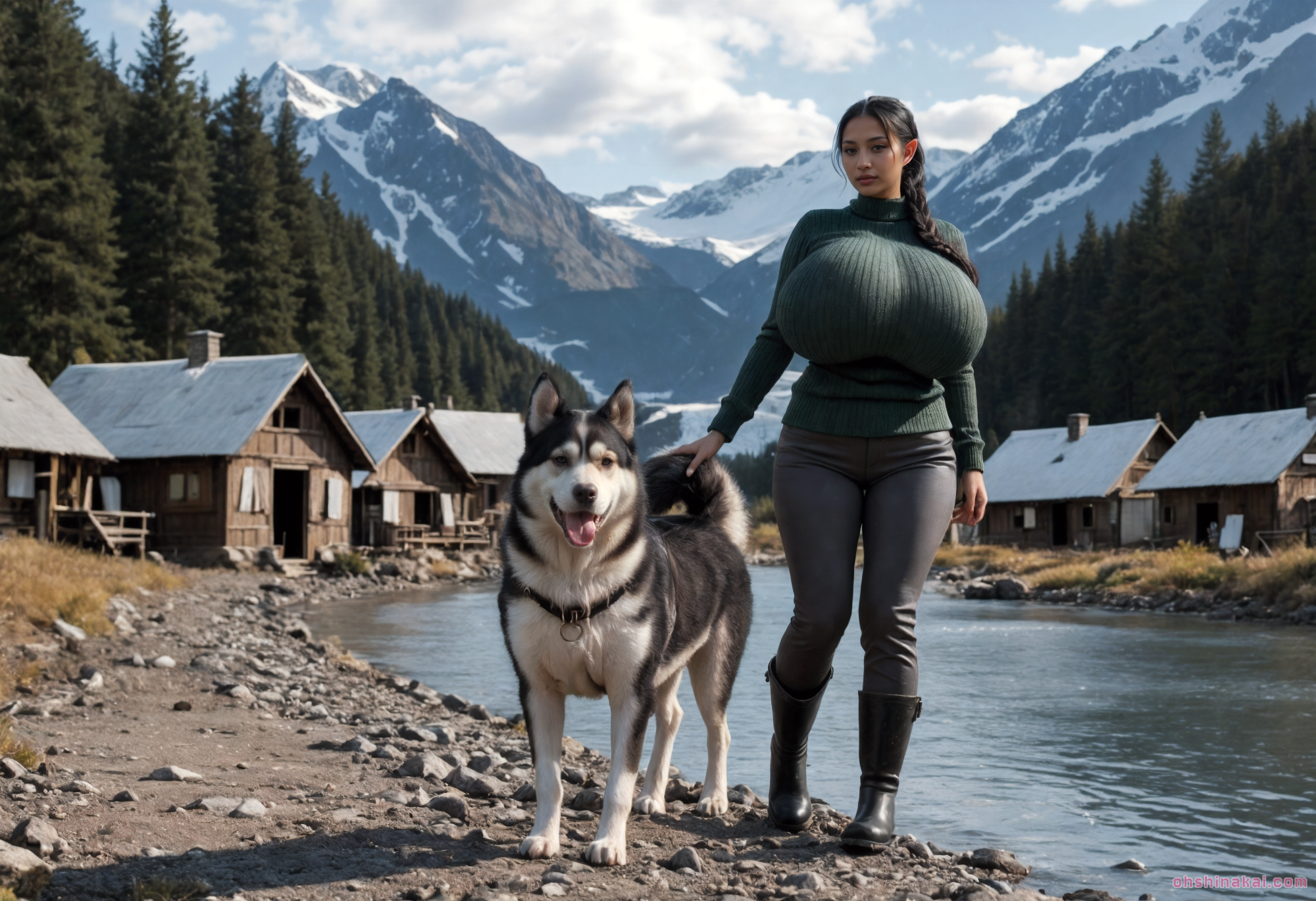
They call themselves Ht’ana, “the People.” The longer name, Tanaina Ht’ana, adds “Among the Frozen Peaks,” and that is where they live: in the Kenai Mountains of south-central Alaska, among glaciers, spruce forest and salmon rivers. There are about 2,200 of them, most living in or around a single village, Ahtna-Tikahtnu, “Stony Mountain Village,” with a few families scattered through the surrounding valleys.
The United States government classifies the Ht’ana as Alaska Natives. The OEA classifies them as an unaffiliated elvish population. The Ht’ana classify themselves as themselves, and they find both of the other labels faintly funny.
They speak Tanaina Elvish, a language of the Athabaskan family with a deep elvish layer underneath, and they speak English. They practise an animist faith of mountain spirits, salmon ceremonies and stories of Raven. They hunt, fish, guide visitors and, increasingly, manage a business empire. It is the last of these that has brought them, rather unwillingly, onto the world stage.
Before the Salmon Were Born
Ht’ana oral tradition says the People came to the mountains “when the ice was thicker and the salmon were not yet born.” Taken literally, that places their arrival before the end of the last Ice Age, when the land bridge from Asia was still open and the glaciers covered far more of Alaska than they do now. For a long time, outsiders treated the claim as poetry.
They may have been wrong to. Imagine a summer of record melt in which a retreating glacier high in the Kenai Mountains exposes a scatter of worked bone tools and a hearth, dated to around twelve thousand years ago, at an altitude no human group of that age is known to have used. It would be the oldest evidence of elvish habitation in the Western Hemisphere. Asked to comment, the Ht’ana would probably say they had mentioned this already.
How the Ht’ana relate to other elvish peoples is unclear. Their language and culture are thoroughly American, shaped by thousands of years beside their human neighbours. Their biology is thoroughly elvish: long lives, keen senses and the cold tolerance of a mountain people. Most researchers think their ancestors crossed from Asia with, or just ahead of, the first humans to reach the Americas.
Neighbours for Ten Thousand Years
For most of their history the Ht’ana’s closest relationship has been with the Dena’ina, the Athabaskan people of the Cook Inlet coast and the lowland rivers. The two peoples traded for millennia: the Ht’ana brought obsidian, mountain herbs and furs down from the high country, and the Dena’ina brought salmon, seal oil and news of the coast. Ht’ana tradition describes the relationship as one of steady mutual respect, and it has never recorded a war between them.
The two peoples share a great deal, including their language family, many of their stories and much of their way of life on the land. They remain distinct, and both are clear about it. Dena’ina elders sometimes describe the Ht’ana as “the old ones up the mountain.” Ht’ana elders describe the Dena’ina as “the ones who taught us about the sea.”
That long, quiet relationship is part of why the Ht’ana have never felt much need for other elves. They already had neighbours they trusted.
Raven, Salmon and the Mountain
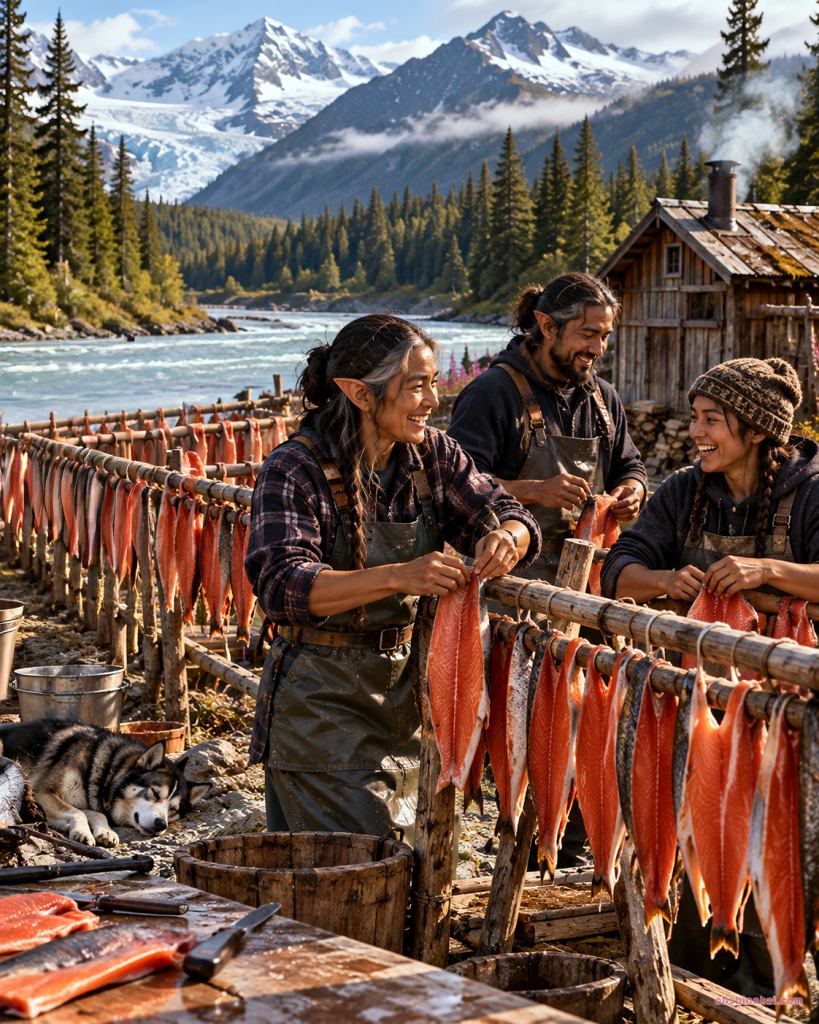
Ht’ana religion is woven through the working year. Each summer’s first salmon is welcomed with a ceremony: the fish is cooked and shared, and its bones are returned to the river so that its kin will know they were treated with respect and come back the next year. Mountain spirits are thanked at the passes, and hunters still speak to the animals they take.
Running through it all is Raven, the trickster and creator who appears in the stories of many peoples along the northern Pacific coast. In Ht’ana tellings Raven is clever, greedy, funny and often wrong, and he is responsible for a good deal of the world’s untidiness. Ht’ana children learn the Raven stories as entertainment and only later realise they are also lessons about patience, generosity and what happens to people who take more than they need.
The Ht’ana have no temples and no clergy. Elders lead the ceremonies, and some families are known for knowing particular stories or songs better than others. They have heard of Freyja, and a few Ht’ana who have travelled to Aldermark have found Freyjaism interesting. Nobody in Ahtna-Tikahtnu has felt any need to adopt it. Raven, one elder told a visiting Völva, has been quite enough trouble on his own.
Russians, Americans and Roads
Contact with Europeans came late and went badly. Russian traders reached the Cook Inlet in the eighteenth century, and their arrival brought disease, debt and violence to the coastal peoples. The Ht’ana responded the way mountain peoples often do: they moved higher and further from the trade posts, and kept their dealings with the Russians to the minimum.
The American purchase of Alaska in 1867 changed the pressure without easing it. Prospectors came looking for gold, surveyors mapped the passes, and in the twentieth century came mining claims, roads and finally oil. Ht’ana families watched all of it happen, and because elves live for centuries, some of them watched all of it personally. There are Ht’ana elders alive today who remember the Russian traders, the American surveyors and the first road into the valley.
That continuity of memory is the Ht’ana’s greatest strength in dealing with the modern world, and it is the root of the legal argument now making them famous.
A Corporation in the Mountains
In 1971 the United States passed the Alaska Native Claims Settlement Act, which settled land claims by creating native-owned corporations to hold land and money on behalf of their peoples. The Ht’ana were included, and their share became the Tsaht’ana Corporation, which now manages the community’s land, mineral rights, investments and a modest eco-tourism business.
The Ht’ana took to it with characteristic patience. The corporation is run conservatively, on timescales that baffle its human financial advisers. Elvish board members think about returns over centuries, not quarters, and the corporation has turned down several offers that would have made it rich quickly and left the land damaged for a long time afterwards.
Elvish has a word for that kind of thinking, gharavi, the debt one generation owes the next. The Ht’ana never needed the word. They have always lived as though the land would still be theirs in five hundred years, because the people making the decisions expect to be alive to see it.
The Witness Who Was There
That brings us back to the courtroom. Imagine a major oil company challenging the corporation’s mineral rights in federal court, arguing that the historical record of Ht’ana land use is too thin to support the claim. In most native-rights cases, the record would indeed be thin: a handful of documents written by outsiders and some oral history passed down through many generations.
The Ht’ana case would be different, because the defence would not need oral history. Its witnesses would be the people the history is about. An elder of four hundred could describe, from her own memory, where the traplines ran in the 1860s, which valleys her family used for which seasons, and what the Russian and American officials actually said. Her memory could be checked against the surviving documents, and wherever it could be checked, it would match.
The legal question that follows is genuinely new. How should a court weigh first-hand testimony about events two centuries old? Can the long memory of a living witness count as evidence of continuous use? Elvish legal thinking has a word for the patience such a case requires, rathivi, justice that waits, the idea that over an elvish lifetime wrongs eventually reach a reckoning. The Ht’ana would simply call it remembering.
Cautious About the OEA
The Ht’ana’s relationship with the wider elvish world is recent and careful. The OEA made its first contact in 2005. In 2012 the Tsaht’ana Corporation sent its first observer to an OEA meeting, explicitly to learn about elvish rights frameworks rather than to join anything, and it has sent delegates ever since.
Ht’ana delegates are polite, attentive and very hard to impress. They see the OEA as a European institution with European priorities: pensions, reparations, the politics of former empires. They are more interested in what other indigenous peoples are doing with land rights, treaty law and resource corporations, and they spend as much time talking to Alaska Native and Canadian First Nations organisations as to any elvish body.
Some OEA officials find this frustrating. A few have suggested the Ht’ana could do a great deal for elvish rights worldwide if they joined. The Ht’ana tend to reply that they are already doing it, in American courts, on their own land, and that they will let the OEA know if they need help.
Elves in Their Own Right
Most elvish peoples on this blog have had to choose between being elves and being part of the human world around them. The Ht’ana have never accepted that choice. They are elves, and Alaska Natives, and shareholders in an American corporation, and people of the Kenai peaks, all at once, and they defend each of those identities with whatever tool suits it best: a ceremony, a council, a balance sheet or a court case.
Their long memory has made them unusually good at it. A people that remembers the Russians, the purchase and the first road into the valley isn’t easily told by anyone what its history was. When the land is at stake, the Ht’ana don’t need anyone to tell their story. They can tell it themselves, in person.
Glossary of Thungalëthaur Terms
- Gharavi The debt one generation owes the next
- Rathivi Justice that waits; patient reckoning over an elvish lifetime
Join the conversation