After the Empire: Aldermark, the Last Elven Empire, in Its First Post-Imperial Decade
In 2018 an elderly elf died peacefully in his garden in the forest town of Elchwood. He was 847 years old. Fifteen years earlier, as Emperor Elydrian IV, he had signed the treaty that ended five centuries of elvish rule in the Alps. He had been born long before the empire he dissolved, and had lived through all of it. Aldermark is a country where that kind of life is not unusual, and where the past is still, quite literally, in the room.

An Empire Built on Merit
Aldermark was founded on 22 November 1473 by King Alberich I, in the Alpine passes where present-day Austria, Switzerland and northern Italy meet. Eighty years earlier, at the Great Convocation in the Elchwood Grove, the elves had voted to integrate with human civilisation rather than withdraw from it. The city elves who stayed in Europe went on to build the empire.
Alberich’s idea was a state run by ability rather than birth. Office was earned, not inherited, and the Hall of Merit in Kaiseringaden still stands as the ceremonial centre of that system. The early empire was confident and productive. The University of Kaiseringaden was founded in 1503 and the Great Library in 1595. The Council of Mirovia in 1615–16 was a diplomatic success that shaped Renaissance Europe. Elvish clockwork, metallurgy and agriculture spread well beyond the empire’s borders.
For 530 years, Aldermark was the most powerful elvish state on Earth.
Five Centuries, and What They Cost
Aldermark’s own telling of its history is short, and it doesn’t flatter the empire. Its summary of the later centuries is a list of costs.
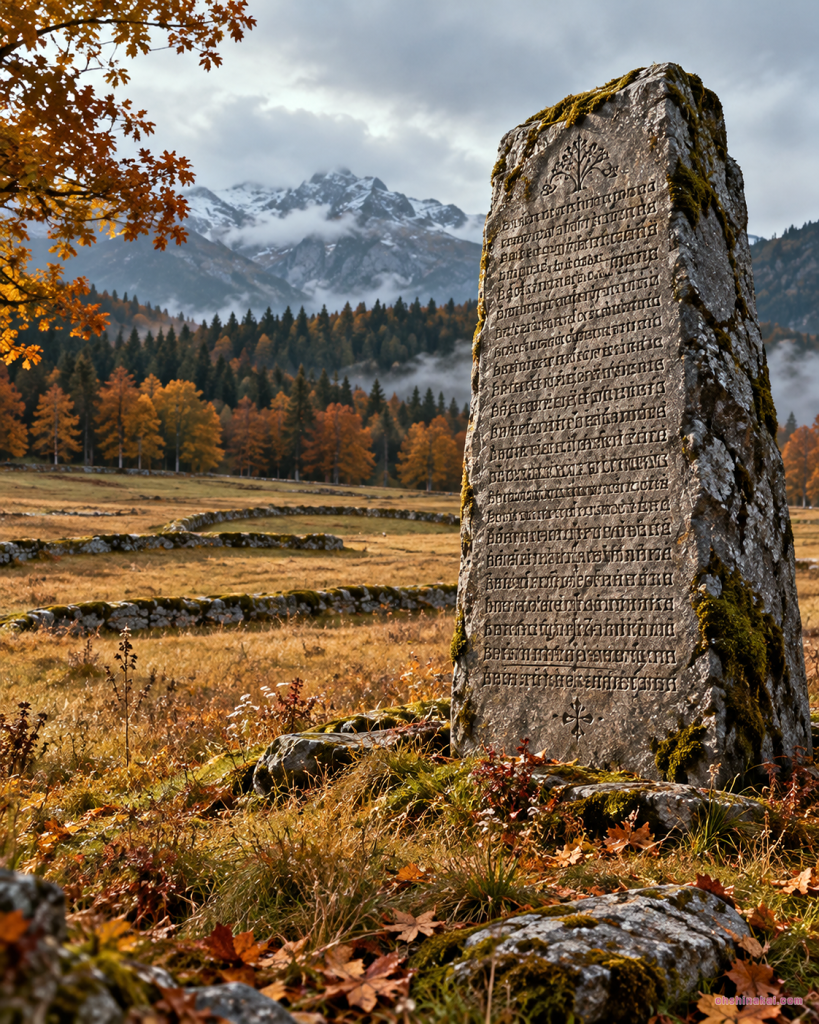
The Sapphire Rebellions of 1764 to 1778 forced the empire’s first real concessions to its human subjects. In 1810, Emperor Alberich X’s Harmony Reforms created mixed elvish-human courts, the basis of a legal system that still blends elvish traditional law with continental civil law. The Great Reclamation War of 1863 to 1866 broke the empire’s military prestige. Its worst day was at Waelfeld in October 1865, where 212 Satsangha fighters died in open ground against a Prussian column three times their number. Their names are carved on the Waelfeld Stone and read aloud every year during the Undying Brigade ceremony. The reading takes forty-seven minutes.
After the war came the forced labour programme, which still “poisons the present” and which the empire concealed for more than a century. The First World War brought occupation and the Aldermark Liberation Front. The Second brought official neutrality, and under occupation, quiet resistance. The fishing boats of Svarthavn ran a secret evacuation route to neutral Sweden, carrying refugees and cultural treasures. The village still doesn’t talk about it, but a mural on the harbourmaster’s office shows a fishing boat flying the Satsangha banner.
2003
On April 19th, 2003, Emperor Elydrian IV signed the Treaty of Eberswald and ended imperial rule. His final public words are now among the best-known quotes in Aldermark: The oak that will not bend must break. We choose, instead, to plant new seeds. The word for oak, eik, is also the root of his dynasty’s name.
He retired to Elchwood, near the grove where the elves had split in 1392, and lived there until his death in 2018. He left an unfinished history of the empire. One of its chapters is titled “The Founding Lie,” and his estate has refused to release it.
The empire ended, but the monarchy didn’t. Aldermark is now a federal parliamentary constitutional elective monarchy. The Kheladhris dynasty keeps a ceremonial role with no political power, opening parliament, appearing at the great Freyjaist festivals and representing the country abroad. Real power sits with the elected parliament, still called the Imperial Convocation, and the government is led by Chancellor Aelindhra Thornwaldh (in English, Aelindra Thornwood).
The Founding Day holiday on 22 November used to be a military parade. Now, it is a day of national reflection, with a special parliamentary session, a wreath laid at the Imperial Crypts and school assemblies on what the empire achieved and what it got wrong.
The country’s defining political question is plain enough: forced labour reparations. The archives may eventually settle it. The Great Library holds two sealed collections, the journal of Alberich XII, which opens in 2061, and the Moonveil Archive, which opens in 2460. Elves who are alive now will be alive to read the first, and some of them will be alive for the second.
Who Lives There
Aldermark covers about 83,000 square kilometres and has some 42.5 million people. About 74 percent are elvish, 18 percent German, and the rest Swiss and other minorities. Kaiseringaden, the capital, has around 2.5 million. Elvish and German are spoken interchangeably, with Italian in the south. Freyjaism is the faith of nearly 80 percent of the population.
The currency is the Aldermark thaler. The country isn’t part of the European Union or the Schengen Area, though it has entry agreements with most Western states. It has its own calling code, +429, and its own internet domain, .ah.
The most important demographic fact isn’t in any table. Aldermark is home to two species with very different lifespans living side by side. Visitors are often warned about it in one line: the elf pouring your wine may have personal memories of the Napoleonic Wars. In some households, the oldest member remembers the thirteenth century.
A Country in Places
Aldermark is easiest to understand through its places.
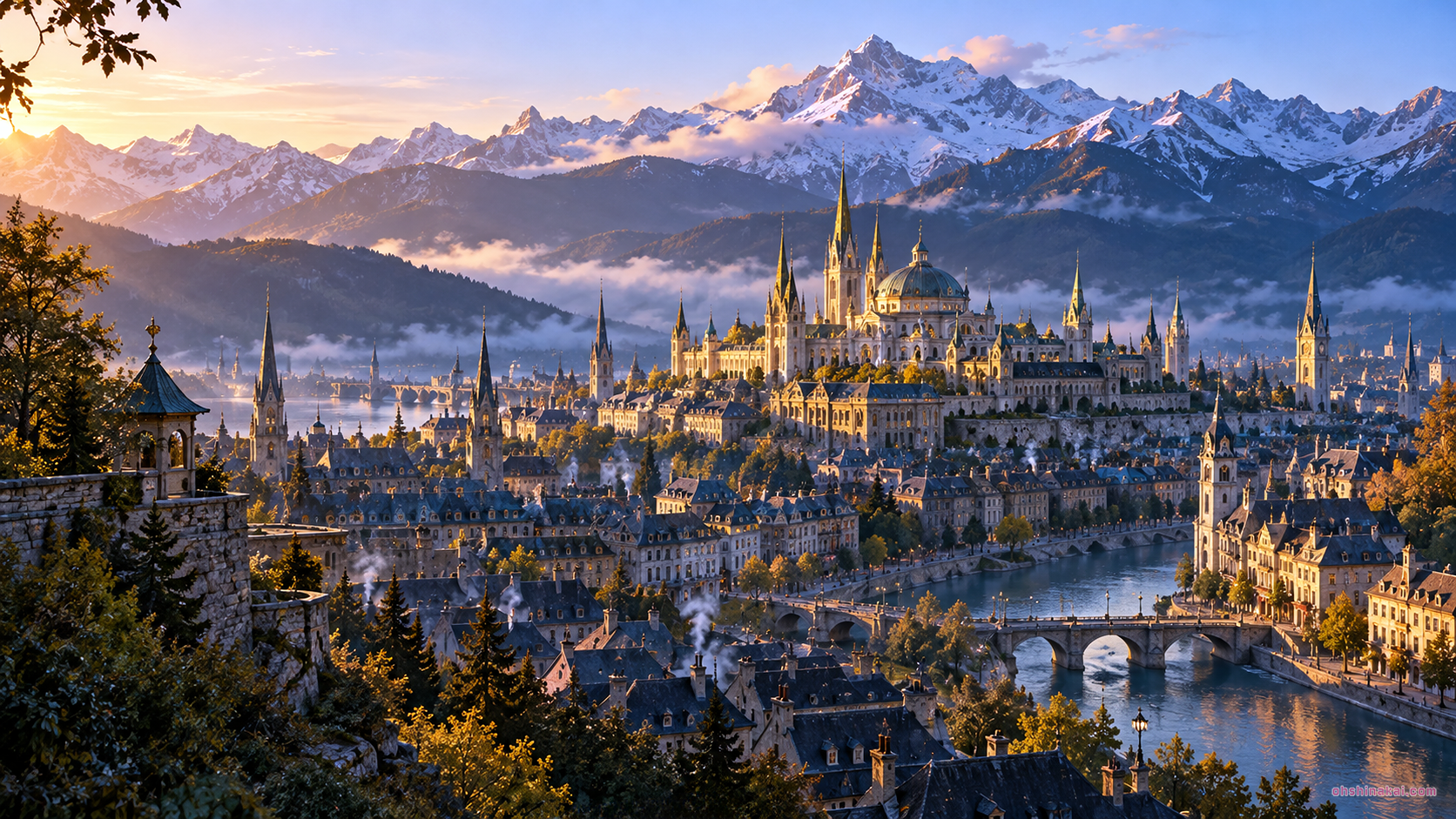
Kaiseringaden, the “empress’s enclosure” (Khaisarigadhen), is laid out in rings around the Imperial Palace, under which every ruler from Alberich I to Elydrian IV is buried. Around it lie the Government Quarter, the University Quarter with the Great Library, the pre-Renaissance Old Market, and the International Quarter, home to the headquarters of Avant, UAME and Ainsworth.
Salzheimen, the second city, is more industrial and more elvish-internationalist. The OEA was founded here in 1893, after the Pan-Elvish Congress of 1888, and the Halls of the Silver Grove are the largest Freyjaist temple complex in Central Europe. Its Saturday market is the best place in the country to buy cheese.
Gaelborg is, as Aldermarkers put it, the empire’s fist where Kaiseringaden was its mind. It is a concentric fortress city of forges with no Freyjaist ornament anywhere, now reinvented as a centre of precision engineering. The old Schattenkrieger training grounds are a military museum. Ealda, where the Reclamation War began, is home to the Aldermark Reclamation Authority and a partly restored Prussian governor’s residence that is now a museum of occupation.
Beyond the cities, the country opens out. The Strómgröin, the great green river, is tinted by minerals and held by Freyjaist tradition to be Freyja’s living blood. Lindheimen has a great linden tree said to have been planted by Empress Sylvania I. Gröinthal has the warmest valley and the oldest vineyards. Isarnborg, the iron fortress, has never been taken. Along the northern border run the seven watchtowers of the Thurmwacht, which once relayed messages by mirror and fire faster than any human postal service of their age.
Faith in Daily Life
Freyjaism shapes the Aldermark year. Its four great festivals follow the sun: Vetrnaetr at midwinter, Vaerblót at the spring equinox, Mithsúmar at midsummer, and Haustblót with the Ernthae harvest festival in autumn. The most solemn date is Fríthsnaetr, the Night of Fólkvangr, when families speak the names of their dead aloud, on the belief that a name spoken is a soul sustained.
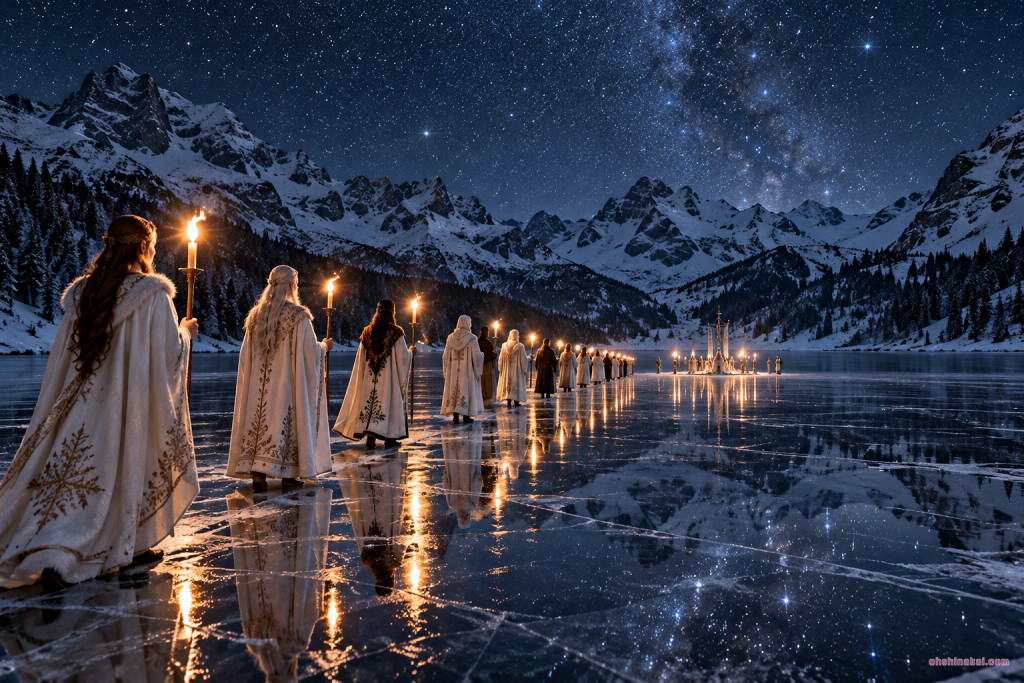
The oldest continuous Freyjaist ritual in Aldermark happens at Mánasë, a glacial lake at 2,200 metres so clear that on calm nights it holds a second sky. At midnight on the winter solstice, the High Völva leads a torchlit procession across the ice and lowers a garland of winter herbs through a hole cut at the centre. In three of the past ten years, the ice was too thin to walk on.
Freyjaism also explains something that surprises many visitors. Freyjaist theology treats the body as sacred, and elvish culture has no concept of modesty in the human sense. Elves may dress revealingly at temples as an act of devotion, and at the Mithsúmar River Washing they bathe in the Strómgröin however their local custom prefers. The advice to human visitors is brief: you aren’t expected to follow suit, and you are expected not to stare.
The faith’s priestesses, the Völva, train for fifty to a hundred years before consecration. Their choir, the Galdrakhór, sings with overtones human voices can’t produce. Listeners describe feeling it in their teeth.
The Country the Dark Elves Didn’t Leave
Not every dark elf went east after 1392. In a deep valley called Thaurthal, reachable only through the Gorvald pass, a small community stayed. They chose neither integration nor withdrawal, but solitude. They keep their own dialect and their own form of Freyjaism, trade a little in herbs, leather and carved stone, and are equally uninterested in the politics of Aldermark and of Shikarapura. Their valley gets less than six hours of direct sun a day, even at midsummer.
They are a reminder that the choice made at Elchwood had more than two outcomes, and that Aldermark has always held more kinds of elf than its official histories admit.
The Elvish Model
Aldermark’s economy follows what it calls the Elvish Model: sustainable craft production combined with a selection of modern industry. In practice, that means a handmade Lauftenhagen clock costs what it does because its maker has spent centuries learning to make it. It means cave-aged Mondkäse (moon cheese), matured for at least twelve years, with the best wheels kept for fifty. It means silver mines in Silbargaden that have been worked since the 1500s without scarring the hills around them, and vineyards in Gröinthal whose vintners measure their careers in centuries.
The modern side is real too. More than 80 percent of the country’s electricity comes from hydropower, the trains run on it, and the International Quarter holds the head offices of an insurer, a chipmaker and an airline group. Seen from the ground, they form one picture: a bus that runs on water through a mountain pass, past a fortress that has stood for five hundred years.
Things Nobody Can Explain
Aldermark also has a set of mysteries that locals mention almost in passing.
The headwaters of the Strómgröin have been moving deeper into the mountains for fifty years, and hydrologists can’t say why. The mineral content of Steinbrunni’s spring water shifts slightly at each solstice. Inside the Völva fortress of Frithálborg, the canopy of the Rootmother’s Grove shows up on satellite images as denser and greener than the forest around it all year round; the Völva have refused every request to study the soil. In the lowest level of Isarnborg, sealed since the Napoleonic Wars, there is said to be a weapon designed in the 1480s and never used because it was considered too terrible.
The biggest mystery of all is Ylvar Garth, the lost sacred grove where Ylva the Rootmother is said to have founded Freyjaism around 200 CE. Every Freyjaist temple in the world traces its lineage there. Nobody knows where it is, and the Völva have never confirmed it was a single physical place.
The Same Postcode
One description of the country fits it well: a land where the mythic and the mundane share the same postcode. Aldermark is a former empire learning to be an ordinary democracy, with an unusual problem: many of the people who ran the empire are still alive, still voting, and still remember why they made the choices they did. It is trying to build something better, and it has more time to get it right than most countries, along with longer memories of what went wrong.
Glossary of Thungalëthaur Terms
- Khaisarigadhen Kaiseringaden; “the empress’s enclosure”
- Strómgröin The great green river; Freyja’s living blood in Freyjaist tradition
- Mánasë The moon-lake; site of the Vetrnaetr procession
- Vetrnaetr The midwinter solstice festival
- Vaerblót The spring equinox fertility festival
- Mithsúmar The midsummer solstice festival
- Haustblót The autumn equinox harvest thanksgiving
- Ernthae The great harvest festival at Lindheimen
- Fríthsnaetr The Night of Fólkvangr; the annual remembrance of the dead
- Völva A Freyjaist priestess
- Ylvar Garth The lost sacred grove of Ylva the Rootmother
Join the conversation