
Illiax: The Temple City of Abakax and the People Who Worship the Void


"The world calls our god a hunger. We call our god honest. The world has decided this is the offensive thing about us. We disagree."
— High Priest of Abakax, sermon recorded by a captured Cordellian missionary
A Kingdom That Worships What the World Fears
In the southeastern reaches of Mystaria, where the Tropics give way to deep primeval rainforest and the maps of most cartographers go vague, lies Illiax, a shadowed, ancient realm where the rainforest is both cradle and crypt, and where the Illiaxu people walk in awe and terror beneath the gaze of a dark, hungry god.
At its center rises the Temple City of Abakax, a monument to devotion, fear, and the power of the Void, an unsleeping heart in the unending jungle night.
Illiax is the kingdom most other Mystarian nations refuse to formally recognise. It is the kingdom whose name is spoken with averted eyes in Verdanian temples and with open hostility in Cordellian academies. It is also, by every metric that can be measured, a functioning society, with its own laws, customs, agriculture, art, and continuity: it just worships the wrong thing.
The Void Wanderer
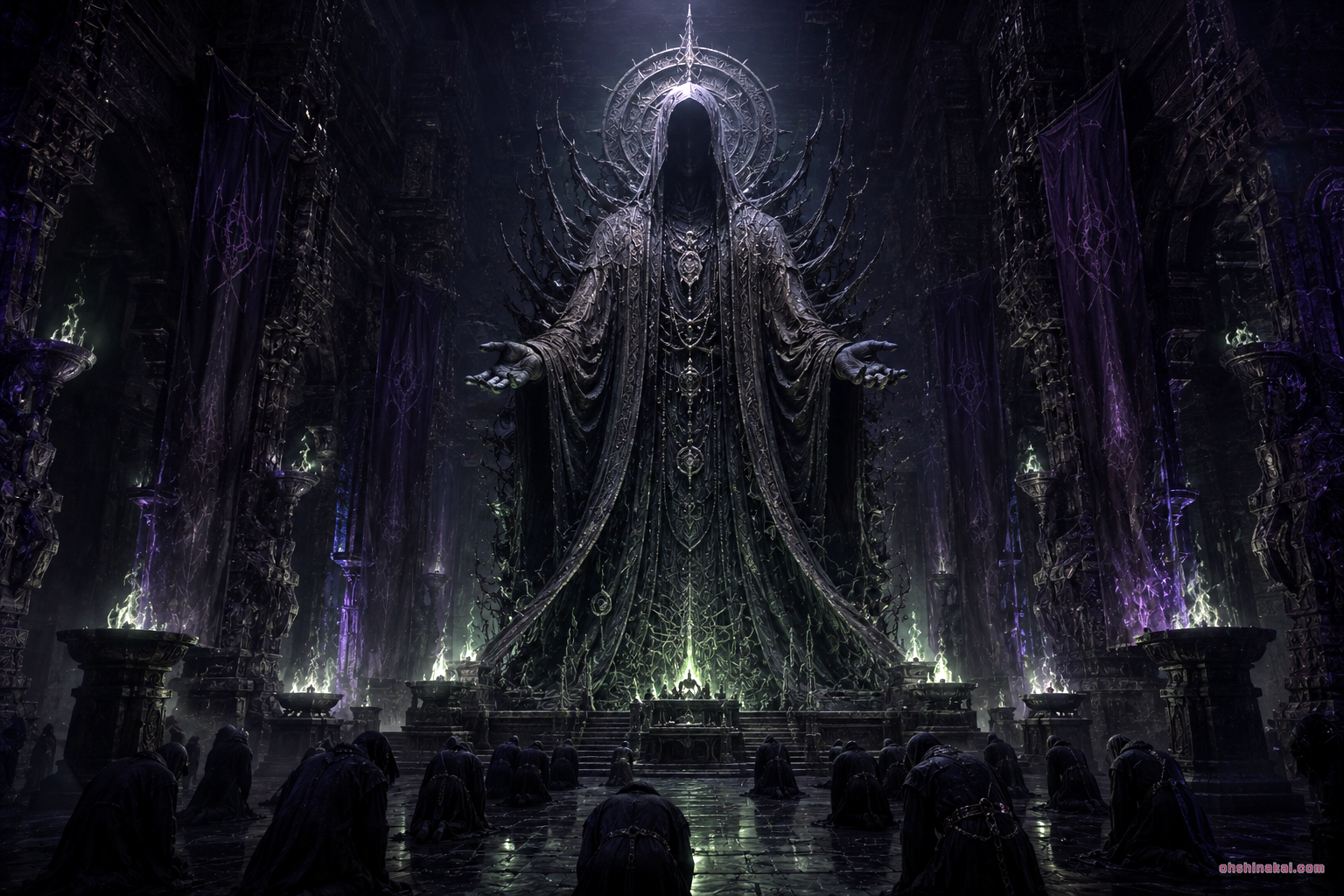
The deity at the heart of Illiaxu faith is called the Void Wanderer, a being that the rest of Mystaria's theologians universally identify as an emissary or aspect of the Hungry Void itself. The Illiaxu reject this identification. To them, the Void Wanderer is a god, one who walks the edges of reality, who hungers honestly, and who deserves the same reverence other peoples give their own divine figures.
The faith holds that:
- All things must eventually return to the silence from which they came
- Worship of the Void Wanderer is the only honest worship, because it acknowledges the truth other faiths suppress
- The Wanderer's hunger is not malice but purpose, the necessary return of existence to its proper resting state
- Illiaxu are not trying to hasten the unmaking; they are trying to walk alongside it without fear
This last point is what most outside theologians refuse to engage with. The Illiaxu insist their faith is contemplative, not apocalyptic. They are not trying to end the world. They are simply living in accurate relationship with the truth that the world will end.
The rest of the continent finds this unconvincing.
Daily Life in the Jungle
Outside the temple complex, Illiaxu life is surprisingly normal. They farm. They fish in the deep rainforest rivers. They build wooden longhouses adapted to the constant wet heat. They raise children. They tell stories. They have their own poetry, their own pottery traditions, and their own elaborate festivals: most of which involve fire, ritual silence, and the burning of small symbolic offerings to the Wanderer.
Visitors who survive their first weeks in Illiax, most do, contrary to the lurid stories told elsewhere, usually report that the Illiaxu people are quiet, polite, and unusually thoughtful. They are not, as a rule, fanatics. The faith is woven into daily life the way other peoples' faiths are: as background, not crusade.
The temple priesthood is more intense. The priests of Abakax are, by all accounts, sincere. They do not hide what they believe. They do not apologise for it. They do conduct rituals that involve voluntary self-erasure, devotees who give parts of themselves (memories, emotions, sometimes physical features) to the Wanderer as offerings. The rituals are deeply controversial. The Illiaxu insist they are consensual. Outside observers note that "consensual" is a complicated word inside a theocratic society.