Who Tells the Elvish Story: A Map of the Aldermark Press

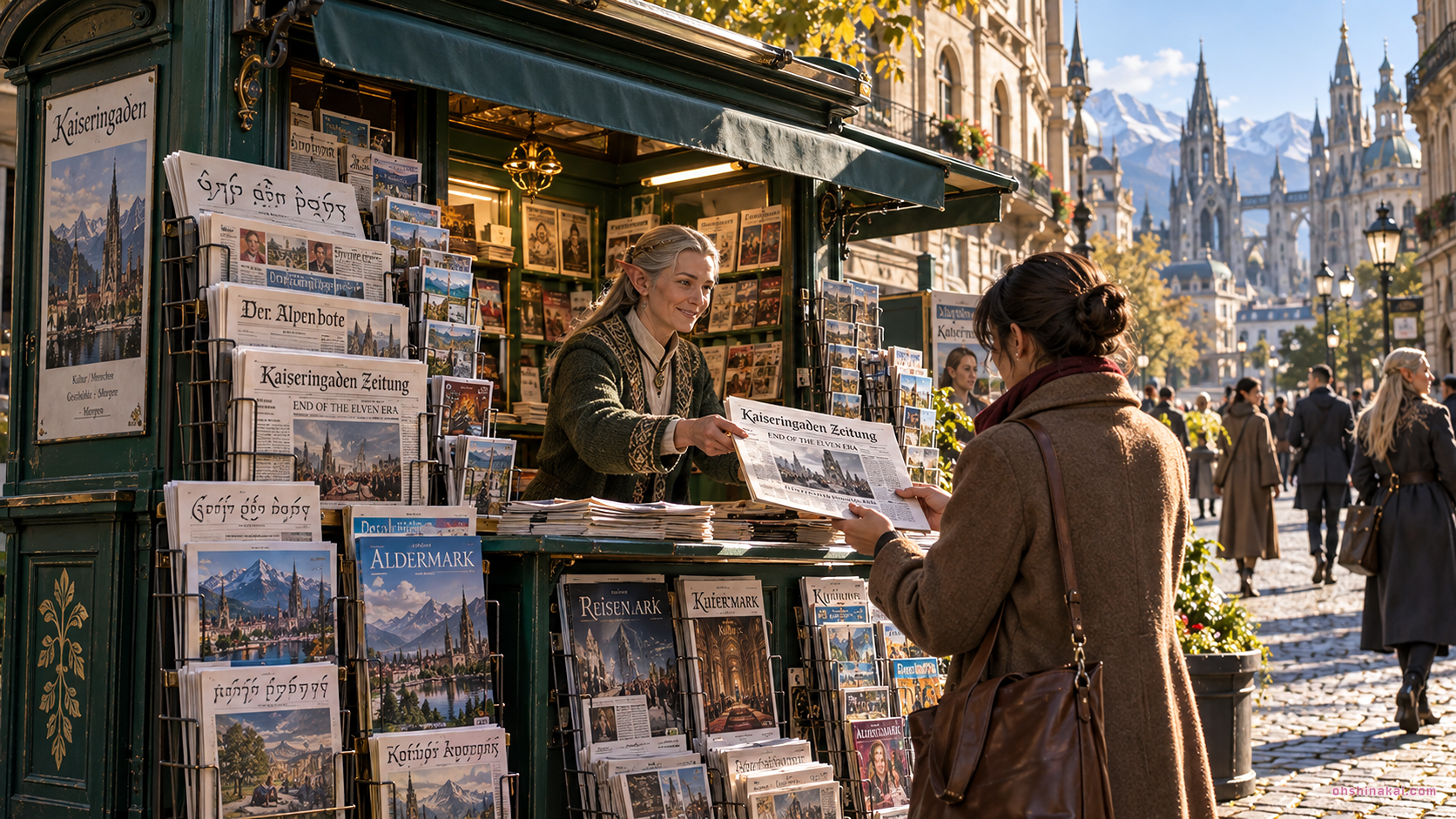
The Elvish Wall Movement listed accurate news among its demands. Its activists were tired of reading heavily edited official accounts of their own lives. Fifty years later, Aldermark has one of the busiest presses in Europe: a conservative broadsheet older than most human newspapers, a public broadcaster, a free tabloid, a far-left website the government calls hostile, a youth portal with millions of readers, and the oldest popular science magazine still in print. Who owns them, and what they choose to say, is a good guide to who has power in Aldermark.
The Old Guard
Two titles define Aldermark’s traditional press.
The Daily Sylvan
Founded in 1795 by Vildhe Sleigh as The Daily Sylvan & Courier, it is Aldermark’s conservative national daily broadsheet. It is published in Kaiseringaden by the Alpen Press Group and distributed internationally, and most people call it simply The Sylvan.
In 1795 the Morality Police had been operating for four centuries, and an elvish newspaper had to work within the moral laws of its time. The Sylvan did, and for most of its history it was the newspaper of the establishment: the imperial court, the senior guilds, the Freyjaist hierarchy. It defended the monarchy throughout the twentieth century and argued for the ceremonial crown after 2003. It is still the paper an Aldermark minister reads first in the morning, and the one human diplomats read to understand what the elvish establishment is thinking.
Kaiseringaden Zeitung
One of Aldermark’s largest dailies, with its own correspondent network and the widest circulation abroad of any elvish newspaper, its editors claim it reaches 120 countries. Its editorial line isn’t set by a single editor but cooperatively by several, an arrangement elvish journalists describe as very Aldermark: slow, consensual and hard to bend in a hurry. It is owned by Lunar Media Communications, which has ties to the imperial government, and that ownership is the main thing its critics talk about.
Lunar Media: The Group in the Middle
Lunar Media Communications (Mánabodhschaft) is Aldermark’s dominant bodhshafthgruphae, media group. It was established in November 1998 by the former French politician Marianne Decourtin and the technology entrepreneur Tereza Grandrett, who has been its chief executive since 2009, and it is based in Kaiseringaden, London and Paris.
Its reach is wide. Besides the Zeitung, it owns:
- The Moon, Aldermark’s first national free daily tabloid, aimed at white-collar workers and urban young people;
- the Aldermark Daily, the country’s first private bilingual tabloid;
- Scientific Elvish Mind, the oldest continuously published magazine in Aldermark;
- A stable of digital brands covering technology, news, sport, gaming, food, property, business, fashion and relationships.
Lunar Media is the clearest example of a pattern media critics worry about everywhere: a few companies owning most of what people read. In Aldermark that pattern has an extra edge, because Lunar’s links to the imperial government (and The Moon‘s description as part of the state-owned Aldermark Media Services) blur the line between a private publisher and a state one. After 2003, with the monarchy reduced to a ceremonial role, those ties came under sharper scrutiny. Lunar’s defenders point out that the Zeitung‘s cooperative editorship makes it hard for any owner to dictate coverage. Its critics point out that it doesn’t need to, if the editors are chosen well.
The Public Broadcaster
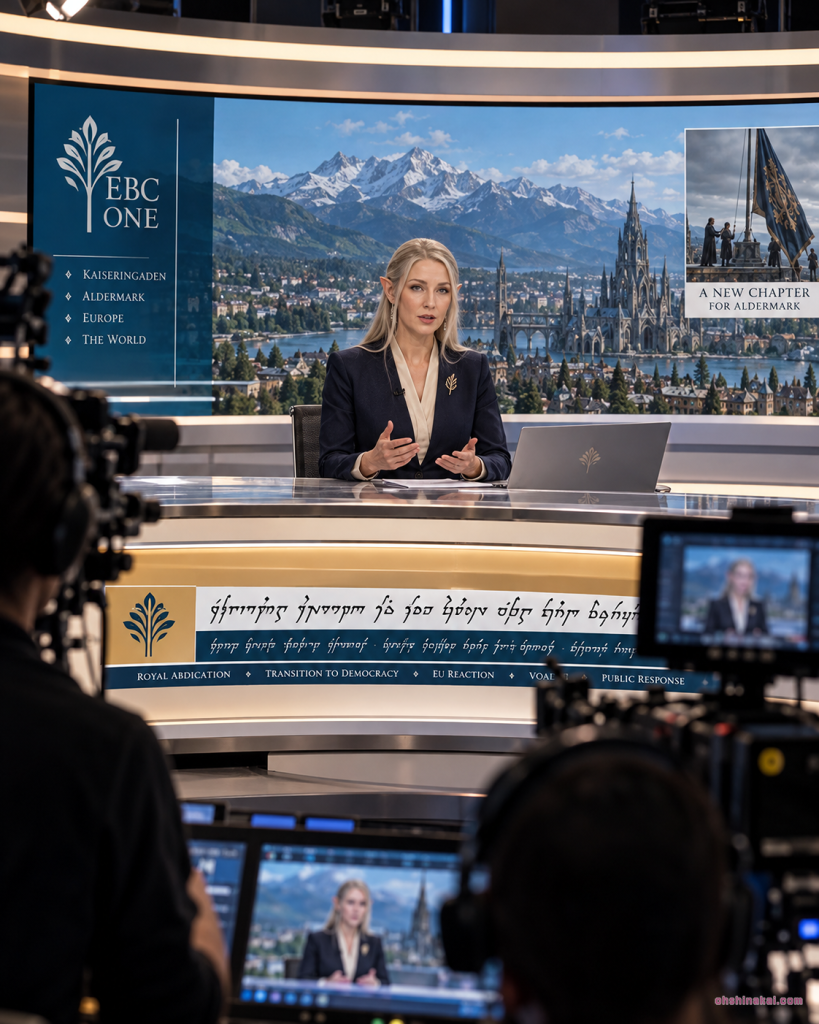
The Elvish Broadcasting Corporation, branded EBC in English and Radio-Elvish in its Elvish-language services, is Aldermark’s government-owned public broadcaster and its largest media organisation. It is an associate member of the European Broadcasting Union.
It runs a full set of services. On radio there is a public-affairs channel, a cultural channel with radio drama, 24-hour news, sport and weather, a youth channel and EBC Classic, which plays classical and traditional elvish folk music. On television there is EBC One with The Daily Report at 17:00 and 18:30 and the longer Current Events at 21:00, EBC Two for documentaries, debate and drama, and EBC Hullabaloo for young children. Online it has EBC Play and EBC Sounds.
The EBC’s biggest role may be linguistic. Its Elvish-language services are one of the main reasons Thungalëthaur is still a living everyday language rather than a ceremonial one. Its English-language services are how most of the outside world hears Aldermark explain itself. Like public broadcasters everywhere, it is accused of bias from every direction: too close to the government by the left, too cautious about the crown by the Liberation Movement, too sympathetic to reformers by The Sylvan.