Fifty Minutes from Sylt: Aldø and the Oldest Temple in the Elvish World

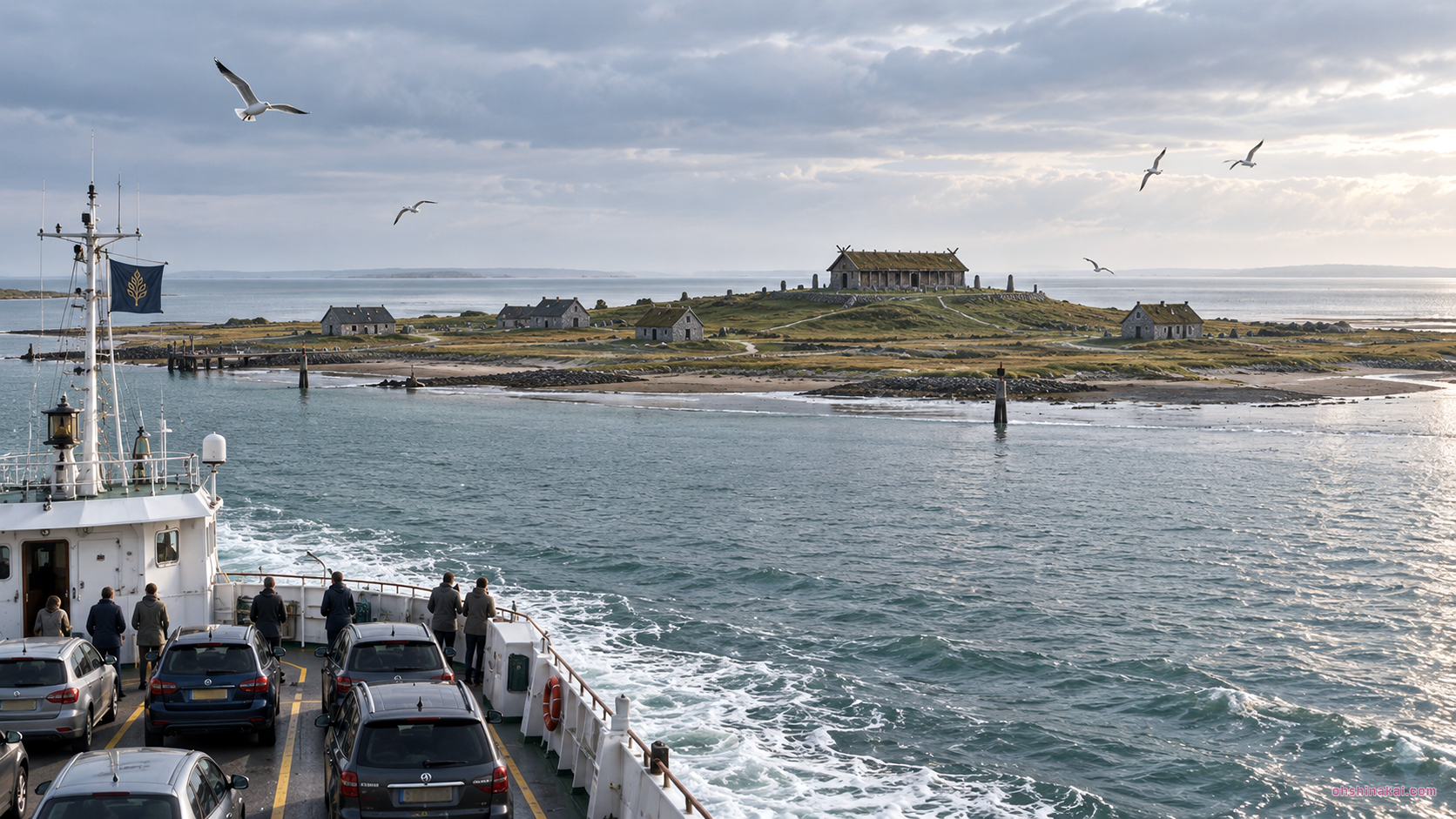
The car ferry from the German island of Sylt runs every hour and takes about fifty minutes. The island comes up slowly through the North Sea haze: flat, green and unremarkable. There is no skyline and no harbour crane, nothing to suggest that this patch of grass in the Wadden Sea holds the oldest working temple of the elvish world’s largest faith. You see the temple only when you’re close enough to hear the gulls on its roof.
A Small Island with a Long Memory
Aldø, Aldhøinsal in Thungalëthaur, is a Danish island in the Wadden Sea, governed by a municipal council under Danish sovereignty. It covers about 135 square kilometres of salt marsh and dune grassland, and 478 people live there. Its one settlement, Dhania, is a small cluster of low stone buildings. Its languages are Danish and Elvish, and most of its people are Freyjaist.
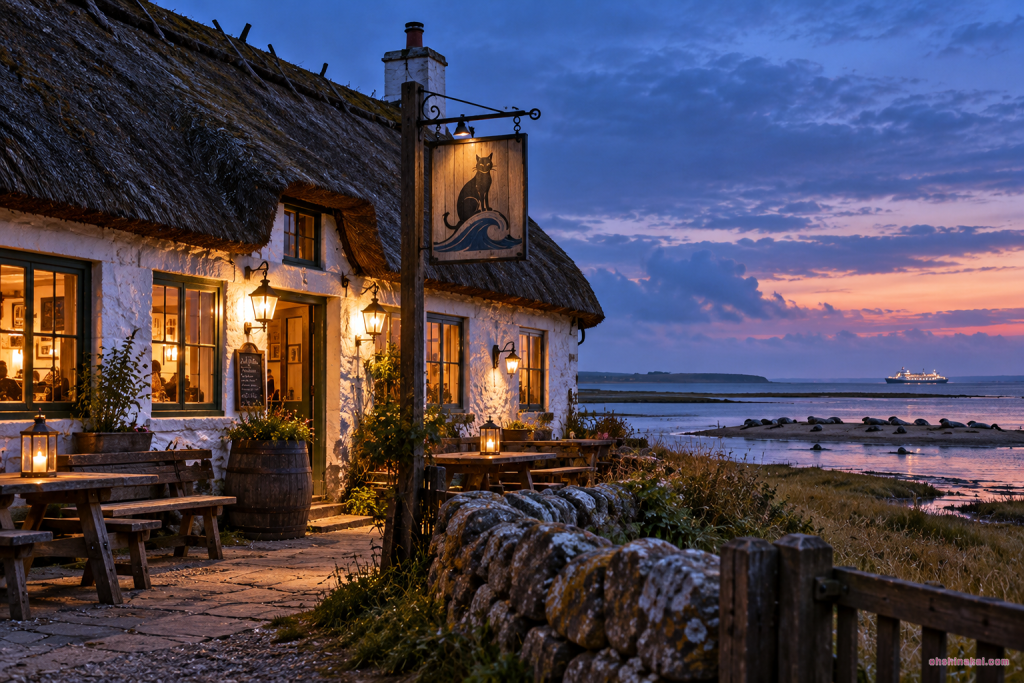
There is one school, one shop, one pub and one ferry terminal. The pub is the Sea-Cat, Marisaekhatta, named for Freyja’s sacred animal. Accommodation is limited to a handful of guesthouses, on purpose. The waters around the island are protected wetland, home to migratory birds and grey seals.
The residents are a mix of elvish families with centuries-deep roots on the island, Danish fishing families, and Freyjaists from across Europe who have retired here to live near the faith’s oldest sacred site.
The Halls of the Eternal Dawn
On the island’s single slight rise stands the Ewigorinnhállar, the Halls of the Eternal Dawn. It is the oldest continuously operating Freyjaist temple in the world. Nobody has written records of its founding. Oral tradition says it was built within a generation of Ylva the Rootmother’s formalisation of Freyjaism around 200 CE, which would make it roughly eighteen centuries old.
The name itself is a compound of German ewig (eternal), the native elvish orin (dawn, the first light before sunrise) and -hállar (halls). It is one of three co-equal seats of the Freyjaist Convocation, alongside the Halls of the Silver Grove in Salzheimen and the Karnathaka Sun Temple in Shikarapura. Every five years, when the Convocation’s leaders gather at the Elchwood Grove for the Aethalmót, Aldø sends its delegates beside the two great temples, as an equal.
Its tradition is the smallest of the three and historically the most important. Aldermark Freyjaism has been shaped by five centuries of empire and modern life. Shikarapuran Freyjaism has blended with animism and the monsoon calendar. Aldø keeps what is generally taken to be the form closest to the original Norse worship: older, plainer and less changed.
Names on the Benches
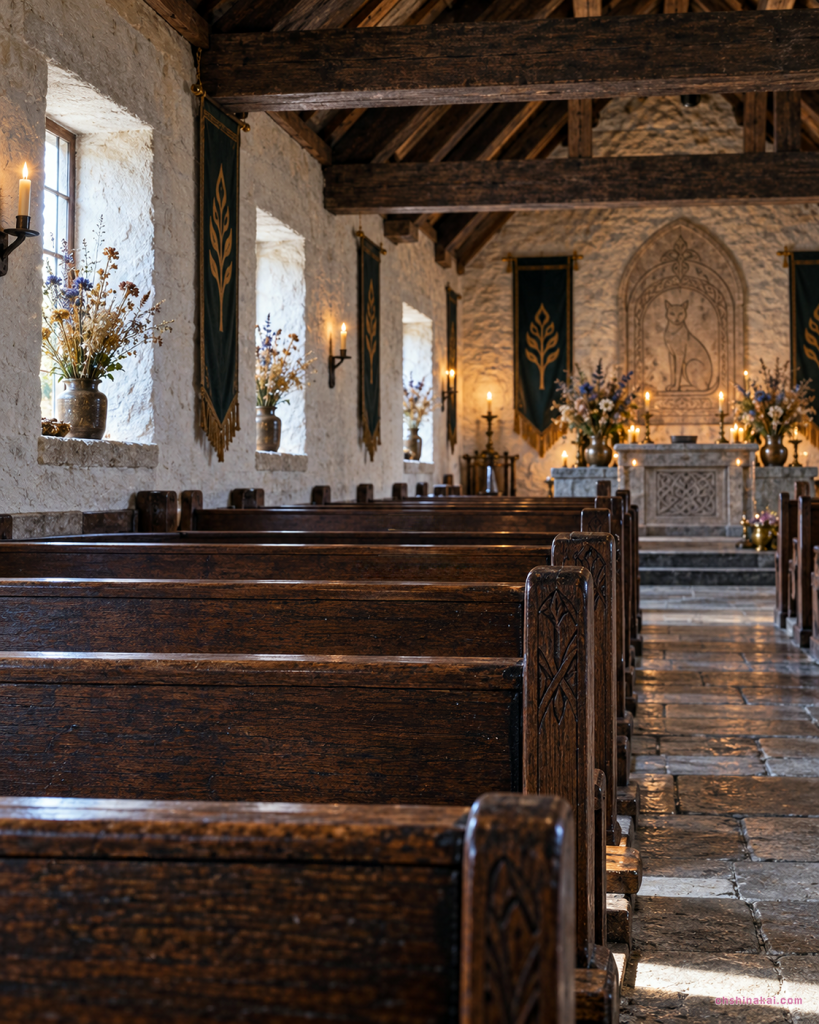
One of Aldø’s best-known customs began as a way to raise money. In the eighteenth century the temple started selling nameplates for its benches. Families paid to have their names fixed to a pew, and the money kept the building in repair.
Nobody planned it, but the result is one of the most remarkable records of continuous worship anywhere. Families whose names were put on benches in the 1700s still attend services and still sit in the same places. For elvish families, the person sitting on the bench may be the same person whose name went on it. The benches are a family register, a parish record and a small piece of living history, all in timber and brass.
The Keeper of the Dawn
The temple’s presiding priestess has a title of her own: the Keeper of the Dawn. She is always a Völva of great age, a priestess who has chosen to spend the last part of her life tending the faith’s oldest site.
That choice fits the elvish life cycle described earlier in this blog. A Völva trains for fifty to a hundred years before consecration, and she may serve for many centuries after. For some, the final calling is Aldø: a small island, a low stone temple, the sea in every direction, and a congregation whose grandparents’ names are on the benches.
What Lies Beneath
Aldø’s quiet was recently interrupted. During drainage work under the Ewigorinnhállar, workers broke into a chamber that predates the temple by centuries. It contains carved stones in a script that no living scholar can read. The script resembles the Theronic Marks, the runic writing that Theron Half-Tongue standardised in the ninth century, but it is not the same. The Keeper of the Dawn sealed the chamber and informed only the Freyjaist Convocation.
That might have been the end of it, except that the Danish construction workers who found it talked. A linguist at the University of Copenhagen then noticed that the script shares structural features with something recorded 8,000 kilometres away: fragments of chanting from the Bakasura Islands in the Bay of Bengal, which contain words from an elvish dialect extinct for three thousand years.
If the two are connected, it raises a question Freyjaism finds uncomfortable. The faith’s story of itself begins in Scandinavia, with Ylva and the grove of Ylvar Garth. A chamber older than the oldest temple, linked to a tradition on the far side of the world, suggests that the oldest elvish spiritual tradition may have begun somewhere else entirely. The previous post in this series looked at that possibility from the Bakasura side. From Aldø it looks like a secret under the floor of the faith’s founding house.
The chamber remains sealed. The Convocation has said nothing in public.
A Pilgrimage by Car Ferry
Aldø’s appeal to visitors is how ordinary the approach is. You don’t climb a mountain or cross a desert to reach the faith’s oldest temple. You catch an hourly ferry from a German holiday island, drive off onto a flat green island, park near the shop and walk up a seven-metre rise.
Elvish pilgrims who make the trip often say that is what makes it moving. The Ewigorinnhállar doesn’t announce itself. It has been holding services in the same low building on the same small rise for something like eighteen hundred years, for families who sit where their names were put three centuries ago, and it has never needed to be anything other than what it is.
Glossary of Thungalëthaur Terms
- Aldhøinsal Aldø Island
- Dhania Dania, Aldø’s settlement
- Ewigorinnhállar The Halls of the Eternal Dawn; the oldest Freyjaist temple
- Orin Dawn; the first light before sunrise
- Marisaekhatta The Sea-Cat pub; named for Freyja’s sacred animal
- Völva A Freyjaist priestess
Join the conversation