Oesterheim: Where the Wind Is the Only Netural Party

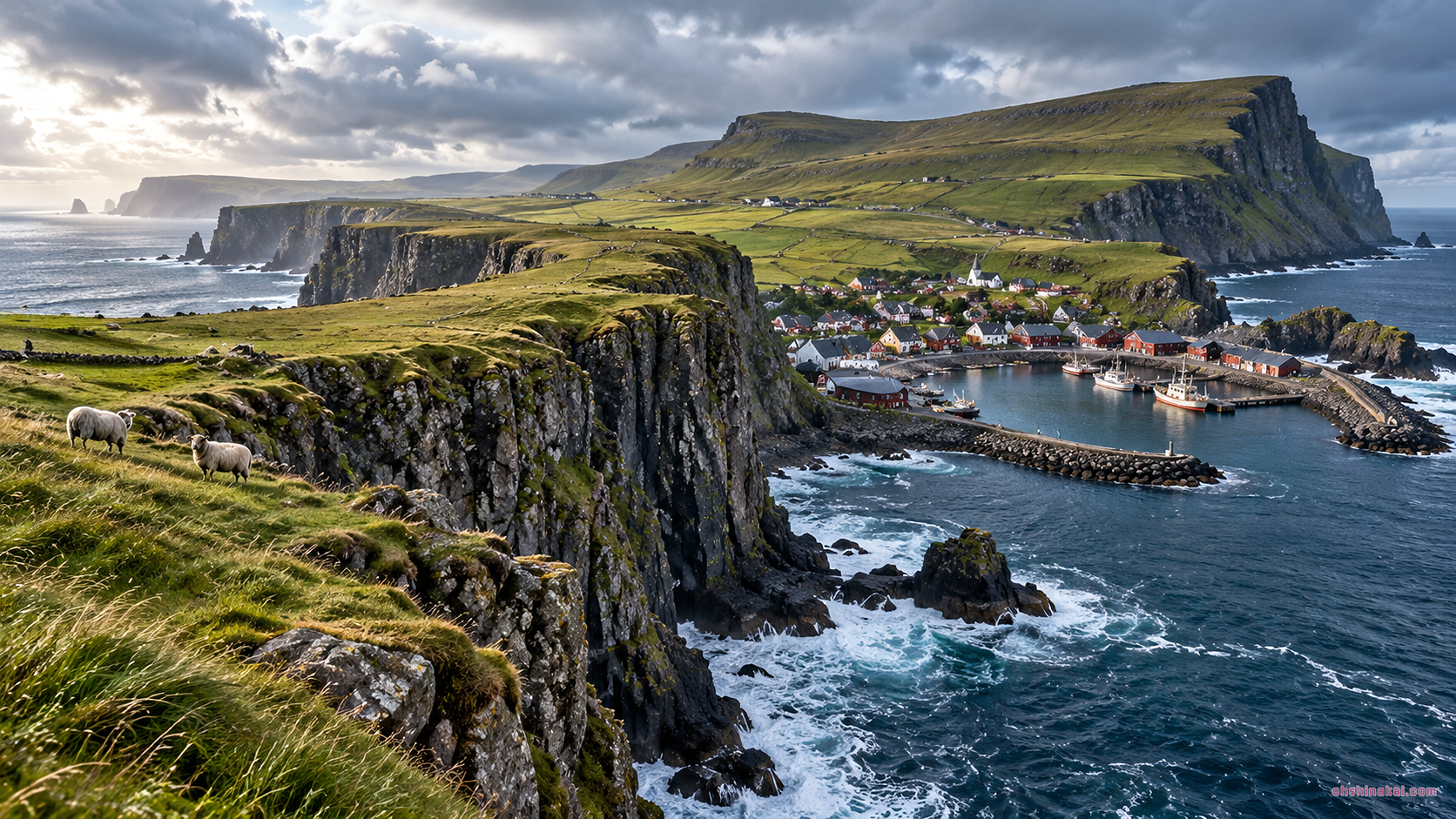
The wind never stops on Oesterheim. It comes off the North Atlantic with a patience that makes elvish patience look hasty, and it was shaping these islands before the elves came, before the Norse came, before anyone came. It doesn’t care whom you pray to; it will take your hat regardless. Islanders like to say it is the only truly neutral force in the elvish world.
An Archipelago at the Edge of the Map
Oesterheim, Oesterheiminsuln in Thungalëthaur and Østerheim in Norwegian, is an archipelago in the North Atlantic about 540 kilometres northwest of Norway. It is an autonomous territory of the Kingdom of Norway, administered locally, and uses the Norwegian krone. About a dozen of its islands are inhabited, along with countless uninhabited skerries, and together they cover 760 square kilometres. About 10,800 people live there.
The landscape is treeless and dramatic: sheer sea cliffs, grassy uplands grazed by sheep, and sheltered harbours full of fishing boats. The North Atlantic Current keeps the climate mild for its latitude but relentlessly wet and windy. The largest town is the administrative centre; the smaller islands are home to farming and fishing communities that have changed little in centuries.
There are three official languages: Norwegian, Elvish and Saami.
The Oesterheim Identity
Oesterheim’s character comes from three traditions living alongside each other for a very long time. Most islanders are Norwegian by descent. The rest are Saami and elvish. The elves were there first. When Norse settlers arrived in the Viking Age, they came with elvish companions, and those companions found elvish sacred sites already established on the islands. Norwegian sovereignty followed in the medieval period and has never been seriously challenged. In 1893 Oesterheim became one of the five founding members of the Organization of Elvish Alliances.
The islands are also home to a substantial half-elvish community. As at Bastille, half-elvish women here who develop the hormonal condition described in the Week 4 post on half-elves are traditionally regarded as carrying Freyja’s blessing, a reading the island’s Freyjaism treats as one sign among many of how its peoples have mixed.
The most striking thing about Oesterheim’s population is its faith. The great majority of islanders, including many of Norwegian descent, are Freyjaist. Nowhere else in the elvish world has an elvish faith become the religion of a human majority. Oesterheim has no imperial history to explain it, no conquest and no Morality Police. It is simply what happens when Norse, Saami and elvish families share small islands and long winters for a thousand years.
Freyja of the Storms
Oesterheim’s Freyjaism is older than the 1392 Convocation. That makes it one of the oldest continuous Freyjaist traditions in the world, second only to Aldø. It is also unlike the Freyjaism of Aldermark. Over the centuries it absorbed elements of Norse and Saami spiritual life: reverence for the sea, weather divination and a relationship with nature that the Campaign Setting calls harsher and more transactional than the mainland faith. Alpine Freyjaism celebrates Freyja as goddess of love, fertility and abundance. On Oesterheim she is just as much a goddess of storms. A faith built on islands where the sea feeds you and drowns you in roughly equal measure was never going to be entirely gentle.
Odin as Odin
Oesterheim is also home to the largest community of the Rúnkhepar, the Keepers of the Rune. When Freyjaism became monotheistic, it absorbed the old Norse pantheon into Freyja. Odin, Thor, Tyr and the others became aspects of a single goddess. The Keepers never accepted that. They worship Odin as Odin and Thor as Thor, and they honour Freyja as one powerful goddess among many. Their objection is theological: collapsing every divine function into one deity is, as they put it, like closing most of the doors in a house and pretending there is only one room.
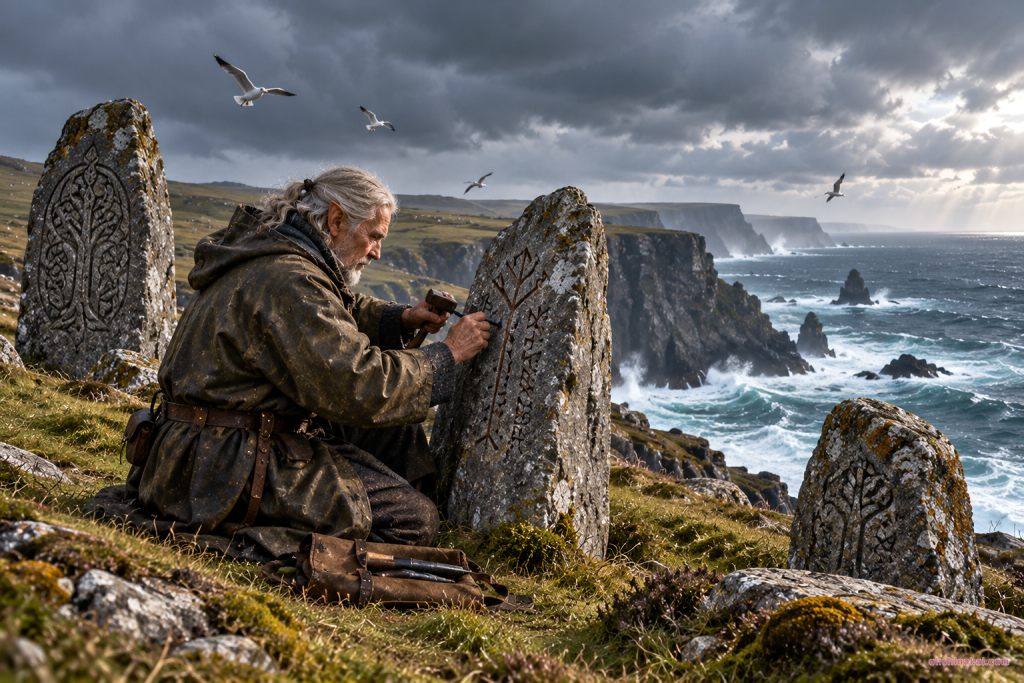
They have no formal clergy. Each Keeper preserves the old rites alone or in small groups, and many carve rune-stones along the island’s windswept coasts. When the Freyjaist Convocation sends missionaries, the Keepers listen politely, thank them for coming and go back to carving. The Convocation officially regards their faith as a legitimate tradition that has been superseded. Unofficially, the Campaign Setting notes, it finds them mildly embarrassing.
The Keepers matter beyond Oesterheim, though, because they keep an awkward question open. If Freyjaism is the truth about the divine, what are the old gods? And what would the Convocation do if a Keeper on a cold Atlantic coast received a vision, a warning in Odin’s own voice rather than Freyja’s, precise enough to be checked, and it came true? Nobody on Oesterheim expects the answer to be comfortable.
Wool, Fish and Seidr
Oesterheim lives mainly on fishing and sheep, with growing eco-tourism. Its best-known export is wool. Hand-spun by elvish weavers using methods unchanged for centuries, it commands premium prices in European luxury markets. The Dalisay guide to Aldermark recommends buying it at the Salzheimen Markt if you arrive in the Alps underdressed.
The islands also attract a particular kind of researcher. Marine biologists and climate scientists come for the North Atlantic. Increasingly, so do seidr practitioners and the scientists who study them. Some practitioners describe Oesterheim’s mix of volcanic geology and ocean currents as unusually favourable to their art. Whether that is true, or simply what practitioners feel on a windswept island at the edge of the map, is still being argued.
Neutral Ground
The islanders’ joke about the wind being the only neutral force is truer than it sounds. Oesterheim holds Norwegians and Saami, elves and half-elves, Freyjaists and Keepers of the Rune, a Norwegian crown and a founding seat in the OEA. It manages all of them without much fuss, perhaps because the weather leaves little energy for arguing about anything else.
Glossary of Thungalëthaur Terms
- Oesterheiminsuln The Oesterheim Islands
- Rúnkhepar The Keepers of the Rune; the Norse polytheist minority
- Seidhr Structured magical practice
- Thungalëbhandh The Organization of Elvish Alliances (OEA)
Join the conversation