Craft at the Nanometre Scale: UAME and the Elvish Answer to the Digital Age

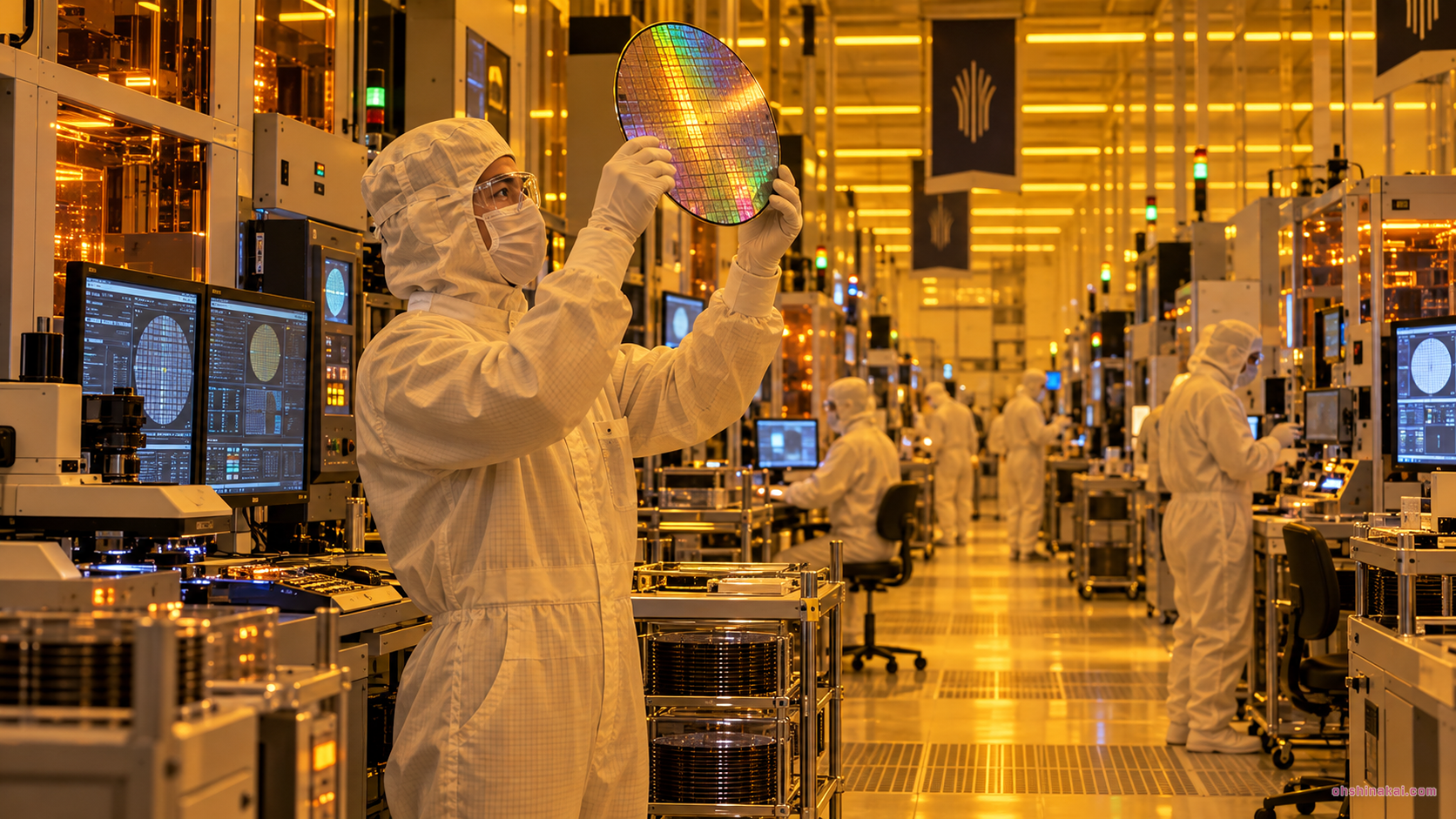
The standard story of Aldermark’s decline ends with computers. Human societies, the story goes, built the digital world with billions of users and programmers, and the elvish specialities of patient craft and fine tools became obsolete. It is a neat story, and it leaves out a company in a small Alpine town that has been making integrated circuits since 1979.
A Late Start, On Purpose
Universal Aldermark Microelectronics Enterprise, UAME, is based in Weisshalbleiter in southern Aldermark. It was founded in 1979 as Aldermark’s first semiconductor company, a spin-off from the government-sponsored Imperial Technology Research Institute (ITRI). It was also the first private integrated-circuit company in the country, and it listed on the Aldermark Stock Exchange in 1997 under the code UAME:2230.
By 1979 the semiconductor industry was already two decades old in the United States and Japan. Aldermark was late. ITRI’s researchers had watched the industry for years with the caution elvish institutions bring to anything new. Their conclusion, set out in the institute’s internal reports, was that chips were going to matter for centuries and that Aldermark could afford to wait until it understood them.
The town’s name tells its own story. Weisshalbleiter, roughly “white semiconductor” in German, was a small Alpine valley town with clean water, cheap hydroelectric power and a craft tradition in precision instruments. It took its current name in the 1980s, after UAME and its suppliers had become most of the local economy.
Why Elves Are Good At This
Semiconductor manufacturing turns out to suit elvish strengths in a way most observers didn’t expect. Making chips well is less about inventing new things than about refining a process. A modern fabrication line has hundreds of steps, each of which has to be controlled to an extraordinary degree, and most of the gains in a mature process come from years of small adjustments. The industry calls this yield improvement: raising the share of chips on each wafer that actually work.
That is exactly the kind of work elvish culture values. It rewards patience, accumulated knowledge and deep familiarity with a single craft, the quality the lexicon calls khalavi, embodied skill that lives in the hands. It also rewards continuity. A human process engineer may work on a production line for ten years before moving on. Several of UAME’s senior engineers have worked on the same family of processes since the company’s founding, and some of them were watching ITRI’s early experiments before that. When something goes wrong on a line, there is often someone in the building who saw the same fault in 1984.
UAME’s yields on its mature processes are among the best in the world, and the company’s reputation is built on reliability rather than speed.