Vi, Undercity Brawler & Piltover's Least Convenient Asset


Information
| Name | Vi (Violet) |
| World | League of Legends / Arcane (Fan-Fiction) |
| Birthdate | Unknown; Zaun undecity records incomplete |
| Age | Early-to-mid 20s |
| Race | Human (Zaunite) |
| Role | Enforcer; Independent heavy hitter; Former pit fighter |
| Affiliation | Piltover Enforcers (current, conditional); Formerly Vander's Lanes crew; The undercity (by upbringing, permanently) |
| Location | PPiltover and Zaun; wherever a case or grudge currently lives |
| Status | Available for Adoption |
| First appears | N/A |
First Impression
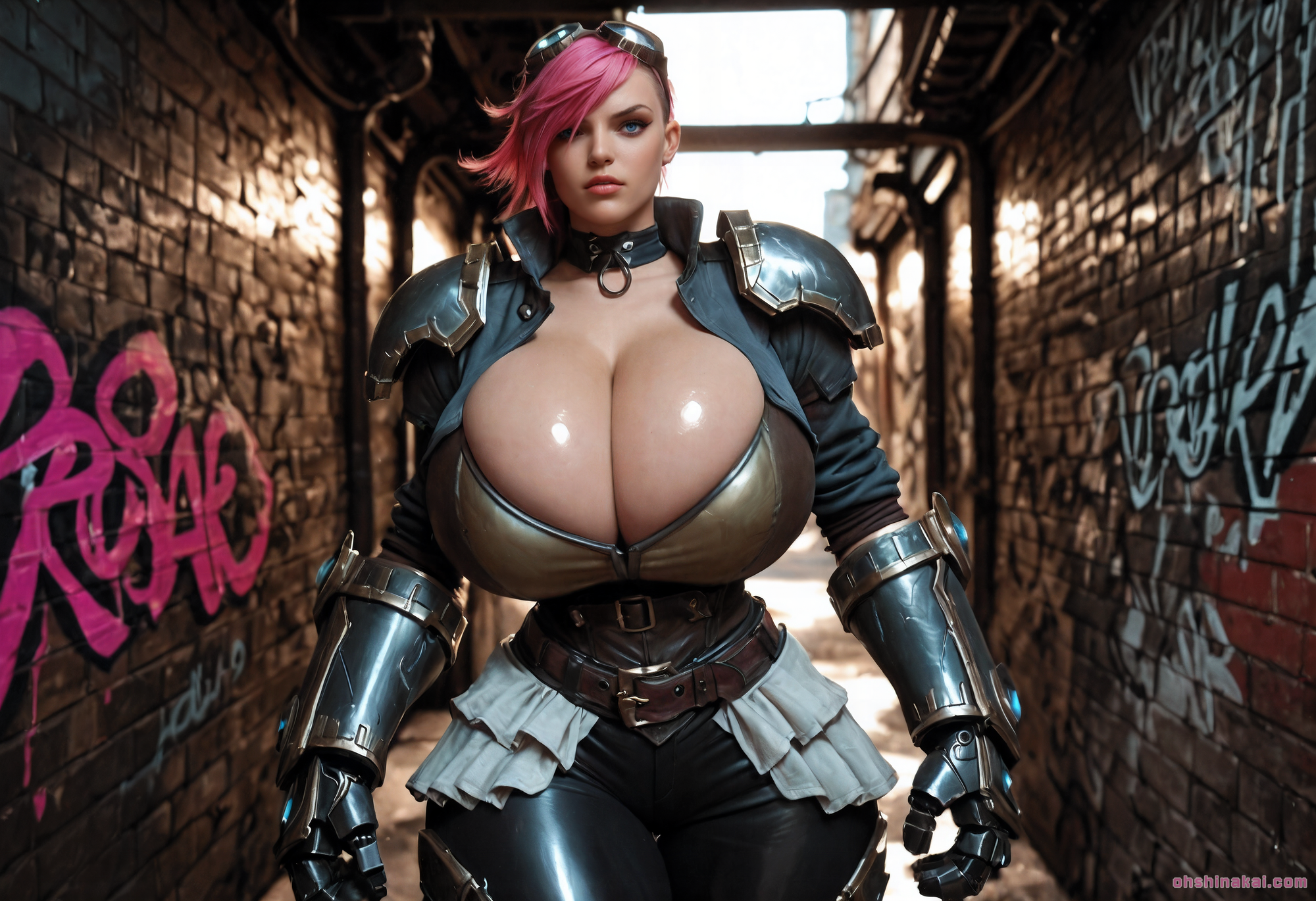
She looks like a riot that learned how to lean on a doorway. The hair, the smirk, the taped hands, and then the jacket has to explain a chest that is twice the size of her head and that the jacket has stopped trying to contain. It should make her a joke. It does not. When the gauntlets lock and the stance widens, the joke is over. The only thing still laughing is the door she is about to go through.
Appearance
Vi still looks like the fighter who came up from the Lanes: sharp jaw, pink hair shaved on the sides and swept or cropped on top in a style that has never once been described as regulation and that no commanding officer has yet been willing to make an issue of, gray-blue eyes that assess a room the way a boxer assesses an opponent, starting with the exits and ending with the threat, tattoos that mark her arms and shoulders with undercity ink done by artists who worked by chemical lamp and did not ask for names, and the kind of shoulders that advertise the gauntlets before the gauntlets appear. Her face is handsome rather than pretty, angular, expressive, and built for the specific combination of smirk and stare that she deploys in place of most social niceties.
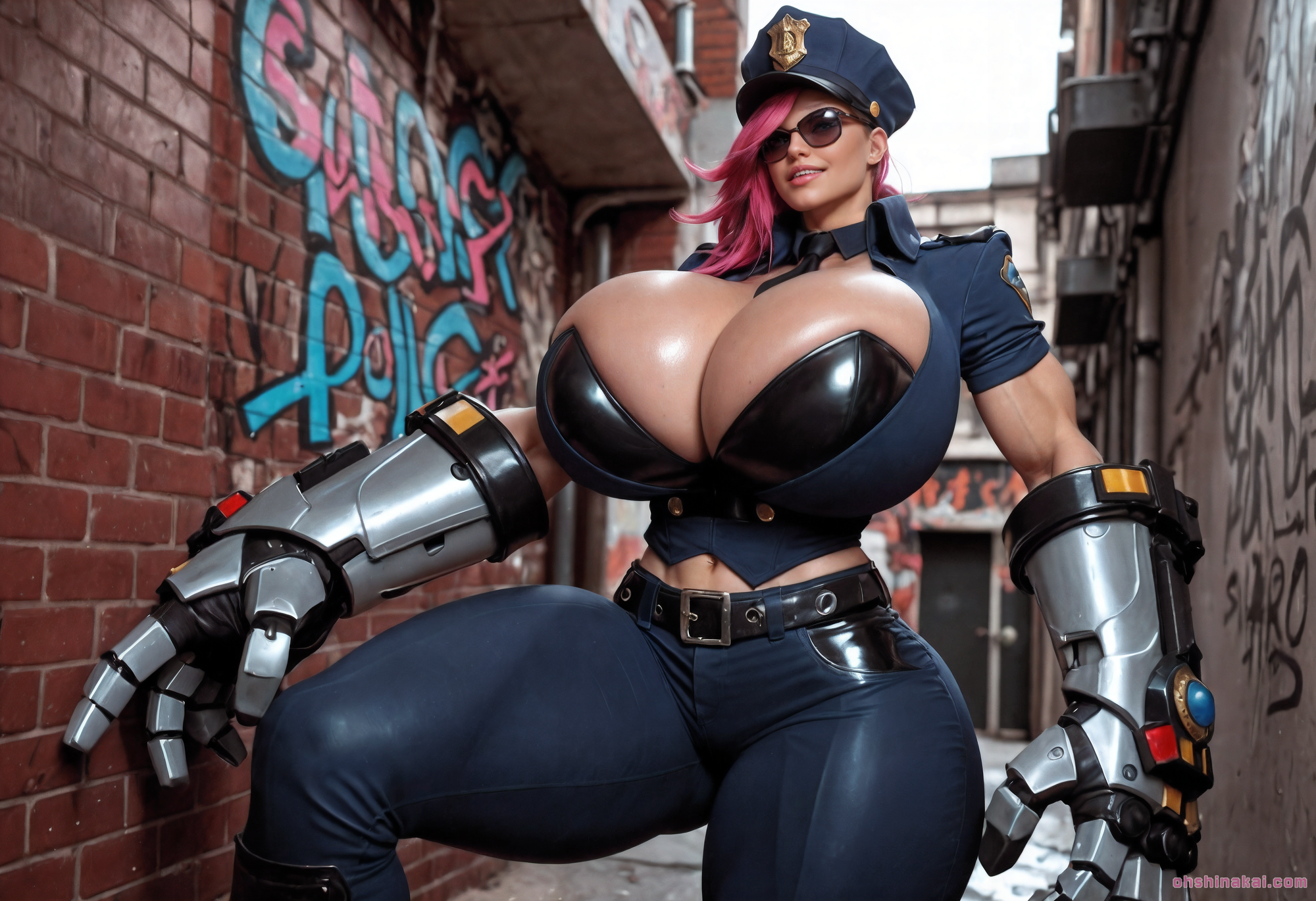
Her upper body is the thing the room sees first and the thing the room does not stop seeing. Her chest is massive, round, and carried forward with the blunt, unapologetic weight of someone who has never once considered minimizing: each breast is larger than her head, heavy enough to reshape the drape of every jacket, vest, and chest wrap she owns into something that the garment was not designed for and that the garment has lost the argument with. The rest of her is fighter-built: thick arms roped with lean muscle, a solid midsection that can take a punch and frequently does, legs that have kicked doors, people, and the occasional load-bearing wall with equal confidence. The waist between the chest and the hips is comparatively narrow, giving the whole silhouette the profile of a brawler who was built for speed and power and then issued a bust that defies the engineering of both. She does not look graceful. She looks like a problem that is about to become your problem, and the chest is the first line of the warning.
Her daily wardrobe is built for the same things she is built for: impact, mobility, and the specific kind of durability that allows a garment to survive a fistfight, a foot chase, and a shift in Zaun's chemical rain without requiring replacement. The default is a fitted leather jacket, brown or black, worn open because buttoning or zipping it across her chest would require either a jacket three sizes too large in the shoulders or a structural intervention she does not have the patience for. The jacket is lined, scuffed at the elbows and cuffs, and old enough that the leather has taken the shape of her shoulders and her arms and has long since given up on accommodating the chest, which simply exists in front of the jacket's open halves like a fact the jacket has accepted. Underneath she wears a tank top or a cropped athletic wrap, usually dark, always tight, always stretched to its functional limit across the bust in a way that is not deliberate and not correctable without a fabric technology that Piltover's textile industry has not yet prioritized. The wraps she uses for hand-taping extend up the forearms in the undercity fighter style, and she re-wraps them between shifts with the speed and economy of someone who has been doing it since before she was tall enough to reach the bar at the Last Drop.
For Enforcer duty she wears a modified version of the standard uniform: the armored vest has been rebuilt with an expanded chest plate and a widened harness system to accommodate the bust, the modifications done by an Enforcer armorer who documented the work under "non-standard frame adaptation" and who has since made identical modifications for no one else, because no one else requires them. The uniform trousers are standard-issue, fitted through the thigh, and she wears them tucked into heavy boots that she chose for traction rather than appearance and that she has kicked through enough doors that the toe caps show the history.
The Atlas Gauntlets sit on a chest-mounted harness rig that was originally designed for a body half her upper-body mass and that has been rebuilt twice: once by the Enforcer workshop, once by Vi herself with tools she borrowed and did not return. The rig now distributes the gauntlets' weight across her shoulders and upper back rather than her chest, routing the load-bearing straps around the bust rather than over it, a configuration that looks improvised and functions perfectly and that she adjusts by feel before every deployment with the specific, practiced certainty of someone who knows exactly where every strap sits and exactly what happens if one of them slips.
Story Appearances
No published appearances yet. Entries added as stories are published.
Personality
Vi is blunt, loyal, and permanently short on patience for people who talk around a problem instead of hitting it. She solves things with contact: a fist, a shoulder, a truth said too loud in a room that was hoping for diplomacy. Humor is both defense and offense; she will joke until the room either relaxes or flinches, and she does not care which outcome she gets because both mean the room has stopped pretending it was comfortable. She is warm with the people she trusts, protective to the point of self-destruction with the people she loves, and dismissive with anyone who has not yet proven they can survive being in the same room with her at full volume, which is the only volume she has.
Underneath the swagger is a protective streak that has already cost her everything once and that she has not learned to moderate because moderating it would require admitting that the warehouse was partly her fault, and the admission is a room she does not enter, not because she is afraid of it but because she is afraid of what she would do to herself once she was inside. She handles the constant attention her body draws with the same approach she applies to most unwelcome commentary: one warning, delivered without heat, followed by a consequence, delivered without apology.
Motivations
She wants the people she still has left to stay breathing, and she wants the system that chewed her childhood to feel it. Enforcer work is a tool, not a conversion. She will take Piltover's badge if it lets her reach the next door; she will not pretend the badge made her respectable. Respectability is a Piltover word for the thing you buy with money you did not earn, and Vi earned everything she has, including the scars, and the earning is the only credential she trusts.
Family, even ruined family, still moves her faster than policy. Powder is the name she cannot stop saying in her own head. Jinx is the name she cannot bring herself to use without it feeling like surrender. The distance between the two names is the distance between who her sister was and who her sister became, and Vi is still walking it, and the walking has not gotten shorter, and she does not know how to stop.
Weaknesses
She leads with impact and can miss the part of a fight that is not standing directly in front of her. Flanking maneuvers, political subtlety, and the kind of institutional maneuvering that Caitlyn navigates by instinct are all things Vi processes at a delay, not because she is unintelligent but because her intelligence is tactical rather than strategic and the difference costs her in contexts where punching the problem is not an option.
Guilt makes her reckless in specific directions. The warehouse is the direction. Every time she encounters a situation where a younger person is in danger and the danger could be reduced by someone putting themselves between the threat and the kid, she volunteers for the position before the tactical assessment is complete, because the last time she was not between the threat and the kid, the kid became Jinx.
The massive upper-body mass of this variant, while handled by a fighter's core strength and the rebuilt harness system, can still throw her balance in a clinch, a climb, or a full-sprint gauntlet swing if the rigging slips or takes damage. The center of gravity sits higher than a standard fighter's, which means grappling opponents with lower builds can use leverage she does not have, and zero-notice transitions from sprint to strike require a half-second of compensation that trained opponents can exploit. She addresses this by being faster than the compensation window, which works until it does not, and when it does not, she takes the hit and keeps moving, because stopping is not in the operational vocabulary and never has been.
Quirks
She rolls her shoulder before she decides whether someone is worth the paperwork, a motion that is both a genuine loosening of the joint and a signal to anyone watching that the next thirty seconds are negotiable and the thirty seconds after that are not. She eats like the next meal is theoretical, standing, fast, using her hands when utensils would slow the process, and she has been known to finish an entire takeout container in the time it takes Caitlyn to unfold a napkin, which Caitlyn has commented on and which Vi has acknowledged by ordering a second container.
She names punches after the fact, giving them designations based on the sound they made or the reaction they produced, a habit that the Enforcer duty logs do not accommodate and that she maintains anyway because the naming is part of how she processes the debrief, which she conducts privately, in her own head, walking home. She sleeps in her boots more often than a bed deserves, because removing the boots means trusting the building, and she grew up in buildings that caught fire, and the habit survived the upgrade in housing. She touches the edge of a gauntlet when she is about to stop being funny, and the people who have seen the transition, from joke to gauntlet-touch to violence, learn to read the gauntlet-touch the way animals learn to read a change in the wind.
World Context
Piltover and Zaun remain two cities stacked on one wound, and Vi is the person who walks the wound every day and has the scar tissue to prove it. Piltover above: clean streets, funded institutions, a Council that governs through consensus and commerce and the specific kind of progressive rhetoric that allows a city to feel good about itself while the people who built its foundations live underneath it in chemical twilight. Zaun below: resourceful, toxic, governed by chembarons and survival and the understanding that the shimmer trade is both the poison and the only medicine available, and that the people who run it are the same people who make the rent possible, and that the moral calculus of that arrangement is not simple and is not meant to be.
Vi grew up in Zaun and works in Piltover, and the seam between the two is where most of her cases live and where most of her problems start. The Enforcer badge gives her access that the undercity kid never had: doors that open, databases that respond, the institutional weight to make an arrest stick instead of watching the suspect walk out of a precinct that was paid to look away. The badge also costs her things the undercity kid would never have surrendered: credibility with the Lanes, the ability to move through Zaun without being identified as the enemy, and the specific kind of trust that comes from being one of the people rather than one of the people who carry the people's history in one hand and Piltover's badge in the other. She is aware of what the badge costs. She has decided the cost is acceptable because the alternative is powerlessness, and powerlessness is what the undercity already has, and adding one more powerless person to the count does not help anyone she is trying to protect.
Among the Enforcers, Vi is classified as an asset with discipline issues, a designation that her commanding officers apply with the weary precision of people who have learned that disciplining Vi produces paperwork rather than behavioral change. Her success rate on cases involving undercity operations is the highest in the department. Her property-damage rate on the same cases is also the highest in the department. The two statistics are related, and the relationship is the Atlas Gauntlets, which solve problems in ways that standard Enforcer equipment does not and that standard Enforcer budgets do not survive. Her physical appearance is documented in her personnel file with the same clinical brevity the Enforcers apply to all operative descriptions: height, weight, distinguishing marks, and a notation under "physique" that reads "non-standard upper-body mass, equipment modifications authorized," followed by thirty pages of incident reports that do not mention her body again because the incidents involved gauntlets and the gauntlets are more interesting to the people writing the reports.
In Zaun the treatment is different. The Lanes know Vi. They knew her before the badge, before the gauntlets, before the prison sentence she does not discuss in Enforcer briefings and that the Lanes remember in granular detail. They know what she looked like as a teenager, they know what happened to her family, and they know that the girl who used to fight in the pits for rent money now walks their streets in Piltover's uniform, and the knowing is complicated, because some of them see betrayal and some of them see the only person from the Lanes who ever got close enough to Piltover's machinery to hit it from the inside. Her body, in the Lanes, is discussed with the same rough, unsentimental familiarity the undercity applies to everything: she is Vi, she is enormous across the chest, she hits like a collapsed building, and the combination of those three facts has been part of the Lanes' collective description of her since before she could legally drink, and the description has not changed, and the Lanes have not decided whether it is affection or inventory. It may be both.
Favorites
- Food: Greasy, cheap, and available after midnight, which in Zaun means the street stalls that operate on the far side of the canal bridges where the Enforcers do not patrol and the grease is a chemical compound that the vendor has not been asked to identify. Vi's default is whatever is hot, portable, and calorie-dense enough to replace what the gauntlets burned: fried dumplings from the cart on the corner of Sump Level that have been there since before she was born and that taste like pork and engine oil and the specific quality of not-caring-what-is-in-it that you develop when you have been hungry enough to eat worse. Skewered meat from the night-market vendors who grill over repurposed shimmer-canisters and who produce a product that is technically unsafe and practically delicious and that Vi eats three at a time while walking. The thick, salty noodle bowls from the place near the old Last Drop location that she cannot bring herself to call by its new name, ordered with extra broth and eaten standing at the counter because sitting means the emergency is over and she is not ready to believe it. She has been introduced to Piltover food through Caitlyn, and she has opinions: the pastries are good, the portions are insults, and the prices are evidence of a civilization that has lost its way. She eats Caitlyn's cooking with genuine enthusiasm and has never once pretended the enthusiasm is about the food, which it partly is and partly is not, and the "partly is not" is something she does not examine because examining it would require sitting still.
- Drink: Strong, simple, and not served in glass that looks expensive, because expensive glass is glass she will break, either by accident or because the night has gone the direction nights tend to go when Vi is drinking. Her default is the harsh, clear grain liquor that the Lanes produce in backroom stills, served at room temperature in whatever vessel is available, consumed fast enough that the taste is secondary to the function, which is the temporary silencing of the specific frequency of guilt that operates in the background of her nervous system at all times and that she has never found another method of quieting. She drinks to take the edge off a bad night, not to join a toast, and the distinction is important because toasts imply celebration and Vi does not celebrate; she survives, and the surviving is not the same thing as winning, and she knows this, and the knowing is what the drink is for. Coffee in the morning, black, from whatever is closest, consumed standing and fast. Water when Caitlyn makes her, which Caitlyn does, and the making is one of the few forms of care Vi accepts without deflecting, because the water is practical and practicality is the only language of care she does not flinch away from.
- Color: Pink: the hair, the old undercity signage that used to mark the safe houses Vander maintained, the bruise-bloom color that appears on skin thirty seconds after a good hit connects. She chose the hair color herself, young, as a visibility decision: in the Lanes, you are either seen or you are forgotten, and Vi decided early that being forgotten was the more dangerous option. She also lives in dark leather because it hides blood and oil and because the color of the leather, after enough wear, becomes the color of whatever the leather has been through, which is a metaphor she would not use and a fact she would acknowledge. She has no opinion on Piltover's color palette, which is white and gold and the specific shade of self-congratulation that she finds neither offensive nor interesting.
- Animal: Stray dogs that bite first and warm up second. She understands the method because it is her method: distrust as the default, loyalty as the reward for surviving the distrust, and the loyalty, once given, absolute and non-negotiable and expressed through physical proximity rather than words. She has been known to share food with the strays that patrol the Lanes' alley network, and the sharing is conducted without sentiment, standing, fast, a portion of whatever she is eating dropped without comment for whatever animal is closest, and the animal's acceptance of the food without performance or gratitude is the only social contract Vi has ever found entirely satisfying.
- Music: Loud enough to cover a street and a bad thought and the specific silence that arrives at 3 a.m. when the case is over and the adrenaline has metabolized and the apartment is empty and the emptiness has a sister-shaped hole in it that no amount of volume can fill, though she tries, and the trying is the music, and the music is whatever the nearest bar or street speaker is producing at maximum output: heavy bass, distorted vocals, the kind of sound that enters through the chest rather than the ears and that competes with the heartbeat for dominance. She does not listen to music for pleasure. She listens to music for displacement: the sound pushes the quiet out of the room, and the quiet is where Powder lives, and Vi is not ready to be in that room, and the music buys her another night of not being there.
- Hobbies & Pastimes:
- Sparring and Pit Habits: Official training when she has to, unofficial fighting when she needs the noise out of her head. She calibrates people by how they take a hit, which is both a social strategy and a genuine diagnostic: the way a person absorbs a punch tells her more about their character than anything they have said in conversation, and the information is more reliable because the conversation can lie and the body cannot. She spars at the Enforcer gymnasium when the schedule allows and at unlicensed Zaun fighting venues when it does not, and the venues know her by her old pit name and do not use it in front of Enforcer personnel, a courtesy she repays by not arresting them, which is a corruption she has decided is acceptable and which Caitlyn has decided not to know about.
- Gauntlet Maintenance: Oil, bolts, the rebuilt chest harness that keeps the Atlas rig from fighting her silhouette instead of the target. The work is meditative in the same way that hand-wrapping is meditative: repetitive, physical, and productive of a result she can verify. She is better at the mechanical work than she lets the precinct techs believe, because letting them believe they are necessary maintains a relationship she might need, and maintaining relationships through the strategic distribution of competence is one of the few political skills she has developed, though she would not call it political and would resent the characterization.
- Walking the Lanes: Not always a case. Sometimes just confirming the city is still there and still angry and still hers in the way that a place you grew up in is always yours regardless of who currently runs it or what you currently carry in your pocket. She walks the routes she walked as a kid, past the buildings that survived and the spaces where the buildings that did not survive used to be, and the walking is not nostalgia because nostalgia requires the past to be better than the present and Vi has never believed that, and the walking is not patrol because patrol requires a badge and she does this off-duty, and the walking is simply walking, done by a woman who needs to feel the ground she came from under her feet in order to remember why she is still fighting, and the fighting is the point, and the point has not changed.
Background
Vi was born in the undercity of Zaun, in the same neighborhood that would later produce Jinx, in the same family that would later be destroyed by a cascade of violence that no one planned and no one survived intact. Her parents were killed in an Enforcer action during the unrest that the official Piltover records describe as "civil disturbance management" and that the undercity remembers as the night the bridge burned. Vi was old enough to remember. Powder was not. The difference between those two facts is the foundation of everything that came after, because Vi carries the memory of what was taken and Powder, who became Jinx, carries only the absence, and the absence and the memory are two different wounds that produce two different kinds of grief, and the two kinds of grief have never been able to sit in the same room without one of them catching fire.
Vander took them in. Vander, who had been a fighter and a leader and who had decided, after the bridge, that the fighting was over and that the only thing worth building was a life small enough to protect. He ran the Last Drop. He raised Vi, Powder, Mylo, and Claggor in the Lanes with the steady, practical love of a man who understood that children need meals, structure, and the occasional reminder that the world is not entirely composed of threat. Vi loved him. She loved him the way she loves everything: loudly, protectively, and with the specific ferocity of a girl who had already lost one set of parents and who was not going to lose the replacement without putting herself between the threat and the family, which is exactly what she did, every time, until the time it was not enough.
The warehouse is the night Vi does not discuss. What happened there, the bomb Powder built, the deaths of Mylo and Claggor, Vander dying, the moment Vi looked at her sister and called her a jinx and hit her and left, is the load-bearing event of her adult life, and the load has not decreased and the bearing has not gotten easier and she has never found a way to put it down. She was taken that night, arrested, imprisoned in Stillwater Hold for years that the Enforcer files document and that Vi herself describes only as "time," a word she uses the way other people use an entire sentence, to contain something too large and too specific to unpack in front of anyone she does not trust completely, and she trusts almost no one completely.
She came out of Stillwater harder, angrier, and carrying a body that had changed during the years inside. Vi's physique developed during her imprisonment and early adulthood into the extreme proportions described above: the massive chest, the fighter's frame, the combination that no standard-issue equipment was designed for and that she has spent years rebuilding equipment around. Whether the change is genetic, environmental, or the result of whatever the Stillwater medical program was doing that the facility's records do not adequately explain is a question she has not pursued, because the question does not change the reality, and the reality is that her body is what it is, and the equipment works or it gets rebuilt, and rebuilding is something she knows how to do.
She found Powder gone and Jinx in her place. The discovery was not a single moment; it was a process, conducted across encounters that were each their own small disaster, each one proving that the sister she remembered and the sister who existed now were not the same person and that the difference was not a problem she could solve by being present enough or protective enough or loud enough. Vi wants Powder back. She wants this with the same futile, unquenchable intensity that she wants the warehouse night to have gone differently, which is the intensity of wanting something impossible and knowing it is impossible and not being able to stop wanting it, and the not-stopping is the thing that makes her reckless, and the recklessness is the thing that keeps putting her between threats and kids, and the cycle has not broken and she has not tried to break it because breaking it would require accepting that Powder is gone, and acceptance is the one form of surrender she has not practiced.
She took the Enforcer badge because it was the tool that reached the farthest. She works with Caitlyn because Caitlyn is competent, because Caitlyn treats her as a partner rather than a project, and because Caitlyn's version of the world, the one where institutions can be fixed and justice can be structural rather than personal, is a version Vi does not believe in and finds herself defending anyway, which confuses her and which she has decided to stop analyzing because the analysis requires sitting still and sitting still is not in the operational vocabulary. She walks the Lanes. She hits what needs hitting. She keeps the badge in her pocket and the gauntlets on the rig and the sister-shaped wound in the center of her chest where no one can reach it, and she does the work, because the work is the only thing she has that is not a loss, and she will not stop doing it until the work stops needing to be done, which is never, and the never is the closest thing Vi has to a plan.
Relationships
- Jinx / Powder: The wound that still walks. Love, wreckage, and the version of herself she cannot punch into making sense. Every encounter is a collision of history, guilt, and the two incompatible versions of the warehouse night that neither of them will surrender: Vi's version says she was taken; Jinx's version says she left. Both versions are true enough to survive on and incomplete enough to keep the wound open. Vi wants Powder back. She says she wants Powder back. She is beginning to suspect, in the specific quiet that arrives at 4 a.m. when the music has stopped working, that what she actually wants is forgiveness, and that the forgiveness might need to come from herself, and that she does not know how to give it.
- Caitlyn Kiramman: Partner, complication, and the closest thing Piltover has offered that she did not immediately try to break. Caitlyn is everything Vi is not: institutional, strategic, patient, and in possession of a belief in systemic justice that Vi finds both alien and, against every instinct she has, compelling. The partnership works because Caitlyn does not need Vi to become Piltover and Vi does not need Caitlyn to become Zaun, and the space between those two non-requirements is where they operate, and the operating is better than either of them expected, and neither of them has named what the better means, and the not-naming is, for now, enough.
- Vander (memory): The first father. The man who chose peace after the bridge and who died because the peace was not strong enough to hold the night the warehouse went wrong. Vi carries Vander's lessons the way she carries the gauntlets: as tools she maintains, uses daily, and has never fully understood the cost of. She does not talk about him. She does not need to. The way she stands between a threat and a person she is protecting is Vander's lesson, performed without narration, and the performance is the only eulogy she has ever given.
- Piltover Enforcers / Zaun Streets: Two uniforms, one temper. Neither side owns her cleanly, and the neither is the point, because being owned cleanly would mean belonging cleanly, and belonging cleanly would mean choosing, and choosing one city means surrendering the other, and she will not surrender Zaun even if Zaun has not decided whether she is a hero or a traitor, and she will not surrender Piltover's badge even if Piltover has not decided whether she is an asset or a liability. She carries both. She fits in neither. The not-fitting is the only honest position available, and Vi has always preferred honest to comfortable.
Relationship entries expand as stories featuring this version of Gwen Stacy are published.
Gallery